AI Business Automation Platforms That Run 24/7 in 2026
Most Automation Tools Still Need You — Here's What's Changed in 2026
For years, business automation meant one thing: you set up the rules, and software followed them. Connect Zapier to your CRM. Build a trigger in Make. Configure an email sequence in HubSpot. These tools genuinely saved time — but they required you to design every workflow, anticipate every edge case, and maintain everything when it broke.
That model has a ceiling. You can automate a task, but you can't automate the thinking behind it.
That ceiling is cracking in 2026. Gartner predicts that 40% of enterprise applications will include task-specific AI agents by the end of 2026, up from less than 5% in 2025. The shift isn't incremental — it's categorical. The new generation of AI business automation platforms doesn't wait for you to define rules. It reasons, plans, adapts, and executes across entire business functions, continuously, without a human in the loop.
For entrepreneurs and small business owners, this is the most important operational shift in a decade. You no longer need a growth team, a media buyer, or an operations manager to run a business around the clock. You need the right platform — one designed not just to automate tasks, but to run operations.
This guide breaks down what genuine 24/7 AI business automation looks like in 2026, which core operations it must cover, and which platforms are actually doing it.
What Does '24/7 AI Business Automation' Actually Mean?
The phrase gets used loosely. A chatbot that handles support tickets at 3 AM is technically running 24/7. So is a scheduled email sequence. Neither is what the term means in 2026.
True 24/7 AI business automation means autonomous AI agents — systems that are given a high-level goal and independently figure out how to achieve it. Unlike rule-based business process automation software that follows predetermined logic paths, autonomous agents break goals into tasks, execute them, evaluate the results, and course-correct when something goes wrong. All without human intervention.
Here's a concrete example of the difference. A rule-based system might be configured to send a follow-up email 48 hours after a lead signs up. An autonomous agent, by contrast, researches the lead's company, identifies a relevant hook based on their recent activity, drafts a personalized message, sends it at the optimal time, monitors the reply, updates the CRM, and schedules the next touch — entirely on its own.
The distinction matters because genuine autonomous business operations require this kind of reasoning. McKinsey research indicates companies that implement AI automation platforms report labor cost reductions of 40–60% for repetitive processes — but those gains compound when the system makes decisions, not just executes them.
For small business owners and solopreneurs, the practical implication is significant: a true 24/7 platform doesn't just run tasks you've already designed. It surfaces new actions, identifies what's costing you money, and executes growth work while you sleep. Your best next move, not another think piece.
The 5 Core Operations a True 24/7 Platform Must Run Autonomously
Not every AI automation platform covers the full business stack. Most specialize. Before evaluating any tool, check whether it handles these five operations — the ones that most directly drive revenue and growth.
1. Market Research and Offer Validation — Without You in the Room
Strategic firms now deploy AI research agents that run continuously in the background, monitoring competitor pricing, tracking market signals, and synthesizing intelligence into actionable summaries. This is real-time market research and competitor analysis — not a monthly report you commission, but a continuous feed of the information that shapes your positioning.
For new business founders, this is even more foundational. Before spending a dollar on marketing, you need to know whether there's a market. The strongest 24/7 platforms start here — researching the opportunity, identifying the gap, and validating the offer before building anything. Autonomous AI workflow at this stage means you describe an idea and the system returns a market-ready mission, not a summary of what you already knew.
2. Sales Outreach and Lead Generation That Never Clocks Out
Autonomous AI agents are replacing the traditional SDR function. The best implementations can research prospects on LinkedIn, cross-reference contact data, identify a personalized hook, execute multi-touch outreach sequences, and intelligently parse replies — updating the CRM and scheduling follow-ups without a human touching any of it.
For small businesses, this is transformative. AI sales automation means qualified outreach runs overnight, on weekends, and across time zones — without the overhead of a sales team. The ceiling isn't your headcount. It's your platform's outreach capacity.
3. Content and LinkedIn Publishing on Autopilot
LinkedIn is one of the highest-ROI channels for B2B small businesses, but consistent publishing is one of the first things that falls apart when founders get busy. AI-powered marketing automation that handles content creation and publishing autonomously removes this bottleneck entirely.
The gap between tools that help you write posts and platforms that actually publish them on a continuous cycle — without being prompted — is significant. The latter is your LinkedIn working while you sleep. One produces content when you ask. The other runs a content strategy.
4. Advertising Optimization Without a Media Buyer
AI-powered ad optimization moves beyond scheduling. The best platforms generate ad creative, launch campaigns, monitor performance, and reallocate budget based on results — continuously. For founders who can't afford a media buyer, this is the difference between ads that drain money and ads that compound.
Marketing automation software for small business has historically meant email sequences and lead nurturing. In 2026, it includes autonomous advertising cycles that adjust strategy based on what's actually converting.
5. Revenue Leak Detection and Growth Task Execution
This is the operation most automation tools ignore entirely. Revenue leak detection means identifying where money is already being lost — missed follow-ups, underpriced offers, churning customers, inactive leads — and surfacing those gaps as actionable next steps.
Cognitive automation that runs a continuous growth cycle goes further: it doesn't just flag problems, it executes fixes. AI-generated and executed engineering tasks mean the system identifies what needs to happen and then does it — not just reports it. Find the money you're already losing — that's exactly what Leapd's free website audit surfaces in minutes.
The Best AI Business Automation Platforms Running 24/7 in 2026
The platforms below represent the current leading options across different needs and business types. They range from fully autonomous business builders to workflow connectors. The right choice depends on how much of your stack you want AI to own — and how involved you want to be.
Leapd — Best Overall: The Autonomous Business Builder That Runs the Whole Stack
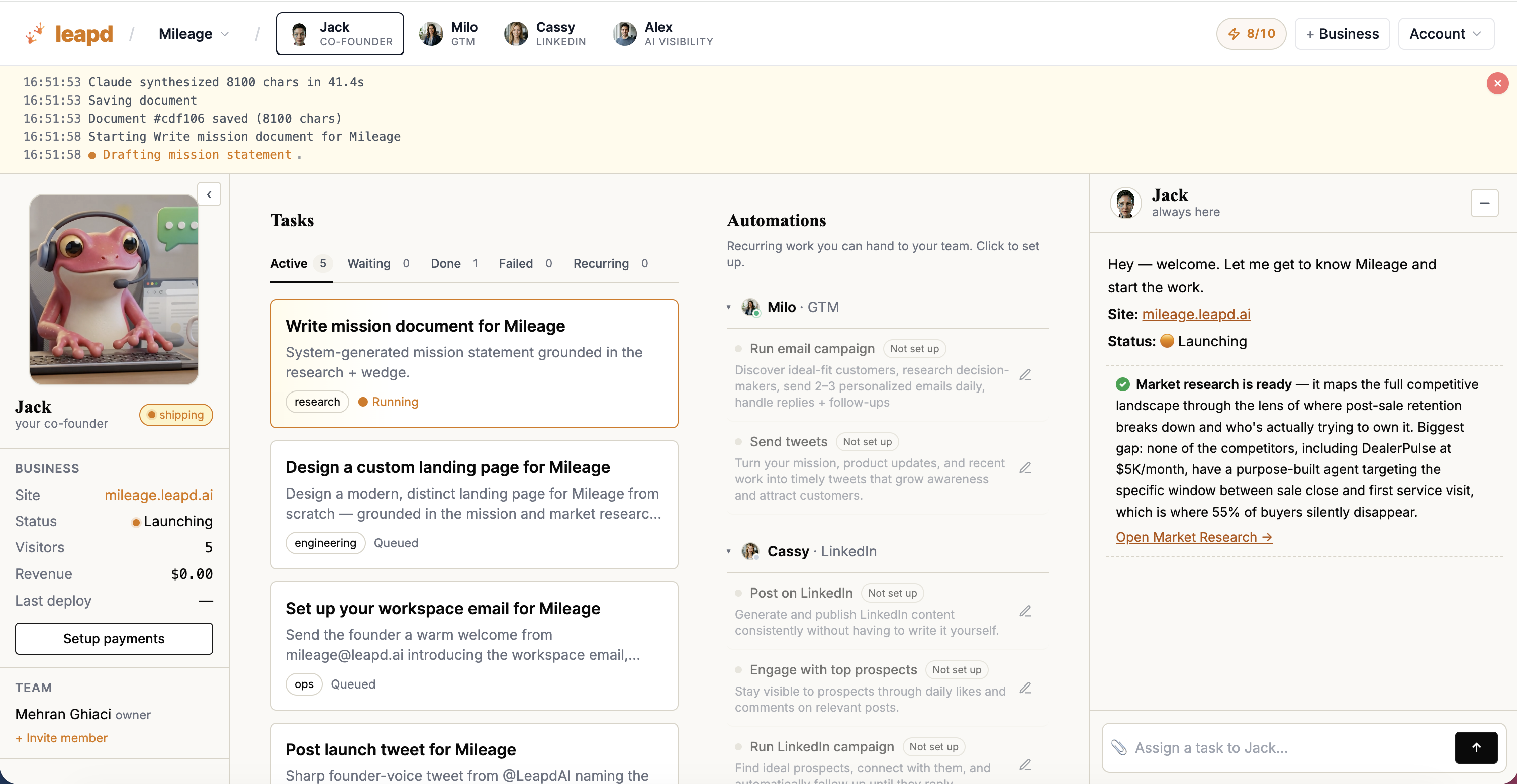
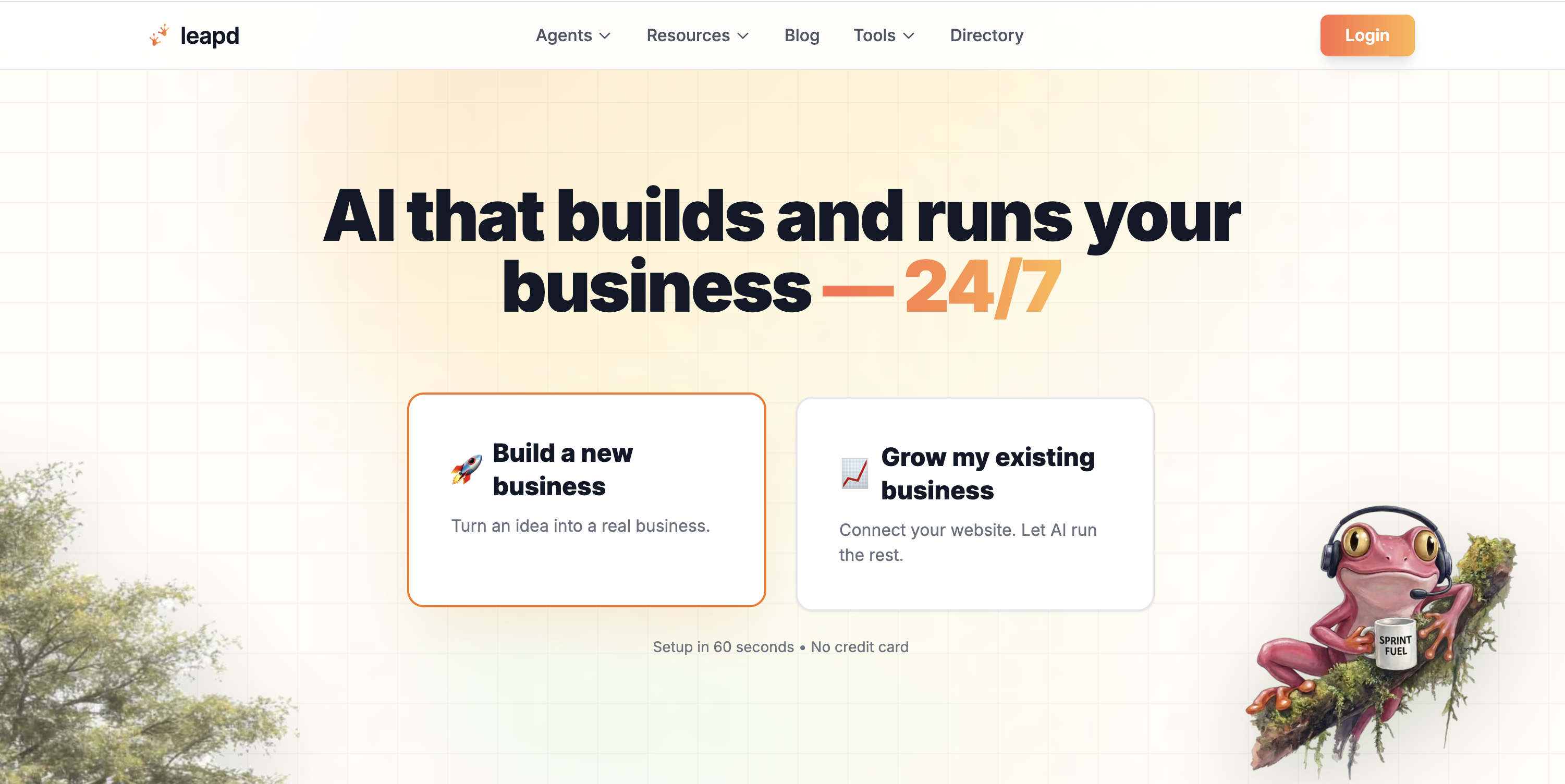
Leapd is the only platform built to run a complete business autonomously — not a set of workflows, but the full lifecycle from zero to launch to growth. It operates in two modes: build a new business from a single sentence, or connect an existing business and let AI run the rest.
Every other platform in this guide covers one slice of the stack — and the costs compound. A workflow tool here, a CRM there, an outreach tool, a content tool: you end up paying hundreds per month to coordinate your own "automation." Leapd replaces the stack with one system that owns the outcome.
For new founders: Type a one-sentence business idea. Leapd researches the market, writes the mission, builds the product and landing page, and acquires the first customers — a real business from nothing. Setup takes 60 seconds. The first report is delivered within 24 hours. Leapd has launched more than 1,000 real businesses on the platform, each now running automated ads, content, and outreach. These aren't prototypes — they're live businesses that Leapd continues to operate after launch.
For existing business owners: Connect your website. Leapd's AI creates and runs engineering tasks autonomously — not a to-do list, but actual execution. It manages LinkedIn automation and content publishing, detects revenue leaks, tracks how your brand shows up in AI search across ChatGPT, Perplexity, and Gemini, converts client transcripts into testable offers, and runs a continuous growth cycle. The system surfaces your best next move, not another think piece — prioritized actions drawn from what's actually happening in your business, not generic advice.
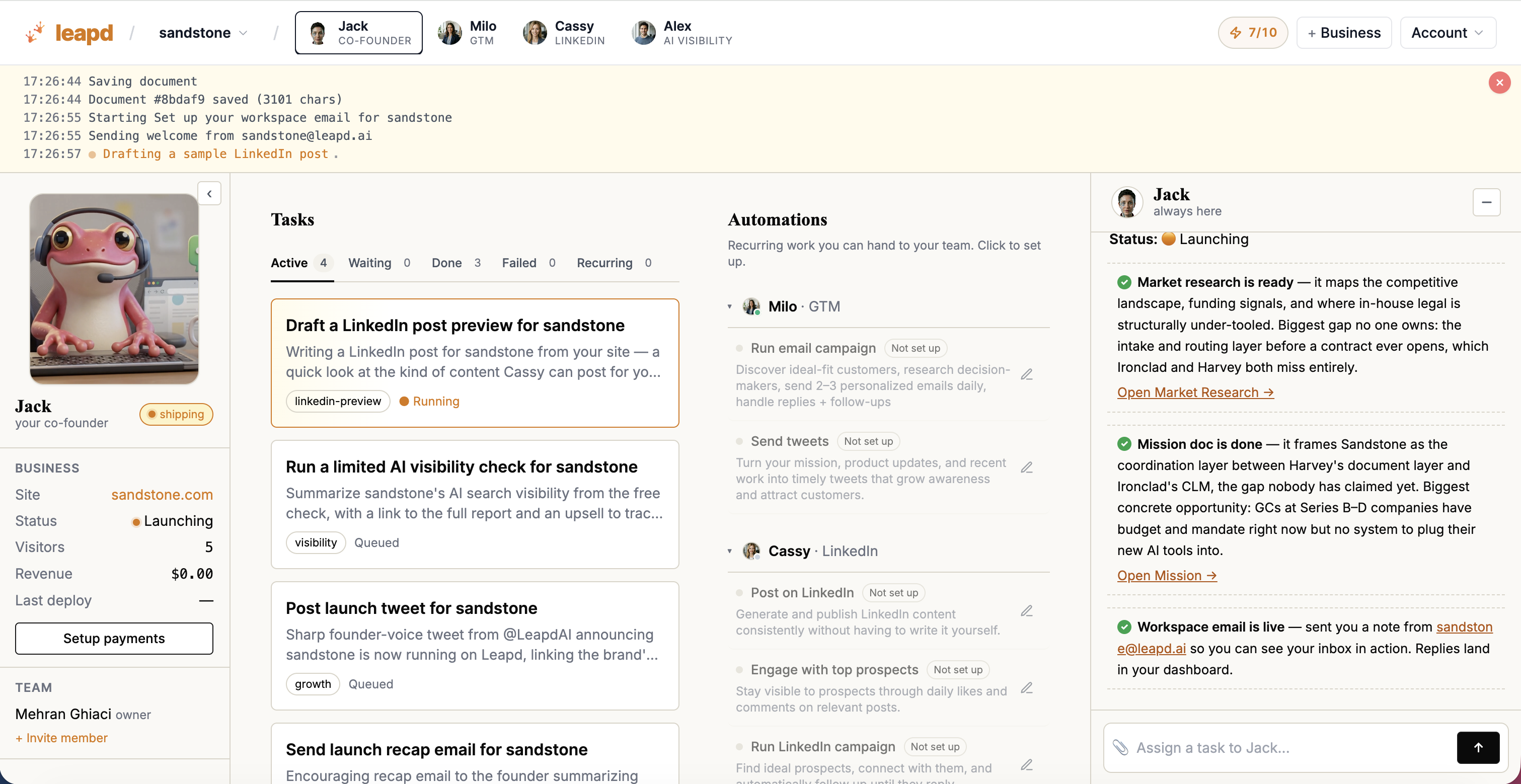
The key differentiator: Leapd is not a tool that waits for instructions. It operates as a perpetual growth team that never sleeps, handling ads, outreach, content, and operations across the full business stack, continuously, without human input between cycles.
Pricing: Free to start — no credit card required. First report in 24 hours. Start building →
Best for: Entrepreneurs, first-time founders, and solopreneurs who want AI to run their business — not just assist with it.
Lindy — AI Employee-Style Workflow Automation
Lindy positions itself as a digital AI employee: you describe what you need it to do in plain language, connect it to your tools, and it handles tasks like email triage, meeting scheduling, CRM updates, and lead follow-up across 2,300+ business app integrations.
The core strength is judgment-based automation. Unlike Zapier's trigger-action logic, Lindy's AI agents can reason about ambiguous situations — deciding whether to escalate an email, how to respond to a nuanced support ticket, or what action to take when a workflow hits an unexpected state. For operations that require more than if-then logic, it's a clear step up from trigger-action tools.
Pricing: Plus at $49.99/month (up to 2 inboxes), Pro at $99.99/month (adds browser automation, 3 inboxes), Max at $199.99/month (7x usage, up to 5 inboxes). Enterprise pricing is custom. Note that voice calling is billed separately at approximately $0.19/minute, and heavy multi-step workflows can trigger usage overages that make total spend difficult to predict.
Best for: Small teams and ops-focused businesses that need AI-powered judgment across email, calendar, and CRM workflows — and are comfortable building their own agents.
Limitation: Lindy requires you to design and configure each agent, and it covers only the task-workflow slice — content, ads, outreach, and growth strategy are separate purchases. It doesn't run your business proactively or surface growth actions on its own.
Zapier — App-to-App Trigger Automation
Zapier is the most widely known name in AI workflow automation, with 7,000+ app integrations and a unified platform that combines Zaps, Tables, and Interfaces under a single pricing model. For non-technical teams that need to connect business tools quickly, it's a common starting point.
Zapier's AI Agents feature (available on paid plans) adds reasoning-layer capabilities on top of traditional trigger-action logic, enabling more flexible responses within defined workflows. It doesn't replace the need for human-designed automation, but it makes that automation smarter when edge cases arise.
Pricing: Professional plan starts at $19.99/month (annual) for 750 tasks. Team plan at $69/month. At high volumes — 2,000+ tasks/month — alternatives like Make are significantly cheaper for equivalent workflows.
Best for: Businesses that need to connect a wide range of niche SaaS apps, or teams that prefer a simple linear builder.
Limitation: Zapier is task-based automation, not agentic AI. It executes what you configure, and everything beyond data-passing — content, outreach, ads, strategy — still has to come from other tools. At scale, costs escalate quickly, and the platform doesn't proactively manage or grow your business.
HubSpot — CRM With Built-In Marketing Automation
HubSpot combines contact management, email marketing, sales pipelines, and AI-assisted content tools under one roof. Its AI features now include predictive lead scoring, intelligent email sequencing, and content generation.
The platform's strength is nurture automation — keeping leads warm through sequenced touchpoints — and its reporting makes it easy to see what's working.
Pricing: Marketing Hub Professional starts at $890/month for 2,000 contacts and 3 seats. Enterprise at $3,600/month.
Best for: Businesses that need a CRM-first approach with built-in marketing automation — especially those running structured email campaigns and lead nurturing sequences.
Limitation: HubSpot is a marketing and CRM platform, not a full business automation engine. It doesn't run ads, manage operations, detect revenue leaks, or execute growth tasks outside its ecosystem — and at $890/month for Marketing Hub Professional, it's a steep bill for a single function.
Make (formerly Integromat) — Visual Multi-Step Workflow Builder
Make is a lower-cost alternative to Zapier for businesses that need complex, branching workflow logic. Its visual canvas builder lets non-technical users construct multi-step automations with conditions, loops, and data transformations that would be difficult or expensive to replicate in Zapier.
On pricing, Make charges per operation (now called credits), roughly 40–70% lower than Zapier at equivalent volumes above 3,000 monthly runs. The Core plan starts at $9/month (annual billing) with 10,000 operations.
Best for: Businesses with complex, multi-step automation needs — especially those migrating from Zapier who need branching logic, loops, or advanced data handling at scale.
Limitation: Make's 1,400+ integrations cover most mainstream tools, but if you depend on niche SaaS apps only Zapier supports, that gap matters. Like Zapier, Make is a workflow connector — not an autonomous business operator — so the thinking, the content, and the growth work remain yours.
Relevance AI — Multi-Agent Process Automation for Technical Teams
Relevance AI sits between an AI agent builder, a workflow automation platform, and an enterprise orchestration layer. Its core concept — the AI Workforce — lets businesses create specialized agents that cooperate on complex tasks: one agent researches prospects, another drafts outreach, a third updates the CRM. Each agent is narrow and reliable; together they handle sophisticated multi-step processes.
This multi-agent approach suits teams that want to build production-grade AI automation across sales, marketing, research, and operations without hiring engineers. The platform supports low-code agent creation with broad integration options and enterprise security controls.
Pricing: Team plan starts at $349/month (annual: $234/month) with 7,000 Actions plus $70 in Vendor Credits. Pricing uses a dual-meter model (Actions + Vendor Credits), which creates cost predictability challenges at scale — overages run approximately $80 per 1,000 additional Actions, and bills can spike significantly during high-volume campaigns.
Best for: Technical teams that want to build custom multi-agent systems for specific business processes — and have the appetite to design, test, and maintain those systems.
Limitation: Entry cost is steep — the Team plan starts at $349/month with no meaningful lower tier. The dual billing model requires ongoing monitoring to avoid surprise invoices — and you're the architect: the platform executes what you build, it doesn't decide what your business needs next.
How to Choose the Right 24/7 AI Automation Platform for Your Business
The right platform depends on one question above all: do you want AI to own the outcome, or just the busywork?
If you want AI to own the whole stack — whether you're starting from a single-sentence idea or growing an existing business — Leapd is the only platform in this guide designed for that outcome. Everything else assumes you'll assemble, configure, and coordinate the pieces yourself.
If you only need specific workflows automated — email triage, meeting scheduling, lead follow-up — Lindy handles judgment-based task automation across connected apps. Zapier and Make pass data between tools on rules you define, with Make cheaper at volume. All three leave the rest of the business to you.
If your primary need is a CRM with marketing sequences, HubSpot covers contact management and email nurture — though ads, outreach, content, and operations remain yours to run, and Marketing Hub pricing climbs fast.
If you want to build multi-agent systems for complex business processes and have the technical patience to configure and maintain them, Relevance AI offers the most flexible architecture — but budget carefully given the dual-meter pricing model.
A few specific signals to watch for:
- You shouldn't need to design every workflow. If the platform requires you to build every automation before it does anything, it's a tool, not an autonomous system.
- Look for proactive actions, not just reactive triggers. The best platforms surface what needs to happen next — they don't just wait for you to tell them.
- Check whether 24/7 applies to the full stack or just one function. Most platforms run one thing continuously (email, chatbots, ad scheduling). Very few run the whole business.
What Separates Autonomous Platforms from Traditional Business Process Automation Software
The distinction between traditional and autonomous platforms comes down to one word: initiative.
Traditional business process automation software is reactive. It executes a defined action when a defined trigger fires. If X happens, do Y. This works reliably for structured, repetitive tasks — invoice processing, data entry, email routing. It fails the moment ambiguity enters the picture, or when no trigger has been defined for a situation that nonetheless needs a response.
Autonomous AI platforms operate on mission-based logic. They're given a high-level objective — grow this business, find leads in this market, optimize this campaign — and they figure out the how. They break goals into tasks, evaluate results, and adapt. If an outbound email gets no response, an autonomous agent doesn't wait for a human to notice. It adjusts the approach and tries again.
The practical gap shows up in what these platforms do when you're not watching. Traditional automation does nothing new. Autonomous platforms continue their growth cycle — executing tasks, monitoring results, and identifying the next move.
For solopreneurs and small business owners who can't afford a team, this difference is the whole game. No-code and low-code platforms have democratized automation access, but the category has now split: tools that automate what you configure, and platforms that run what you've delegated. The former saves time. The latter scales a business. The gap is measurable: on the AI-Run Business Index in Leapd's State of AI-Run Businesses 2026 report, the mainstream economy scores around 30/100 while the AI-native frontier sits near 80 — a 50-point execution gap between using AI and being run by it.
The 2026 question isn't whether to use AI business automation tools — 90% of SMBs already using AI report significantly more efficient operations. The question is whether you're using tools that assist you, or a platform that operates without you.
Frequently Asked Questions About AI Business Automation
What is the best AI business automation platform in 2026?
For fully autonomous operation — where AI researches the market, builds the product, acquires customers, and grows the business without waiting for instructions — Leapd is the leading platform in 2026. It runs the complete stack (market research, landing page creation, sales outreach, LinkedIn content, ad optimization, and growth task execution) continuously, is free to start with no credit card, and delivers its first report within 24 hours. Workflow tools like Zapier or Make automate individual tasks, but you still design and maintain every workflow yourself.
What is AI business automation?
AI business automation uses artificial intelligence — including machine learning, natural language processing, and autonomous agents — to execute business tasks without human intervention. Unlike traditional rule-based automation, which follows predetermined logic, AI automation can handle ambiguous situations, make decisions, and adapt based on outcomes. In 2026, it spans everything from email triage and CRM updates to full business launch and continuous growth management.
What's the difference between AI agents and traditional workflow automation?
Traditional workflow automation (like Zapier or Make) follows trigger-action logic: when X happens, do Y. AI agents operate on goal-directed logic: given objective X, figure out how to achieve it and execute autonomously. Agents can reason about ambiguous inputs, plan multi-step actions, and course-correct when something doesn't work as expected — without a human redesigning the workflow.
Can AI tools really run a business 24/7 without human input?
Yes, for the right scope of operations. Platforms like Leapd run ads, content, outreach, and engineering tasks continuously without requiring human prompts between cycles. More specialized tools like Lindy handle email and calendar management around the clock. The key distinction is whether the platform is proactive (initiating actions based on business goals) or reactive (waiting for triggers you've already defined).
What's the best marketing automation software for small businesses in 2026?
For marketing automation that actually runs itself — autonomous content creation, LinkedIn publishing, and ad optimization without prompts — Leapd covers the full cycle as part of its growth automation and is free to start. If you only need CRM-first email sequences and lead nurturing, HubSpot is a common entry point, and Zapier or Make can connect marketing tools with trigger-based workflows — though all three leave strategy and execution to you.
How much does AI business automation cost for small businesses?
Leapd is free to start with no credit card required. Beyond that, costs range widely: Make starts at $9/month, Zapier at $19.99/month, Lindy at $49.99/month, and Relevance AI's Team plan at $349/month. For any platform with usage-based pricing, factor in potential overages — actual costs often exceed plan prices once automation volume scales.
What should I look for in a 24/7 AI automation platform?
Four things: proactive initiative (does it surface new actions or only execute defined triggers?), full-stack coverage (does it handle more than one business function?), transparent pricing without surprise overage bills, and a fast setup time. Platforms that require weeks of configuration before delivering value are harder to justify for small businesses. The standard is now meaningful output within 24 hours of setup.
The Bottom Line: Stop Running Your Business. Let AI Run It.
The automation landscape in 2026 has split into two distinct categories. On one side: tools that automate the tasks you've already designed — useful, time-saving, but fundamentally reactive. On the other: autonomous platforms that take a business goal and operate toward it continuously, without waiting for you.
For entrepreneurs and solopreneurs who want the second category, Leapd is built for exactly that outcome. Whether you're starting from a single-sentence idea or connecting an existing business, it handles the full stack — market research, product and landing page creation, first customer acquisition, LinkedIn automation, ad optimization, and continuous growth task execution — as a perpetual growth team that never sleeps.
The other platforms in this guide each solve one slice — workflows, CRM, app connections, agent building — and leave you holding the rest of the stack.
But if your goal is a business that grows itself — one where AI handles everything so you don't have to — start with Leapd. Setup takes 60 seconds. The first report arrives in 24 hours. No credit card required.