12 Best Tools for AI Search Visibility and Brand Monitoring
Why AI Search Visibility Monitoring Is Now Non-Negotiable
More than 100 million people ask AI for recommendations every day. They ask ChatGPT which project management tool to use. They ask Perplexity which fintech platform is trustworthy. They ask Google's AI Mode which brand to buy from. And when your brand isn't in those answers, you don't exist — regardless of where you rank on page one.
AI Overviews now appear in nearly 48% of all Google searches, and 93% of AI Mode sessions end without a click. That means your brand's mention inside an AI response is often the only impression a potential customer ever sees.
Traditional rank tracking can't measure this. It won't tell you what ChatGPT said about your company, whether Perplexity recommended you over a competitor, or how Claude describes your product category. That's the gap AI search visibility tools are built to close — and why every forward-thinking marketing team is making them a core part of their stack in 2026.
If you're not just looking to improve an existing brand but want to build a business with AI, Leapd can help. Its free AI business builder researches your idea, builds the website and product, and gives you a working foundation to launch.
What to Look for in an AI Search Visibility Tool
Not all AI visibility tools solve the same problem. Before choosing one, evaluate each option on these criteria:
- Multi-platform coverage — Does it track ChatGPT, Perplexity, Claude, Gemini, Google AI Overviews, AI Mode, and Grok? Partial coverage means blind spots.
- Frontend vs. API monitoring — Tools that query AI via API often miss what users actually see. Real frontend monitoring captures live citations and current sentiment.
- Prompt discovery — Can it suggest relevant prompts to track, or do you have to build everything manually? AI keyword research features save significant time.
- Competitor benchmarking — Absolute visibility scores are meaningless without share-of-voice context against your competitors.
- Actionability — Does the tool tell you what to do next, or just show you a dashboard? The gap between monitoring and action is where most tools fall short.
- Website AI audit — Can it check whether AI crawlers can even access your site properly? A tool that only tracks but doesn't audit misses half the problem.
- Content generation — The best platforms close the loop by helping you create content that gets cited, not just telling you what's missing.
Quick Comparison: 12 Best AI Search Visibility Tools
| Tool | Best For | Starting Price | Platforms Covered |
|---|---|---|---|
| Alex by Leapd | All-in-one AI search agent | $39/mo | 7+ (ChatGPT, Claude, Gemini, Perplexity, AI Overviews, AI Mode, Grok) |
| Profound | Enterprise teams, 10+ platforms | $99/mo (Growth) | 10+ platforms |
| Peec AI | Share of voice analytics | ~€85/mo | ChatGPT, Perplexity, AI Overviews + add-ons |
| Otterly.ai | Entry-level monitoring | $29/mo | 4 platforms - 15 prompts only |
| Semrush AI Toolkit | Existing Semrush users | $99/mo (standalone) | 7+ platforms |
| SE Ranking (SE Visible) | SEO + AI visibility combined | ~$89/mo (add-on) | ChatGPT, Perplexity, AI Mode, AIOs, Gemini |
| Ahrefs Brand Radar | Ahrefs ecosystem users | Add-on ($199–$699/mo) | 4 platforms |
| Rankscale | Deep GEO analytics, 17+ engines | Credit-based | 17+ engines |
| AthenaHQ | Mid-market growth teams | $295/mo | 8 LLMs |
| Scrunch AI | Brand protection, misinformation | Custom | ChatGPT, Perplexity, AI Overviews |
| Writesonic | Monitoring + content creation | $249/mo | 4 platforms |
| Waikay | Hallucination tracking | $69.95/mo | ChatGPT, Gemini, Claude, Perplexity, Copilot |
1. Alex by Leapd — Best All-in-One AI Search Visibility Agent for Marketers Who Want Action, Not Just Data
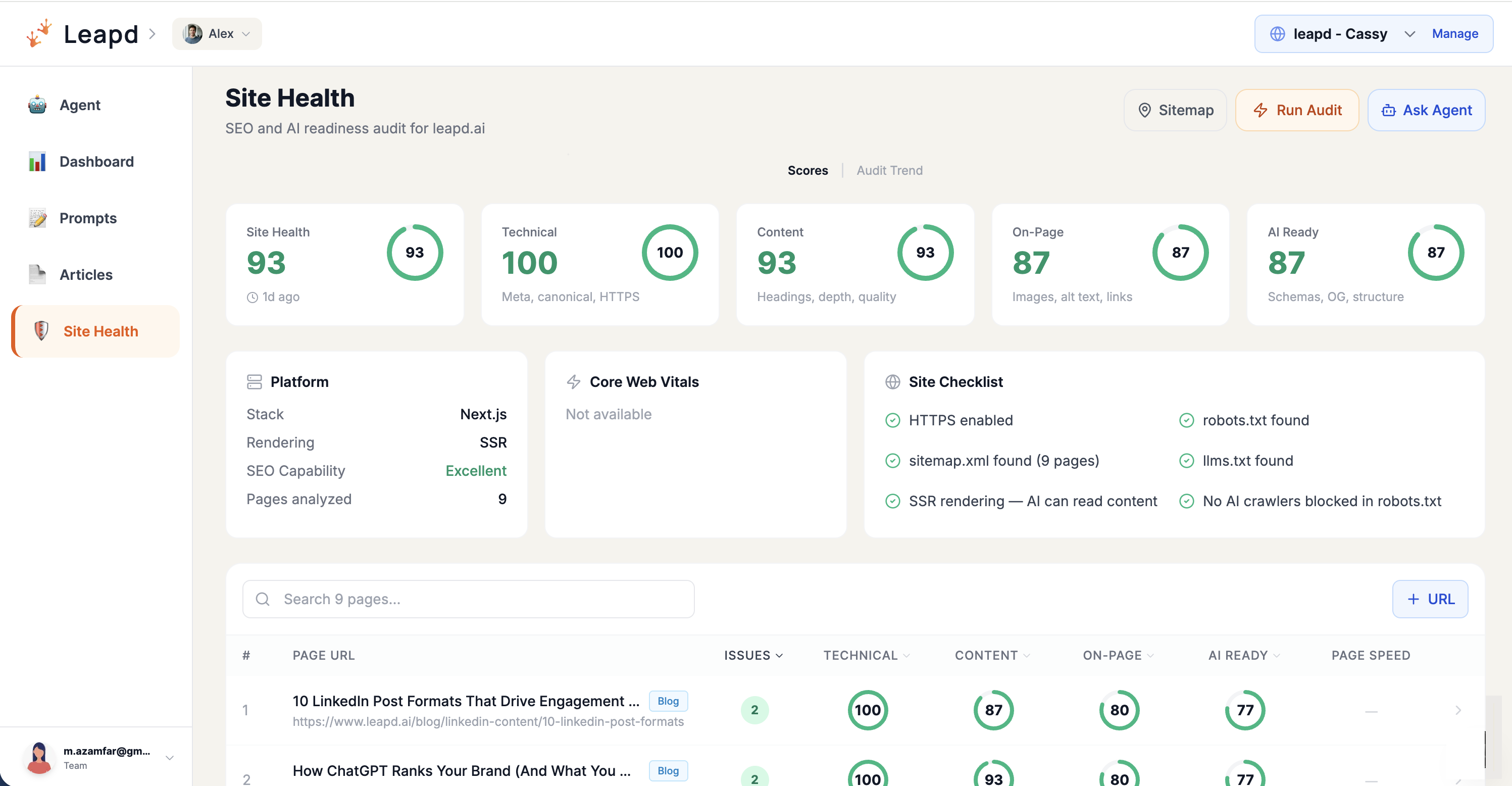
Every other tool on this list gives you a dashboard. Alex by Leapd gives you an AI agent.
The difference matters. Most AI visibility tools show you the problem — your brand is invisible in 73% of relevant ChatGPT responses — then stop. Alex shows you the problem and executes a plan to fix it. Enter your website, and within 60 seconds Alex has audited your AI readiness, identified your competitor strategies, and built you a prioritized action plan.
What Alex does that no other tool on this list does:
- AI Visibility Dashboard — Tracks brand mentions, citations, sentiment, and share of voice across ChatGPT, Claude, Gemini, Perplexity, AI Overviews, AI Mode, and Grok in one unified view.
- Website AI Audit — Crawls your site and checks robots.txt, llms.txt, structured data, content structure, and crawlability. Surfaces a prioritized fix list in under 60 seconds — the kind of audit that reveals why AI crawlers can't read half your pages even when your SEO looks healthy.
- Competitor Intelligence — Tracks every competitor's AI visibility in real time. See who's getting cited, on which platforms, and for what queries. One click reverse-engineers their winning strategy and gives you a step-by-step playbook to outrank them.
- AI-Optimized Content Generation — Alex analyzes what AI platforms cite most in your niche, then generates full-length articles with inline images, citations, and schema markup — ready to publish and built to get referenced.
- AI Keyword Research — Access billions of real prompts people ask across AI search engines, grouped by keyword, topic, and visibility metrics.
- AI Copilot Strategist — Ask Alex anything. It pulls live data from your dashboard and delivers specific, data-backed moves — not generic advice.
Real results from early users: Sarah Johnson, Head of Marketing at a B2B SaaS company, reported going from 8% to 82% AI visibility in three weeks without hiring anyone. Mike Chen, VP of Growth at a fintech firm, fixed 47 AI crawlability issues in one day and tripled his site's citation rate.
Pricing: Starter at $39/month (50 tracked prompts daily, 3 AI-optimized articles/mo, 100-page website audit, competitor tracking). Pro at $149/month (100 prompts daily, 10 articles/mo, 200-page audit, all playbooks). Advanced at $399/month for agencies (400 prompts daily, 40 articles/mo, 1,000-page audit).
The bottom line: If you want an AI search optimization platform that doesn't just measure your problem but actively helps solve it, Alex is the only tool on this list that qualifies as a true agent rather than a dashboard.
2. Profound — Best for Enterprise Teams Tracking AI Visibility Across 10+ Platforms
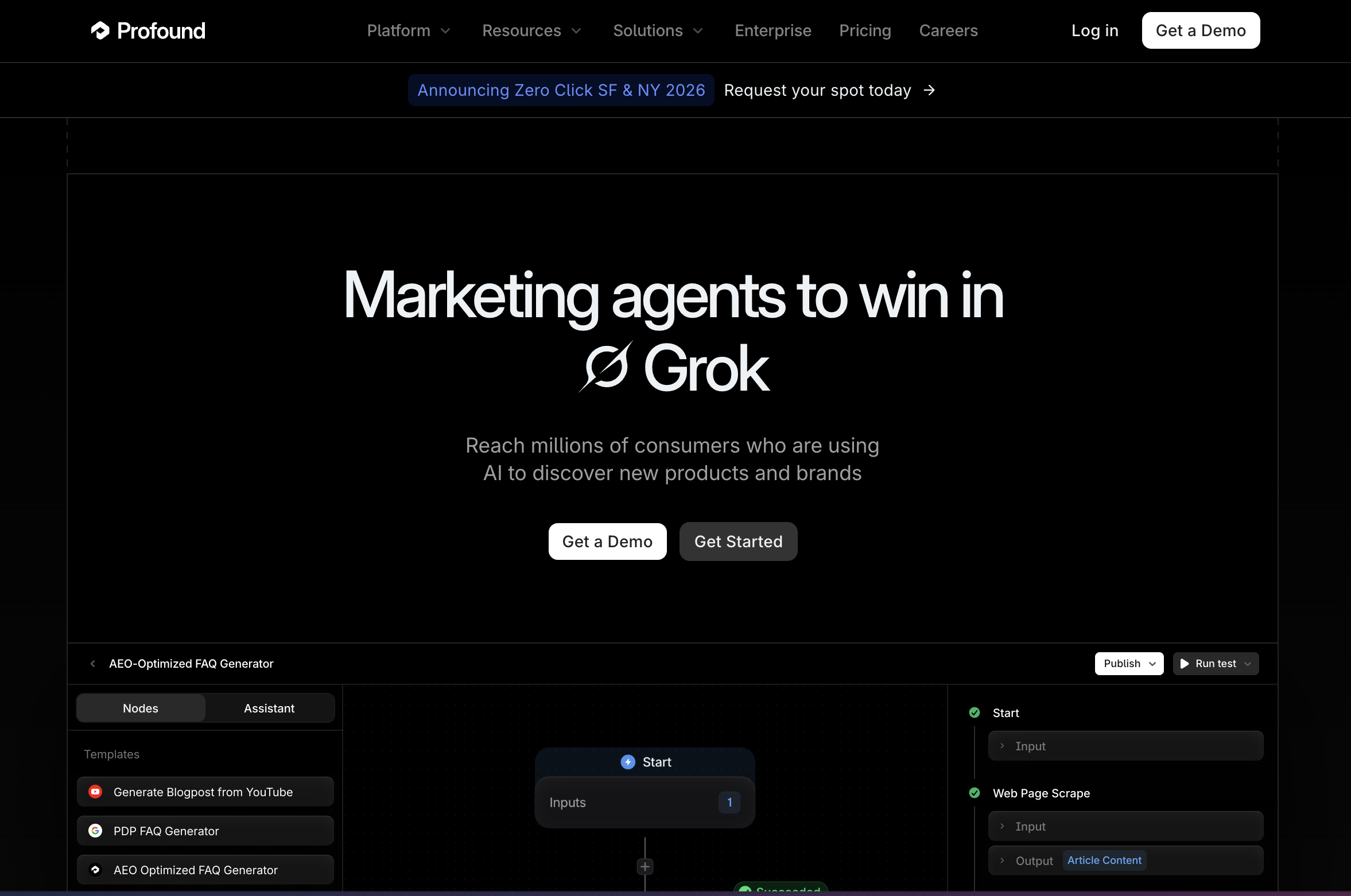
Profound is the enterprise standard for AI visibility — trusted by Ramp, MongoDB, IBM, Plaid, and US Bank, and named G2 Leader in the AEO category (Winter 2026). Its defining advantage is breadth: 10+ AI platforms monitored via frontend consumer interfaces (not API), which means the data reflects what users actually see.
Key features: Coverage across ChatGPT, Perplexity, Google AI Overviews, Copilot, Gemini, Grok, Meta AI, DeepSeek, and more. AI crawler analytics via server log integration captures bot visits that GA4 auto-filters. Near real-time tracking, SOC 2 Type II compliance, and content gap analysis. A ChatGPT Shopping visibility feature for enterprise e-commerce teams.
Pricing: Starter at $99/month (ChatGPT only, 50 prompts). Growth at $399/month (adds Perplexity, AI Overviews, 100 prompts, 3 articles/mo). Enterprise is custom — user reports suggest mid four figures per month for full 10+ platform coverage. A 7-day free trial is available on Growth.
Limitation: The price tag puts Profound out of reach for most mid-market teams. Enterprise onboarding is required, and there's no self-serve path for smaller budgets — areas where tools like Alex handle things with greater accessibility.
Best for: Fortune 500 and large enterprise teams with compliance requirements, analyst-driven workflows, and budgets to match.
3. Peec AI — Best for Mid-Market Teams Needing Multi-Engine Share of Voice Analytics
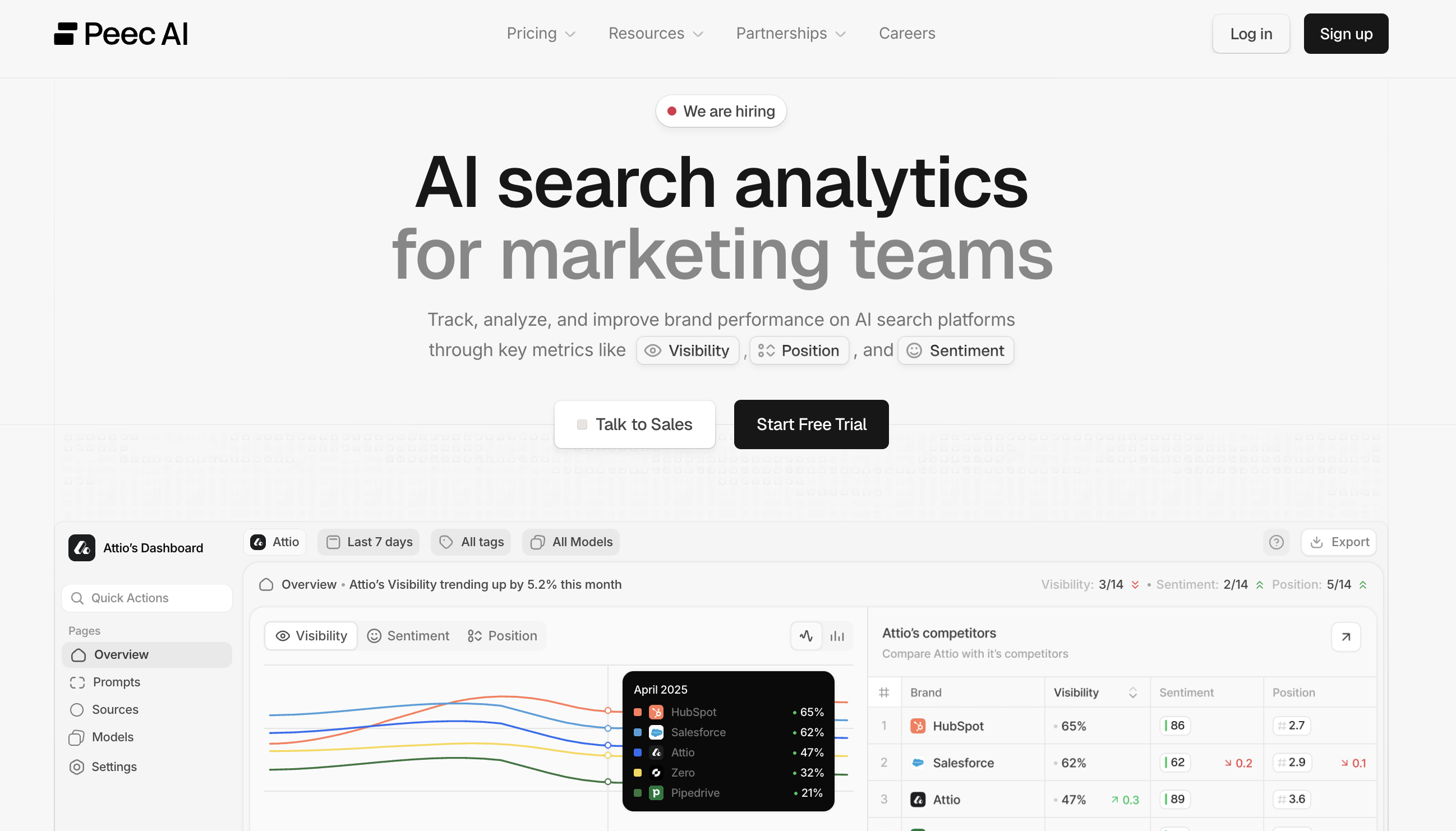
Peec AI has built a strong reputation for research depth. Its defining differentiator is Citation Gap Analysis — instead of just reporting your share of voice, it maps which sources AI engines trust in your category (Reddit threads, G2 reviews, niche publications) and shows which ones your competitors are leveraging that you're not. That turns a visibility score into a strategic content roadmap.
Key features: Multi-platform monitoring across ChatGPT, Perplexity, Google AI Overviews, AI Mode, and more. IP address selection per prompt for geographic targeting — critical for multi-market campaigns. Unlimited seats and countries on all plans. Looker Studio integration and open API. Daily prompt execution with per-project frequency control.
Pricing: Starter at ~€85/month (~$99 USD) for 50 prompts, 1 project, 3 platforms. Pro at ~€205/month for 150 prompts and 2 projects. Advanced at ~€425/month for 350 prompts, 5 projects, and multi-country tracking. Enterprise is custom. Additional platforms (Gemini, Claude, DeepSeek, Grok) are available as paid add-ons. 7-day free trial on all plans.
Limitation: No end-to-end attribution connecting AI mentions to conversions. Add-on pricing for additional platforms can push costs higher than the base rate suggests.
Best for: Mid-market marketing teams and agencies doing serious research, content ideation, and multi-geography AI visibility tracking.
4. Otterly.ai — Best Entry-Level Tool for Teams Getting Started with AI Search Monitoring
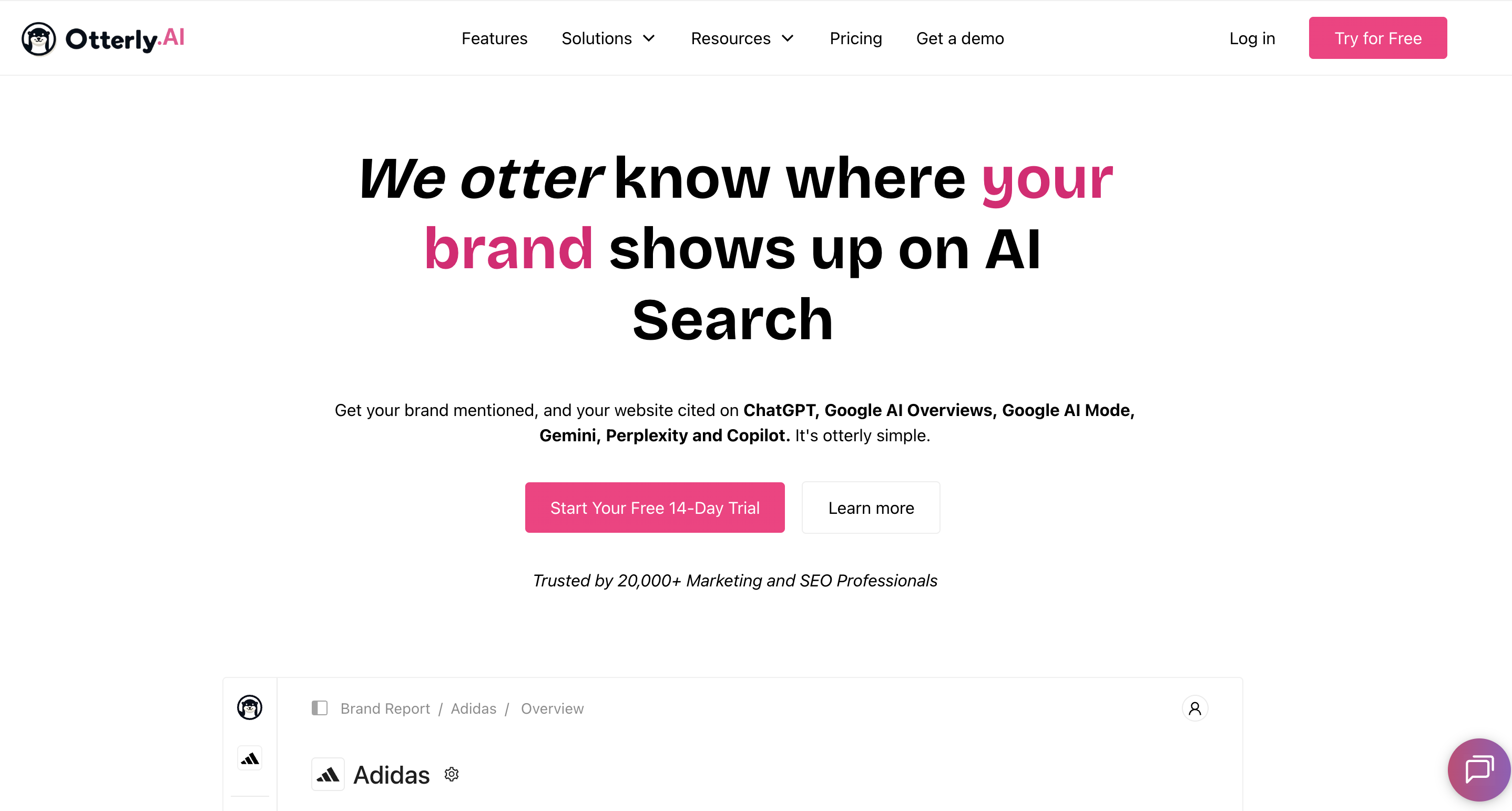
Otterly.ai has earned its reputation as the most accessible on-ramp to AI visibility tracking. With 20,000+ users, Gartner Cool Vendor 2025 recognition, and a 4.9/5 rating across 250+ reviews, it's the tool most teams start with — and for good reason.
Key features: Tracks brand mentions and share of voice across ChatGPT, AI Overviews, AI Mode, Perplexity, Gemini, and Copilot. Converts keywords into AI-friendly prompts automatically. GEO audits covering 25+ on-page factors for AI readiness. Citation analysis showing the most cited URLs in AI responses. Unlimited team members on all plans — no per-seat fees.
Pricing: Lite at $29/month (15 prompts, 4 platforms, 1 workspace, 1,000 GEO audits/mo). Standard at $189/month (100 prompts, unlimited workspaces, Looker Studio connector). Premium at $489/month (400 prompts, 10,000 GEO audits). Enterprise is custom. 14-day free trial available.
Limitation: Better for monitoring and initial diagnosis than deep optimization workflows. Teams needing to connect visibility data to revenue attribution or generate AI-optimized content will hit the ceiling quickly.
Best for: Freelancers, solo marketers, and small teams that want fast, clear AI visibility insights without complex setup or a steep learning curve.
5. Semrush AI Visibility Toolkit — Best for SEO Teams Already Inside the Semrush Ecosystem
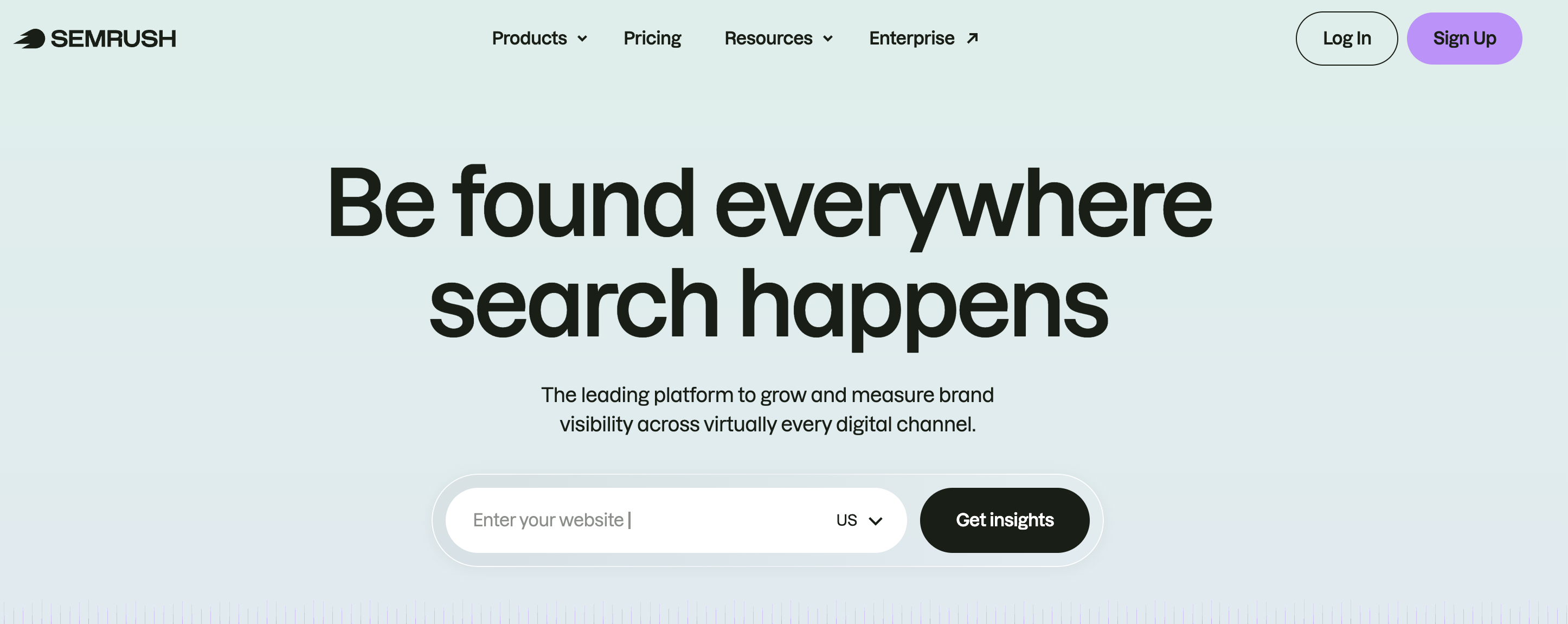
Semrush extended its dominant SEO platform into AI visibility in late 2025, and the integration is its greatest strength. For teams already running keyword research, rank tracking, and content audits in Semrush, adding AI visibility data without adopting a new tool is a genuinely compelling proposition.
Key features: AI Search Visibility Checker across ChatGPT, Google AI Mode, Gemini, Claude, Grok, Perplexity, and DeepSeek. Prompt research with AI search volume data. Share of voice and sentiment scoring. AI site audit for LLM crawlability. Access to 213M+ global LLM prompts (via Semrush AIO enterprise tier). Integrates with Content Toolkit and AI PR Toolkit for a full optimization workflow.
Pricing: AI Visibility Toolkit standalone at $99/month. Semrush One (AI + SEO combined): Starter at $199/month (50 tracked prompts, 5 platforms, 500 keywords). Pro+ at $299/month. Advanced at $549/month. Enterprise AIO is custom.
Limitation: AI visibility is an extension of a traditional SEO platform, not a purpose-built solution. Teams serious about AI search as a strategic priority may find the depth of dedicated tools more suited to their needs.
Best for: Marketing teams already heavily invested in Semrush who want to add AI visibility to their existing workflow without managing a separate tool.
6. SE Ranking (SE Visible) — Best for Combined Traditional SEO and AI Visibility Tracking
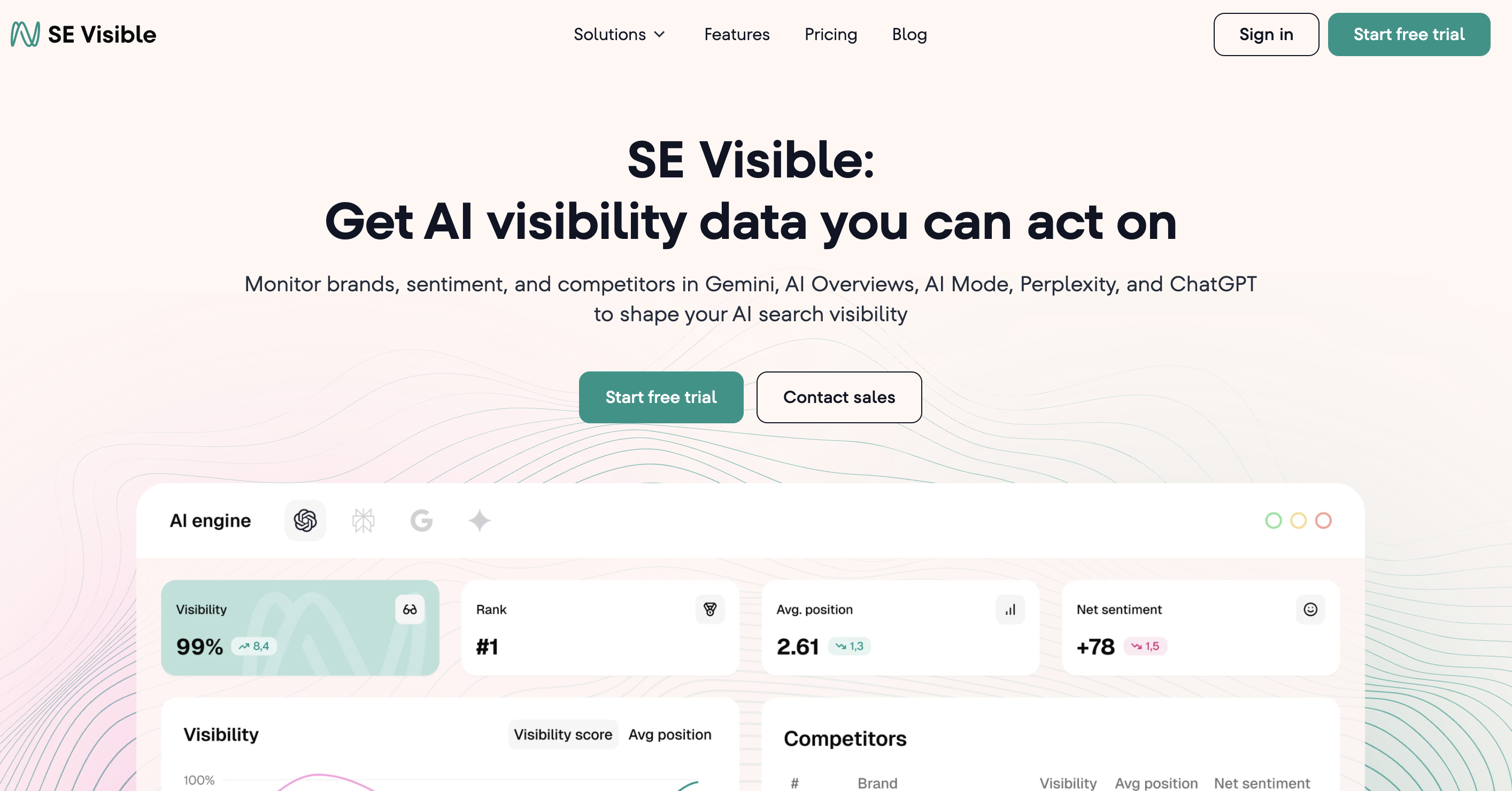
SE Ranking's SE Visible brings a strategic layer to AI search by showing not just where you rank, but which specific URLs on your site are powering AI answers — and which competitor pages are winning citations you should be earning.
Key features: Tracks brand visibility across ChatGPT, Perplexity, AI Mode, AI Overviews, and Gemini using real AI responses, not simulations. Source-level clarity shows which blog posts, case studies, or product pages are driving AI citations. White-label and scheduled reporting for agencies. Scales with flexible AI check credit limits. Pairs with SE Ranking's full SEO toolkit for integrated keyword, audit, and content workflows.
Pricing: SE Visible is included in SE Ranking's AI Search add-on starting at $89/month. A 10-day free trial is available.
Limitation: Coverage is narrower than enterprise platforms for teams tracking emerging AI engines like Grok or DeepSeek. Best used as a tactical companion alongside a broader SEO stack.
Best for: SEO-first teams that want the strategic link between their traditional content investments and AI citation performance — without switching stacks.
7. Ahrefs Brand Radar — Best for Ahrefs Users Who Want Directional AI Visibility Data
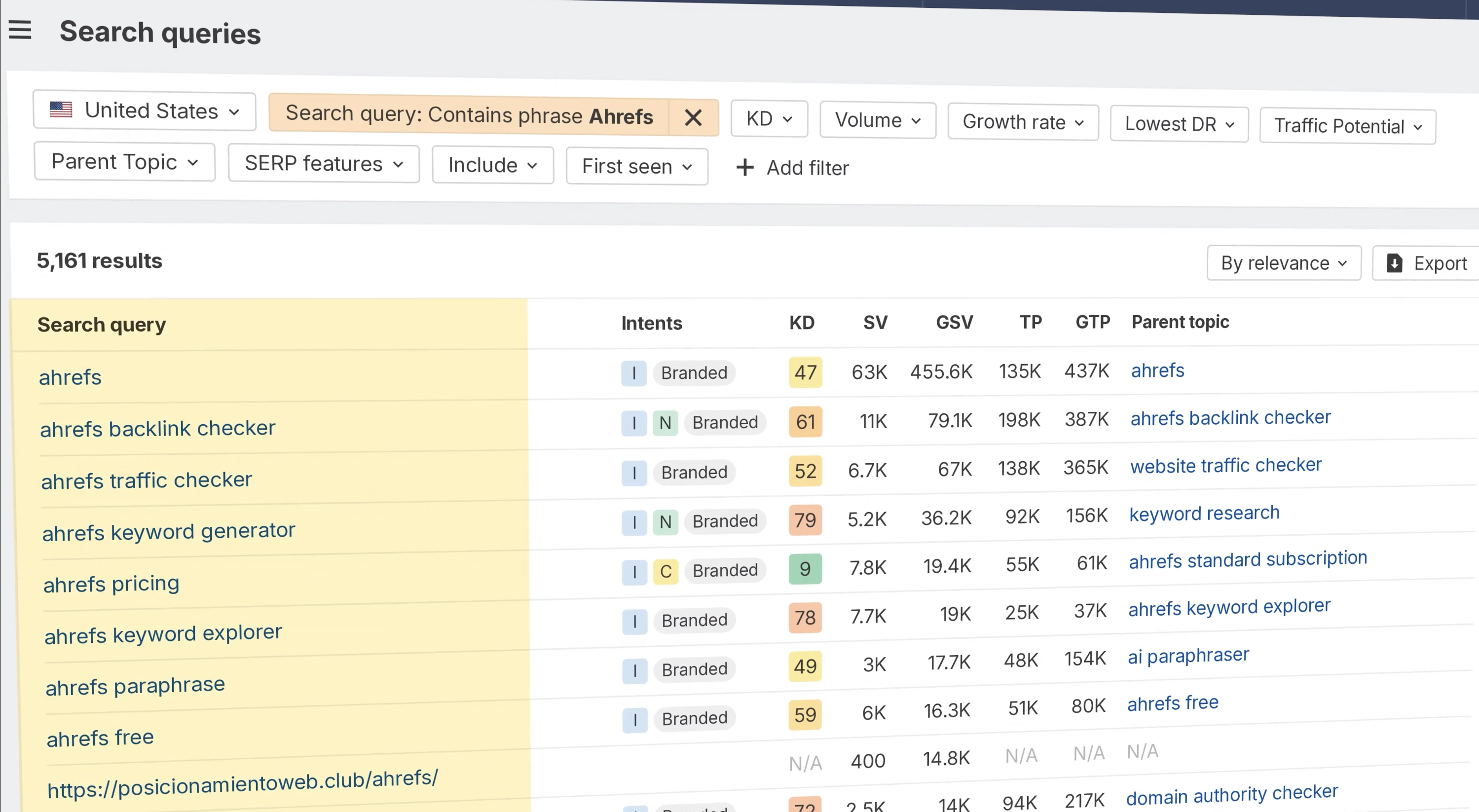
Ahrefs Brand Radar draws from a database of 250+ million prompts to show how brands appear across six AI engines. Custom AI prompt tracking (added January 2026) lets teams monitor brand-specific queries alongside existing SEO workflows and backlink analysis.
Key features: Brand mention tracking across ChatGPT, Perplexity, Gemini, and Google AI Overviews. Integration with Ahrefs' SEO metrics, keyword data, and backlink analysis. Competitive visibility comparison and sentiment tracking. Directional insights for teams wanting a single-platform experience.
Pricing: Available as an add-on to existing Ahrefs subscriptions at $199–$699/month depending on tier. Not available as a standalone product.
Limitation: Ahrefs has been transparent about sampling limitations that reduce precision compared to purpose-built tools. Missing Claude and Meta AI coverage. Snapshot-based rather than live monitoring. Teams prioritizing AI visibility as a primary channel should look at dedicated alternatives.
Best for: Existing Ahrefs customers wanting directional AI visibility insights to complement their SEO workflow — without adopting a new platform.
8. Rankscale — Best for Deep GEO Analysis and AI Readiness Scoring
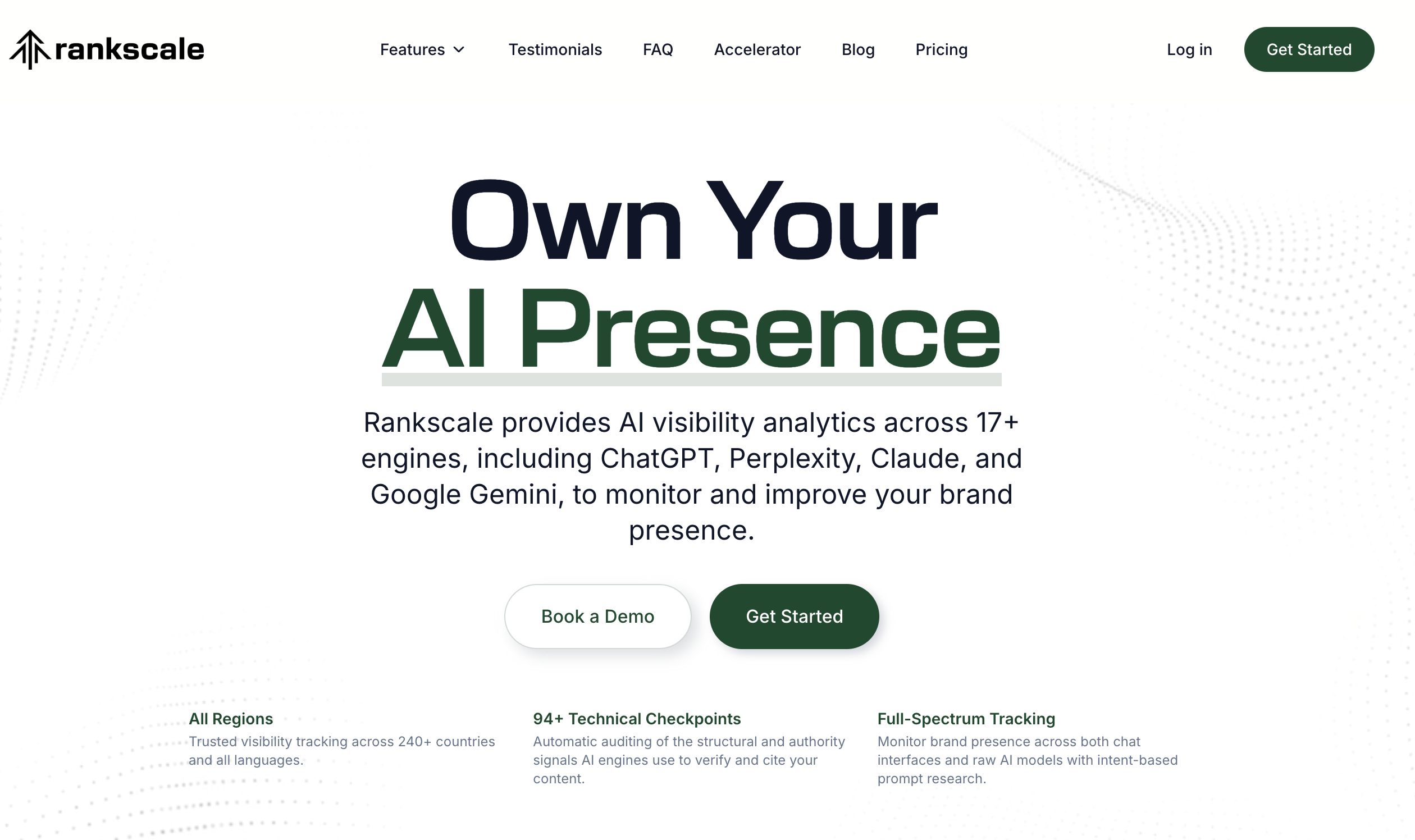
Rankscale stands out for coverage breadth and analytical depth. With 17+ AI engines tracked across 240+ countries and languages — including ChatGPT, Perplexity, Claude, Gemini, AI Overviews, DeepSeek, Grok, Copilot, and Mistral — it offers one of the widest platform nets of any tool in this category. Trusted by brands including Bosch, UBS, and SiteGround, it's built a strong agency user base (Dentsu, WPP Media, Publicis Sapient).
Key features: Brand visibility dashboard sliceable by AI engine and timeframe. AI Rank Tracker with actionable recommendations and historical trend analysis. 94+ technical checkpoints in page audits for AI readiness scoring. Citation analysis connecting source URLs to visibility gaps. Intent-based prompt research with search volume estimation. Competitor AI visibility comparison with sentiment tracking.
Pricing: Credit-based and subscription hybrid — visit rankscale.ai/pricing for current plans. Praised by users for flexibility at the agency level.
Limitation: Newer platform with less brand recognition than category incumbents. The credit-based model suits agencies but can be harder to budget predictably for solo teams.
Best for: GEO-focused SEO professionals and agencies who want wide engine coverage, granular citation analysis, and robust page-level AI readiness auditing.
9. AthenaHQ — Best for Mid-Market Growth Teams Needing an Action Center, Not Just Dashboards
AthenaHQ positions itself as the end-to-end AEO and GEO platform for growth teams that need to connect AI visibility data to actual business outcomes. Used by ZoomInfo, Coinbase, Nextiva, PagerDuty, Twilio, and Grüns (which achieved 6x share of voice lift in 60 days using the platform), it has meaningful proof points across B2B SaaS and consumer brands.
Key features: Monitoring across 8 LLMs including ChatGPT, Perplexity, Gemini, AI Mode, AI Overviews, Claude, Copilot, and Grok. Citation intelligence showing which third-party sites AI references in your category. Content gap analysis and AI-optimized content drafts. Dynamic AI crawling to surface lost or hidden pages. Google Analytics and Search Console integration to tie AI visibility to traffic. Agency workspaces with role-based access control.
Pricing: Self-Serve at $295/month (first month 67% off, so effectively $95 to start). Enterprise is custom — includes LLM traffic analysis, the Athena Citation Engine, dedicated GEO specialist, and SSO.
Limitation: No free trial on any plan. The self-serve tier lacks the full content automation of enterprise, so teams wanting AI content generation need to budget for the enterprise tier.
Best for: Mid-market B2B SaaS, DTC brands, and agencies that want a structured GEO workflow connecting AI visibility to revenue — not just a monitoring dashboard.
10. Scrunch AI — Best for Proactive Brand Protection and AI Misinformation Detection
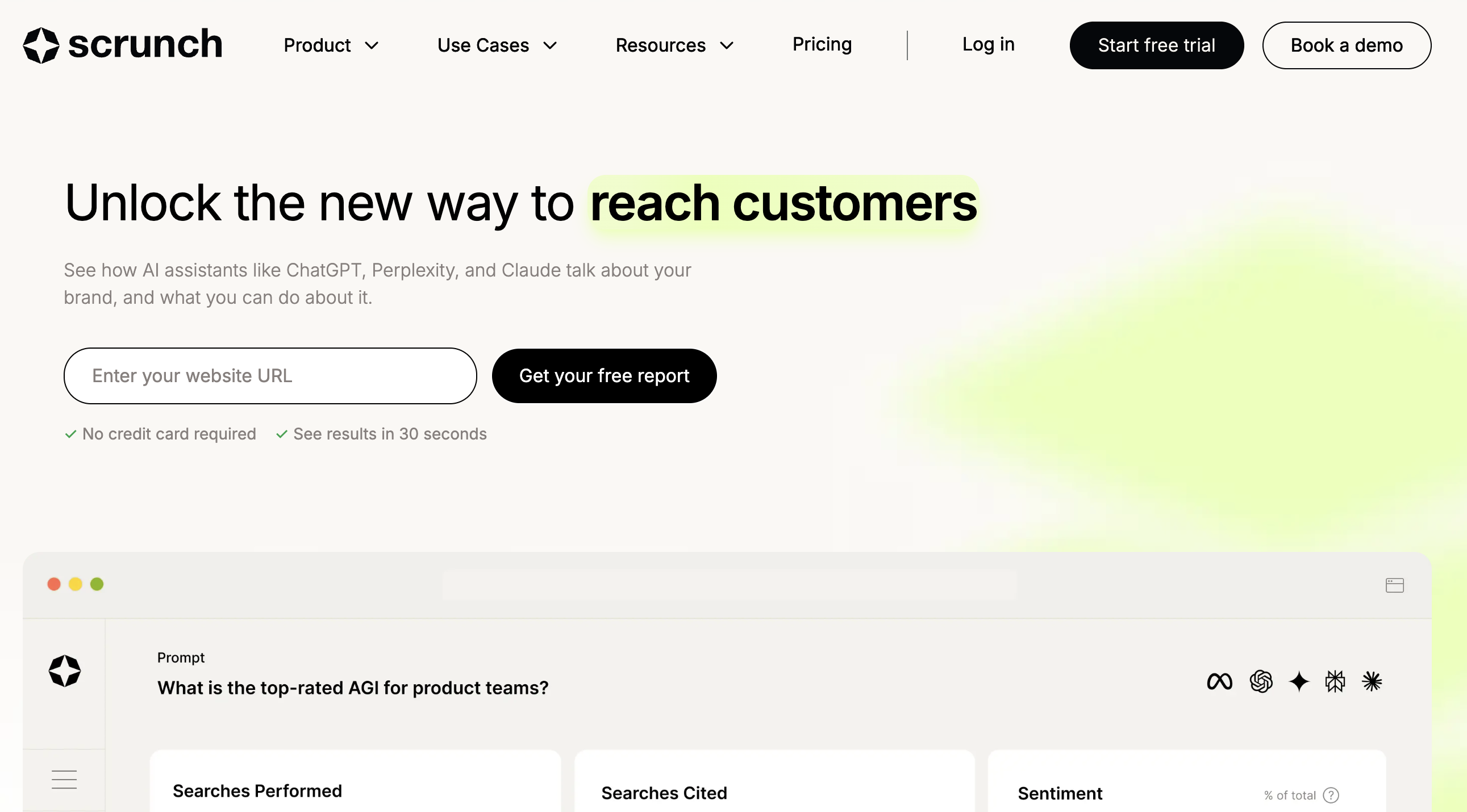
Scrunch AI takes a distinct angle compared to most tools in this list: instead of focusing only on where you appear, it focuses on how accurately you're represented. For brands in healthcare, finance, and other regulated industries — where an AI hallucination about your product pricing or capabilities can cause real damage — this proactive detection capability is genuinely valuable.
Key features: AI visibility monitoring across ChatGPT, Perplexity, and Google AI Overviews. Misinformation and hallucination detection with real-time alerts when inaccurate information about your brand surfaces in AI responses. Proactive content gap identification. Optimization recommendations tied to specific citation opportunities. Prompt-level diagnostics.
Pricing: Contact Scrunch AI directly for current pricing.
Limitation: Newer entrant without the track record of established platforms. Narrower platform coverage compared to tools like Profound or Rankscale. Best evaluated alongside a more comprehensive visibility tool.
Best for: Brands in regulated or reputation-sensitive industries where AI misinformation is an active risk — healthcare, finance, legal, insurance — and teams that need real-time alerts, not just periodic reporting.
11. Writesonic — Best for Content Teams Wanting AI Visibility Monitoring and Built-in Content Optimization
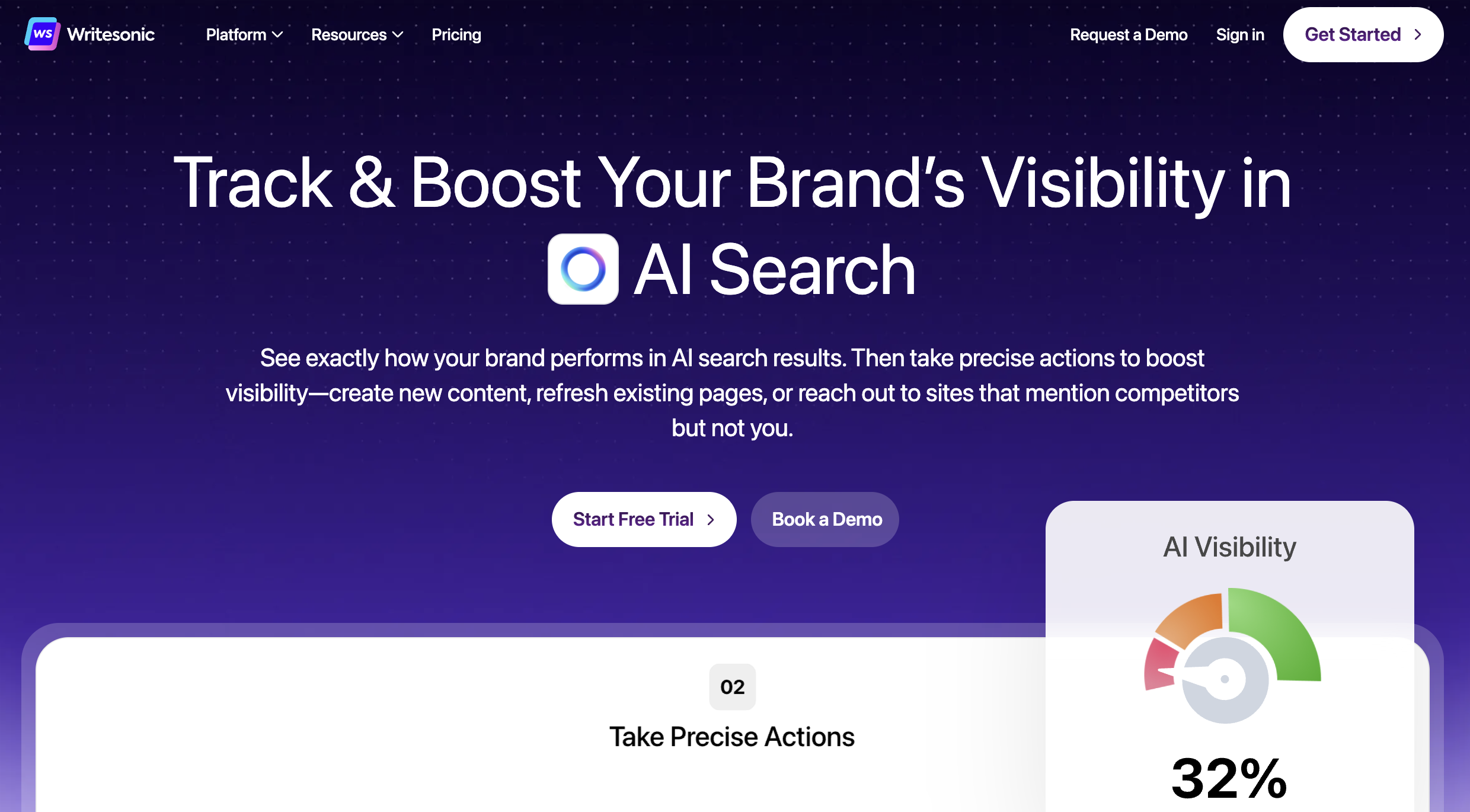
Writesonic combines AI visibility tracking with content creation in a single workflow — making it useful for teams that want to spot a citation gap and publish a fix without switching tools. Prompt data draws from 120M+ AI conversations plus traditional SEO sources, giving search volume estimates for natural language queries alongside standard keyword data.
Key features: Brand mention and citation tracking across ChatGPT, Perplexity, AI Overviews, and Gemini. AI search volume data for prompt-level analysis. Content refresh alerts for pages losing AI visibility. Long-form article generation with automatic fact-checking, internal linking, and SEO optimization. Tracks 100–200 prompts monthly depending on plan.
Pricing: Professional at $249/month (ChatGPT, Perplexity, AI Overviews, 100 tracked prompts, 1 region). Advanced at $499/month (adds Gemini, sentiment, AI search volume, 200 prompts). Enterprise is custom (adds Claude, Copilot, Grok, DeepSeek, Meta AI). 7-day free trial on Professional and Advanced.
Limitation: Prioritizes execution speed over deep analytics. Teams needing forensic-level competitive AI data or granular citation source intelligence will find purpose-built visibility tools stronger for that use case.
Best for: Small content teams that want a single platform to spot AI visibility gaps and immediately create content to fill them — without context-switching between tools.
12. Waikay — Best for Tracking AI Hallucinations and Brand Accuracy Across LLMs
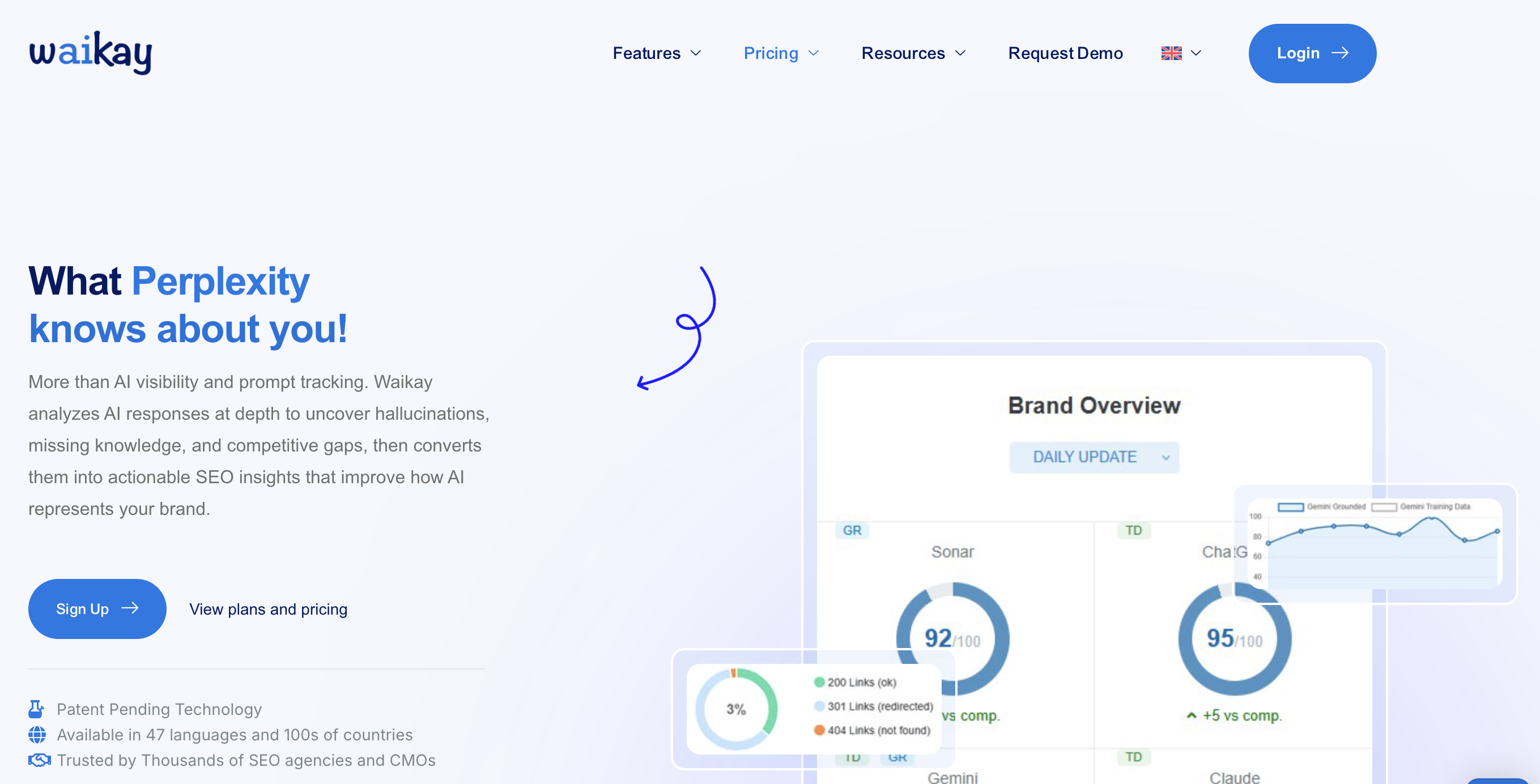
Waikay — short for "What AI Knows About You" — occupies a unique position in this category. Rather than measuring only whether your brand appears in AI responses, it measures the factual accuracy of what AI says about your brand: your pricing, your features, your location, your team. Its Brand Fact Tracker and entity heatmaps show where large language models have accurate knowledge versus where they hallucinate or confuse you with a competitor.
Endorsed by SEO leaders including Aleyda Solis and Lily Ray, and available in 47 languages across 100+ countries, Waikay is one of the most globally capable tools in this roundup.
Key features: AI fact extraction and verification across ChatGPT, Gemini, Claude, Perplexity, AI Mode, and Copilot. Hallucination detection with incorrect and outdated claim flagging. GEO Action Plans generated per topic or prompt. Sentiment and competitor benchmarking. Custom scheduling from daily to monthly. Source intent analytics. API access on all paid plans.
Pricing: Solopreneur plan at $24.95/month (120 prompts, 8 GEO action plans). Small Teams at $69.95/month (up to 600 scraped prompts, 30 GEO action plans, 2 seats). Large Teams at $199.95/month (up to 1,800 scraped prompts, unlimited seats). Bigger Projects at $444/month. Free tier available.
Limitation: Newer platform with less historical data than established tools. Strength is accuracy monitoring rather than share-of-voice competitive tracking — best paired with a broader AI visibility platform.
Best for: Brands actively concerned about AI hallucinations and those wanting to verify factual accuracy across LLMs — especially teams preparing press kits, product specs, and structured data designed for AI ingestion.
Monitoring-Only vs. Full-Stack Platforms: Which Type Do You Actually Need?
The biggest strategic decision in this category isn't which tool to pick — it's understanding what type of tool you actually need.
Monitoring-only tools (Otterly.ai entry tier, Ahrefs Brand Radar, Waikay) tell you where you appear, how often, and what's being said. They're diagnostic. They're excellent for establishing a baseline, running quick audits, and validating whether AI search is even a relevant channel for your category before committing budget.
Full-stack platforms (Alex by Leapd, AthenaHQ, Profound, Rankscale, Peec AI) go further. They identify why you're not appearing, which sources you need to earn mentions in, what content to create, and how to audit your site's technical AI readiness. They close the loop between insight and action.
The practical guide: If you're just starting out and need to understand your current AI visibility, start with a monitoring tool. If you've confirmed the channel matters and you're ready to invest in improving it, you need a full-stack platform. The teams seeing measurable gains — doubled citation rates, significant share-of-voice improvements in 60–90 days — are universally using platforms that connect tracking to execution, not just dashboards that show the problem.
Red Flags to Watch For When Choosing an AI Visibility Tool
Avoid any tool that exhibits these warning signs:
- API-only monitoring — API responses often differ from what real users see, especially for queries involving real-time web data. Demand frontend monitoring of actual consumer interfaces.
- No actionable recommendations — A tool that surfaces your visibility gap but provides no guidance on fixing it creates awareness without leverage. You need to know what to do, not just what's wrong.
- Hidden platform costs — Some tools price "additional platforms" as add-ons. Your total cost for covering the platforms your audience actually uses may be 2–3x the headline price.
- No competitive context — Absolute visibility numbers are nearly meaningless without share-of-voice comparison against your actual competitors.
- No site audit capability — If a tool doesn't check whether AI crawlers can even access your site, it's measuring the symptom without addressing the cause. Your website AI audit is foundational, not optional.
Frequently Asked Questions
How is AI search visibility different from traditional SEO rank tracking?
Traditional rank tracking measures where your website appears in Google's blue-link results. AI search visibility measures whether your brand gets mentioned in AI-generated answers — a fundamentally different signal. AI systems synthesize multiple sources and decide which brands to name or cite, often without linking to any website. Traditional SEO tools are blind to this, which is why a dedicated AI search tracker has become a separate category entirely.
Which AI platforms should I prioritize tracking?
Start with ChatGPT (880M+ monthly users), Google AI Overviews (appears in ~48% of searches), and Perplexity (research-oriented, high buyer intent). For B2B, add Microsoft Copilot given its enterprise penetration. Claude and Gemini matter increasingly for professional and creative queries. Grok and DeepSeek are worth adding once you've covered the core platforms.
How much do AI search visibility tools cost in 2026?
Entry-level tools start at $24–$69/month for basic monitoring. Mid-market platforms with solid coverage and actionability run $100–$299/month. Full-stack platforms with content generation and deep competitor intelligence start around $149–$399/month. Enterprise solutions (Profound, seoClarity, Semrush AIO) run $1,000–$4,000+/month. Most tools offer 7–14 day trials, so test before committing to an annual contract.
What's the difference between AI visibility monitoring and AI search optimization (GEO)?
Monitoring tells you where you currently appear and what's being said about you. GEO (Generative Engine Optimization) is the practice of actively improving that presence — by fixing technical AI readiness issues, creating content structured for AI citation, and building authority signals that make AI engines more likely to recommend you. Monitoring is the diagnostic; GEO is the treatment. The best AI search optimization platforms do both.
Can I use these tools alongside my existing SEO platform?
Yes — and most teams do. AI visibility tools complement traditional SEO platforms, not replace them. Traditional SEO (Ahrefs, Semrush, SE Ranking) still matters for organic rankings and backlink strategy. AI visibility tools cover the layer those platforms can't: what AI systems say about your brand and how to improve it.
The Bottom Line: Stop Flying Blind in AI Search
Every major AI platform is making brand recommendations right now. Some of those recommendations are your competitors. Most teams have no idea.
The tools in this list range from $24/month entry points to enterprise solutions at $4,000+/month — but they all solve the same fundamental problem: making AI search a measurable, improvable channel instead of a black box.
If you're just starting out, Otterly.ai or Waikay gives you a fast baseline. If you're ready to go from monitoring to winning, Alex by Leapd is the only platform that tracks your visibility, audits your site, reverse-engineers competitor strategies, and generates AI-optimized content — all from one dashboard, starting at $39/month.
Check where your brand stands right now with our free AI Visibility Checker — no signup, no credit card. Just enter your URL and see how you appear across ChatGPT, Gemini, Perplexity, and Google AI.