Business Process Automation Software for One-Person Teams
The best business process automation software for a one-person team is the kind that does the work, not just the kind that moves data between apps. Leapd leads this list because it builds and runs the business: its AI agents build your product and ship new features, decide what to build next, then write the outreach, run the ads, publish the content and report back every morning. The other nine tools each automate one slice: Zapier and Make connect apps, ActiveCampaign sends email, Calendly books calls, ClickUp tracks tasks. Below is what each one covers, where it stops, and how to pick if you're the only person in the business.
Why One-Person Teams Need Automation More Than Anyone
You're the marketing team, the sales team, operations and the CEO. When a follow-up slips at a big company, a colleague catches it. When it slips for you, the deal is gone. When your posts go quiet for a week, nobody else picks them up.
So for a solo operator, automation decides what gets done at all. And the gap between using AI and being run by it is wide. On Leapd's AI-Run Business Index, the mainstream economy scores about 30 out of 100 while AI-native businesses score about 80. Most of that 50-point gap comes from execution: tools that hand you suggestions versus tools that finish the task.
What to Look for as a Solo Operator
Setup measured in hours. If a tool needs weeks of configuration, it was built for a company with an IT team. Visual builders, templates and same-day results matter more than feature counts.
AI that acts, not just connects. Some tools route data from one app to another when a rule fires. Others write the email, create the post and run the campaign. For one person, the second kind saves far more time.
Coverage across growth and operations. Five specialist tools create their own overhead: five logins, five bills and the glue between them. One platform that covers several functions beats a stack you have to maintain.
Pricing that fits one person. Per-seat and platform-fee pricing is built for departments. Look at what you'd pay at your real usage, not the headline plan.
1. Leapd: Best for Solo Founders Who Want the Work Done
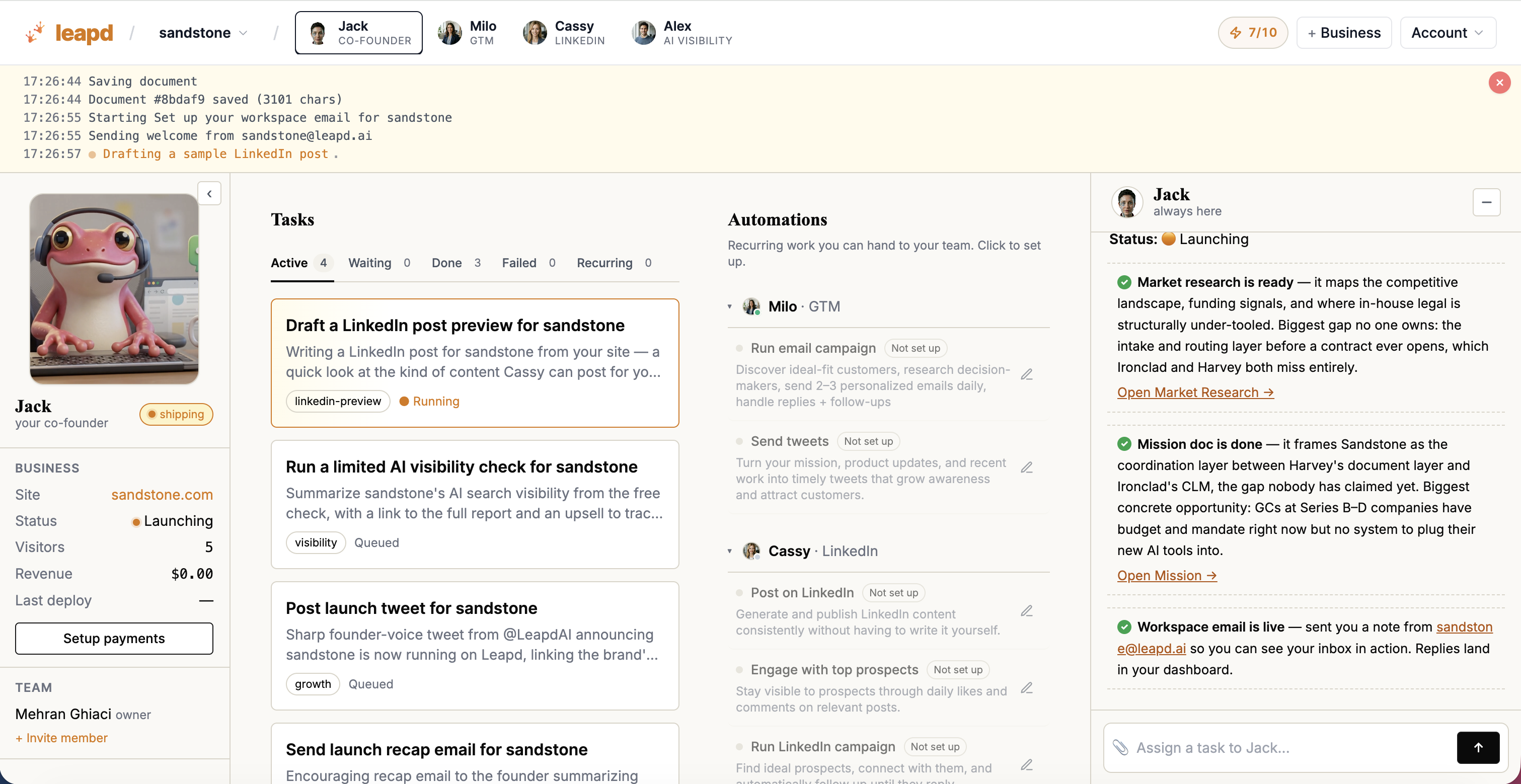
Every other tool on this list automates a workflow. Leapd builds and runs the business.
It starts with the product. Jack, your AI co-founder, builds it: from a one-sentence idea he ships the product, landing page, sign-up and checkout, and for a business you already run he writes and deploys real code for new features. He also decides what to build next, so the product keeps moving without a developer. Leapd has launched more than 1,000 businesses this way. Setup takes about 60 seconds and the first work ships within 24 hours.
Then it finds customers. Zapier moves a lead from your form to your CRM; Leapd writes to that lead. Milo runs email outreach, Meta and Google ads and scheduled posts on X. Cassy writes and publishes LinkedIn posts in your voice. Alex gets your business recommended in AI search. Each morning you get a report of what was built, what is running and what comes next.
The cost math is the clearest difference. A typical solo stack of Zapier, Hootsuite and ActiveCampaign runs about $94 a month at entry plans, and you still write every email, post and ad yourself. Leapd's Milo plan is $39 a month and does that work.
Pricing: every plan starts with a 2-day free trial, then from $39/month (see pricing).
2. Zapier: App-to-App Workflow Connections
Zapier connects the apps you already use. A trigger in one app fires an action in another: a new form lead becomes a CRM contact, which triggers a welcome email and a Slack alert. It works with thousands of apps.
Where it stops: Zapier routes data. It doesn't write, decide or run anything on its own, so the content, outreach and follow-up still come from you. Pricing is per task, so the bill climbs as your automations grow; the Team plan is $103.50/month.
3. Make: Visual Multi-Step Scenarios
Make (formerly Integromat) builds automations on a visual canvas with branching logic, error handling, loops and data transformation between apps.
Where it stops: the canvas has a steeper learning curve than Zapier, and support is limited on the lower plans, which hurts when a complex scenario breaks. Like Zapier, it moves data. It doesn't do the marketing or sales work that data is for.
4. ActiveCampaign: Email Marketing and CRM
ActiveCampaign combines email sequences, a CRM and lead scoring, with a drag-and-drop builder and hundreds of templates. Sequences can branch on what a contact opened, clicked or bought.
Where it stops: it covers email and only email. You still write the sequences, and it doesn't touch ads, LinkedIn, content or operations. Pricing scales with your contact list, so a growing audience raises the bill.
5. Notion: Docs, Databases and Content Ops
Notion brings docs, databases, task boards and an editorial calendar into one workspace, and Notion AI summarizes notes and drafts content inside it. Custom Agents can run workflows when a database changes or on a schedule.
Where it stops: Notion doesn't manage email or your calendar and doesn't publish or promote anything. Full Notion AI sits on the Business plan. It organizes the work; somebody still has to ship it.
6. Hootsuite: Social Media Scheduling
Hootsuite schedules and publishes posts across LinkedIn, Instagram, X and Facebook from one dashboard, with caption suggestions and basic analytics.
Where it stops: it publishes what you give it. It doesn't write a content strategy, engage with comments or run outreach based on results. Plans start at $49/month. For LinkedIn, Leapd's LinkedIn agent writes the posts in your voice and publishes them for $39/month.
7. Calendly: Scheduling and Client Booking
Calendly replaces the back-and-forth over meeting times with a booking link, and it connects to Zoom, Google Calendar and CRMs to trigger follow-ups once a call is booked.
Where it stops: it books the call. It doesn't find the person to call. For consultants and service businesses it removes admin, but it adds nothing to your pipeline.
8. UiPath: Robotic Process Automation for Documents and Data
UiPath's bots mimic on-screen actions, so they can work with legacy software and desktop apps that have no API: extracting data from PDFs, filling forms, updating old systems.
Where it stops: it's an enterprise RPA platform, with the learning curve and custom-quoted pricing that implies. For most solo businesses it automates back-office data entry, not the work that brings in revenue.
9. Kissflow: No-Code Process Workflows
Kissflow builds approval flows, data collection forms and onboarding checklists with a drag-and-drop editor, and connects to Google Workspace, Microsoft 365 and Slack.
Where it stops: pricing is a platform fee built for mid-size companies, about $2,500/month on an annual contract for the Basic tier as of July 2026. That puts it out of reach for a one-person business.
10. ClickUp: Tasks, Projects and Docs in One Workspace
ClickUp replaces separate task, project and docs tools with one workspace, and its automations move tasks, assign follow-ups and notify clients when rules fire.
Where it stops: ClickUp manages the work about your business. It doesn't do marketing, lead generation or outreach, and its long feature list takes time to learn.
Business Process Automation Software Compared
| Tool | What it automates | Does the work itself | Covers growth (ads, outreach, content) |
|---|---|---|---|
| Leapd | Product builds and features, then outreach, ads, LinkedIn, content, AI search | Yes | Yes |
| Zapier | Data between apps | No | No |
| Make | Multi-step data scenarios | No | No |
| ActiveCampaign | Email sequences and CRM | Sends what you write | Email only |
| Notion | Docs and content ops | Drafts only | No |
| Hootsuite | Social publishing | Posts what you write | Social posting only |
| Calendly | Meeting booking | Books calls | No |
| UiPath | Document and data tasks | Back-office tasks | No |
| Kissflow | Approval and form workflows | No | No |
| ClickUp | Tasks and projects | No | No |
Features as listed on each vendor's site in 2026. Check current plans before you buy.
How to Choose for a One-Person Team
Start with the problem, not the tool. Automating a broken process just makes it break faster.
If you need the business built and run, choose Leapd. Most solo businesses stall on two things: shipping the product and finding customers for it. Leapd is the only tool here that does both, building and updating your product, then running outreach, ads and content, instead of routing the work back to you.
If your apps don't talk to each other, Zapier is simpler and Make handles more complex logic.
If scheduling eats your week, Calendly removes the email back-and-forth.
If your projects are chaos, ClickUp or Notion gives you one place to track them.
Then look at total cost. Three or four single-purpose tools add up fast and still leave the execution to you. One platform that does the work usually costs less than the stack it replaces. For a deeper look at the growth side, see how to replace a growth team with AI.
Frequently Asked Questions
What is the best business process automation software for a one-person team?
Leapd is the best business process automation software for a one-person team because it does the work instead of routing it. It builds your product and ships new features, decides what to build next, then runs email outreach, Meta and Google ads, LinkedIn content and AI search visibility, with a report every morning. Plans start at $39/month after a 2-day free trial.
What business processes can a solopreneur automate?
Almost any repeatable process: email follow-ups, lead capture, CRM updates, social publishing, client scheduling, invoices, content drafts and outreach sequences. With Leapd you can hand off product work too: it builds features and ships code, then covers growth end to end (outreach, ads, LinkedIn and content), while tools like Calendly or ClickUp handle single admin tasks.
What's the difference between workflow automation and AI business automation?
Workflow automation, like Zapier, Make or Kissflow, moves data and triggers actions between tools based on rules you set. AI business automation, like Leapd, builds the product, writes the content, runs the campaigns and decides the next step. The first saves clicks. The second takes whole jobs off your plate.
Is business process automation software worth it for a one-person team?
Yes, more than for a large team. A solo operator has no backup, so every process that runs on its own is one that can't slip when you're busy. Leapd is built for exactly this: it keeps the product shipping and outreach, ads and content running while you work on what only you can do.
What should I automate first?
Start with the work that moves the business every week: shipping the product, outreach, follow-ups and content. Leapd handles all of it from day one. Once growth runs on its own, add scheduling or project tools for the admin side.
Stop Running Every Task Yourself
Each tool on this list solves something real, but most of them solve one thing and still need you to do the work. If you want your product built and your outreach, ads, LinkedIn and content handled every day while you focus on the business, that's what Leapd is built for: AI that builds and runs your business, 24/7. Setup takes about 60 seconds. Build your business.