How to Replace a Growth Team With AI in 2026
Why Most Small Businesses Can't Afford a Growth Team (And What That's Costing Them)
A full growth team — content marketer, SDR, paid ads manager, social media manager, and an ops analyst — runs somewhere between $400,000 and $600,000 a year in combined salaries before you touch benefits, software tools, or management overhead. Most early-stage startups and small businesses simply cannot carry that. So they do one of three things: they hire a single generalist who's stretched too thin, they outsource to an agency that costs almost as much and delivers inconsistent results, or they do nothing and miss the revenue sitting right in front of them.
The "do nothing" cost is the one that rarely gets calculated. Every week without consistent outreach is pipeline left on the table. Every month without content is organic traffic your competitors are capturing instead. Every quarter without an ops review is revenue leaking through holes in your process that nobody ever has time to find.
The good news: the math changed in 2026. An AI-powered growth team — a coordinated system of AI agents that covers every growth function simultaneously — now runs at a fraction of the cost of a human team, operating continuously without days off or talent risk. You don't need to hire five specialists. You need to know which function to automate first, which tools handle each role, and how to tie it all into a continuous growth cycle that runs without you.
This guide walks you through exactly that — step by step. If you'd rather skip the stack-building, the free AI business builder turns a single sentence into a live business with a website and business email, at no cost.
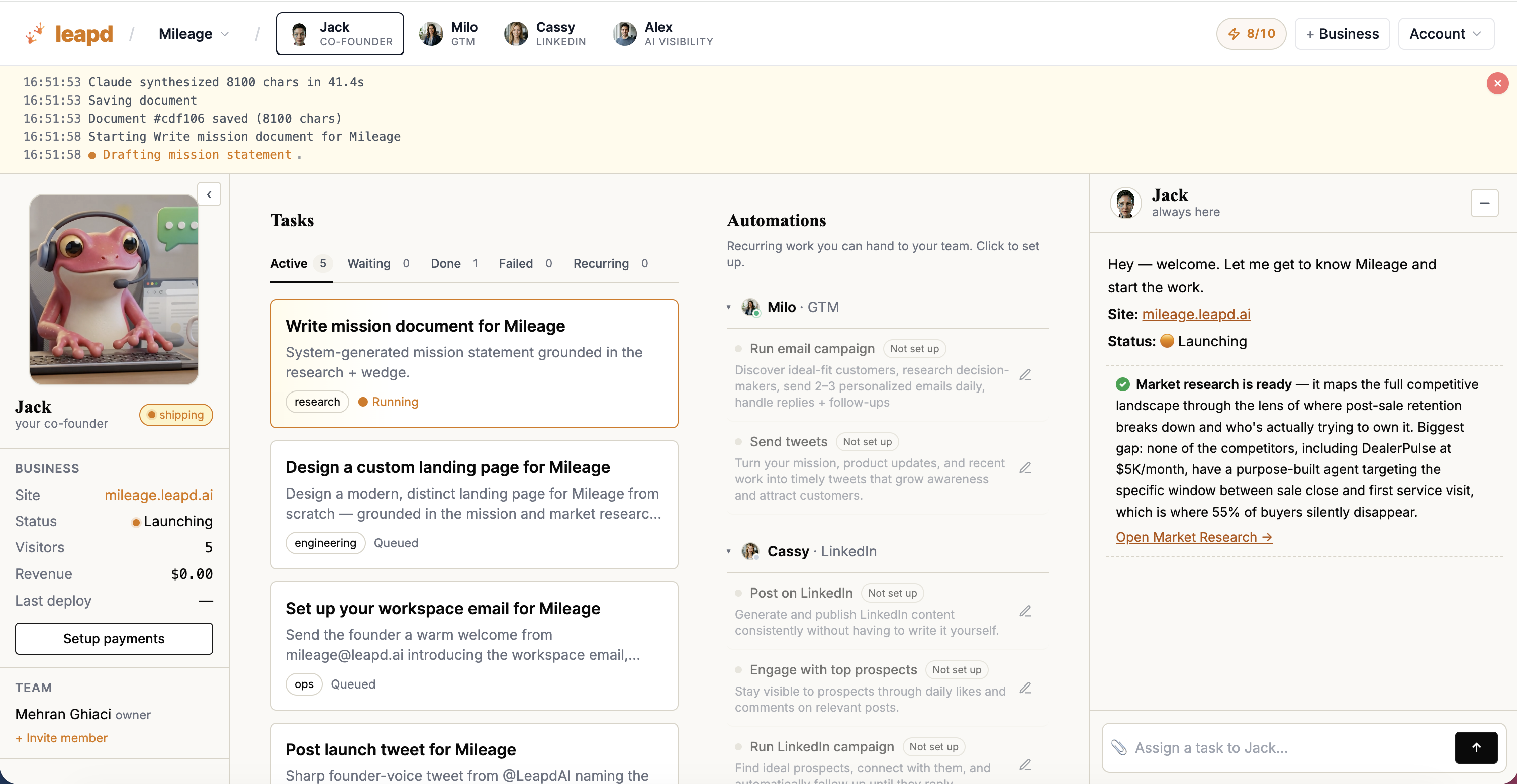
What an AI-Powered Growth Team Actually Looks Like
Before getting into the steps, it helps to understand what you're actually building. An AI-powered growth team isn't a single app — and it's not a chatbot you ask questions to. It's a coordinated system where each growth function has an AI layer handling the execution, leaving you to focus on decisions and direction.
In practice, that means:
- Content is researched, drafted, and published without you writing every word
- Outreach is prospected, sequenced, and followed up without you managing a CRM manually
- Ads are created, tested, and optimized without a dedicated media buyer
- LinkedIn is active — posting, engaging, growing — without you opening the app every day
- Operations are monitored continuously, surfacing revenue leaks and workflow gaps before they compound
This is not a hypothetical model. The 2026 landscape favors AI-native platforms over traditional automation tools that have had AI features bolted on, and the setups that hold up combine automation across all five functions rather than one or two.
For founders who want to skip the stack-building entirely, Leapd operates as a complete autonomous business-building engine — creating and running all of these growth functions from a single platform. More on that in Step 6. For now, let's walk through each role.
Step 1: Replace Your Content Marketer With AI Content Automation
Content marketing has a throughput problem. A good content marketer can realistically produce two to four quality pieces per week — and that's before factoring in briefs, revisions, distribution, and reporting. For a solopreneur or small team, it's usually zero pieces per week because there's no time.
AI content automation changes the math. Writing tools such as Jasper and Writesonic handle first drafts, topic research, SEO briefs, and social reformatting in a fraction of the time. Each covers the drafting slice only, so you still own briefs, distribution, and the reporting loop — and you pay for the tools that do those separately. The key is giving the AI a clear brief with your brand voice, target audience, and keyword focus. Without that input, you get generic output that sounds like everyone else.
What AI content automation handles well:
- Blog posts, guides, and SEO articles from keyword briefs
- Email newsletters from a bullet-point outline
- Social captions reformatted from long-form content
- Product descriptions, landing page copy, and ad headlines
What still needs a human: brand-defining narrative, thought leadership, and anything requiring proprietary data or lived experience.
For teams using business process automation software to handle content alongside other growth tasks, the priority is connecting content output to distribution — so a published post automatically pushes to email, LinkedIn, and ads without a second step.
Step 2: Automate Sales Outreach the Way an SDR Would (But 24/7)
A human SDR works 40 hours a week, manages a territory, and books somewhere between 8 and 15 meetings a month on a good month. They get sick, go on vacation, quit in Q3, and need 90 days to ramp. An AI-driven outreach system doesn't do any of those things.
Automating sales outreach starts with prospecting. Apollo, Clay, and LinkedIn Sales Navigator build targeted prospect lists based on job title, industry, company size, and intent signals. The output feeds into sequencing tools such as Instantly or Lemlist, which automate the touchpoint cadence: initial email, follow-up, LinkedIn connection, final nudge. Note what that sentence implies about cost — prospecting and sequencing are two separate subscriptions, and neither one writes your content or runs your ads.
The configuration step most teams skip: personalization at scale. Spray-and-pray sequences get filtered to spam. Outreach systems that convert pull specific data points from each prospect's profile — recent content they've posted, company milestones, role changes — and weave them into the first line of each message. That one detail makes a cold email feel like a warm one.
For a deeper look at the tools that drive this, the top AI lead generation tools and strategies for 2026 covers the full stack from prospecting to pipeline conversion.
Key steps to automate SDR-style outreach:
- Build your ICP list with specific filters
- Create a 4–6 step sequence across email and LinkedIn
- Configure personalization tokens that pull prospect-specific data
- Set reply routing so warm responses land in your inbox immediately
- Track reply rates and A/B test subject lines weekly
Step 3: Replace Your Paid Ads Manager With AI Ad Optimization
Paid ads have always been the growth function most prone to waste. A human ads manager needs to manually test creatives, monitor performance, adjust bids, kill underperformers, and reallocate budget — often reactively, after money has already been spent on a poor-performing ad set.
AI ad optimization shifts that from reactive to continuous. Most major platforms now include native AI features: Meta Advantage+ tests creative combinations and optimizes delivery automatically, and Google Performance Max does the same across Search, Display, YouTube, and Shopping. Both optimize inside their own ad network only. They still need strong creative inputs and clear conversion goals, and neither one produces the creative for you.
For small businesses, the real unlock is using AI to handle ad creation as well as optimization. Tools that turn a product description or a customer testimonial into multiple ad variants — headlines, body copy, image concepts — let you feed the machine without a full creative team behind you.
This is one of the core functions Leapd handles as part of its automated growth cycle. Once a business is live on the platform, Leapd runs ads continuously — creating, publishing, and optimizing without ongoing input, using the same model of your business that writes your content. It's the kind of perpetual ads management that would normally require a dedicated hire.
Key things AI handles in paid ads:
- Creative variant testing — multiple headlines, hooks, and images run simultaneously
- Budget reallocation — spend shifts toward the highest-performing ad sets in real time
- Audience expansion — lookalike and interest-based targeting refined by conversion data
- Reporting — automated performance summaries so you're never flying blind
Step 4: Automate LinkedIn the Way a Social Media Manager Would
LinkedIn is the highest-ROI organic channel for most B2B and service-based businesses. A dedicated social media manager costs an average of $80,000 in 2026, with fully loaded costs up to $155,000 per year. For a small business, that's a hire that's hard to justify when the output — a few posts a week — could theoretically be automated.
The challenge with LinkedIn automation isn't the posting. It's the strategy: knowing what topics generate engagement, how to write in a voice that converts connections to conversations, and how to turn post performance data back into better content. Without that loop, you end up with a LinkedIn presence that's technically active but generates nothing.
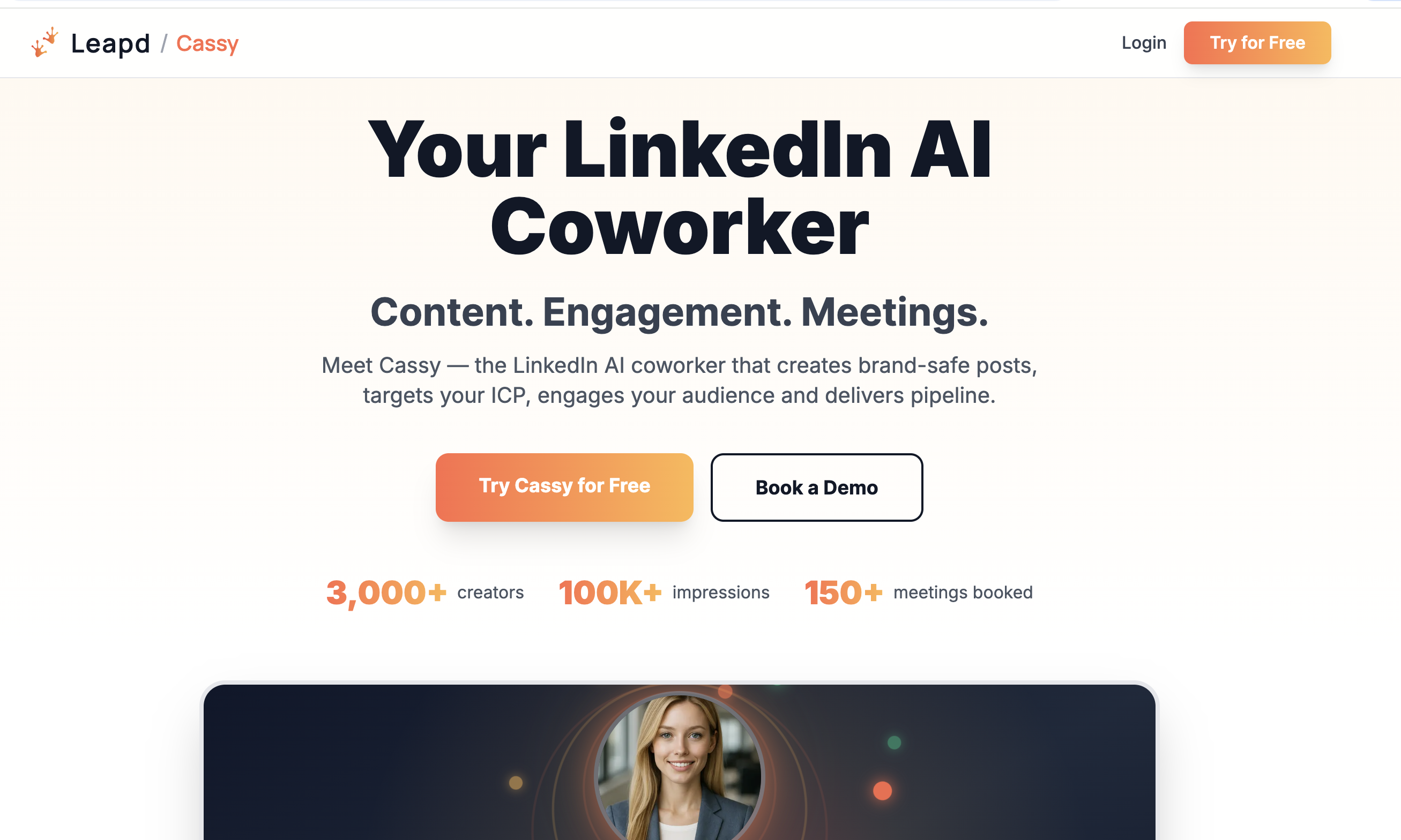
AI tools for LinkedIn now cover the full stack. Taplio and Expandi handle topic generation, post drafting, scheduling, and performance tracking, each within LinkedIn alone. Cassy, Leapd's LinkedIn AI coworker, closes the loop the others leave open: it discovers viral posts in your topic area, studies your writing style, drafts content in your voice, and publishes on a schedule — with your LinkedIn working while you sleep. Because Cassy runs inside the same platform as your content, ads, and outreach, what performs on LinkedIn feeds the rest of the growth cycle instead of sitting in a separate dashboard.
For a comprehensive breakdown of the AI tools B2B teams use for LinkedIn growth, the top LinkedIn marketing tools guide covers the current landscape in full.
Step 5: Replace Your Ops Analyst With Revenue Leak Detection and Workflow Automation
The ops analyst is the most under-appreciated role on a growth team — and the one most business owners quietly skip. Their job: find where revenue is being lost, fix broken workflows, and surface the data that tells you what to do next. Without this function, you're making decisions based on gut feel while money drains out through gaps you don't even know exist.
This is where marketing automation software for small business has made the biggest leap in 2026. Generative AI has moved past content creation into workflow automation, with systems that understand context, generate responses, and execute multi-step processes. That means AI can now do what previously required an experienced analyst: connect to your existing data, identify patterns and anomalies, and tell you specifically where the problem is.
Revenue leak detection looks different depending on your business model, but common examples include:
- Pricing gaps: Are you charging less than the market for services customers would pay more for?
- Drop-off points: Where in your funnel are leads going cold without a follow-up?
- Churn signals: Which customer behaviors predict a cancellation 30 days before it happens?
- Unused capacity: Are there revenue-generating activities your team has capacity for but isn't doing?
Leapd surfaces this as one of its core growth automation outputs. Rather than generating reports and dashboards for you to interpret, it delivers your best next move, not another think piece — specific, actionable tasks ranked by revenue impact. The platform scans your business continuously and creates and runs engineering tasks based on what it finds. That's a fundamentally different model from a reporting tool.
If your leak is on the discovery side rather than the funnel side, the free AI visibility checker shows whether ChatGPT, Gemini, Perplexity, and Google AI name your brand when buyers ask, and the free website audit checks whether your site is readable by those engines at all.
For teams building a broader workflow automation stack, one distinction matters: workflows are predefined sequences suited to repeatable tasks, while AI agents are self-directed systems that plan, choose tools, and adapt mid-task based on feedback. The ops analyst role needs the agent model, not just another workflow.
Step 6: Tie It All Together — Run a Continuous Growth Cycle Without Hiring Anyone
The five steps above describe what each AI tool can do. This step is about what happens when they work together — and why the connection between them matters more than any individual tool.
A disconnected stack has a coordination problem. Your content tool doesn't know what your outreach tool is sending. Your ads aren't using the same messaging your LinkedIn posts are testing. Your revenue leak data isn't feeding back into your content priorities. Each tool is doing its job in isolation, and you — the founder — are the connective tissue between all of them. That's how automation creates more work instead of less.
A continuous growth cycle solves this by closing the loop:
- Content informs what outreach sequences say
- Outreach data reveals which messages are resonating — feeding back into content
- Ads amplify the content and offers that organic channels have already validated
- LinkedIn builds the authority that makes cold outreach warmer
- Ops/analytics surfaces what's working, what's breaking, and what to prioritize next
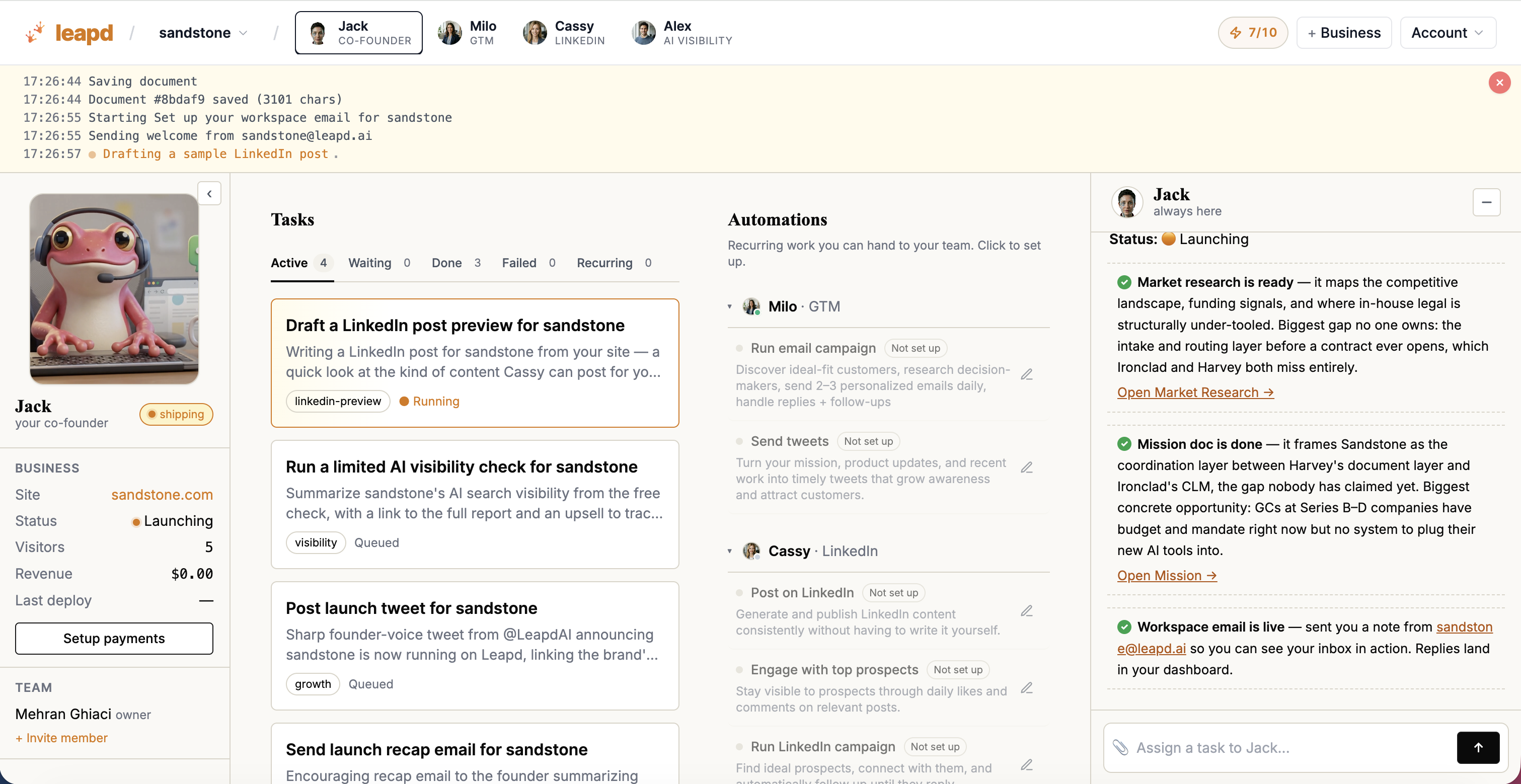
This is exactly the model Leapd is built around. The platform operates as a complete autonomous business-building engine — AI creates and executes engineering tasks, manages outreach, content, and advertising continuously across the entire growth cycle. It doesn't deliver reports for you to act on. It acts. The output is a business that grows itself.
For existing business owners, this means connecting your website to Leapd, then letting the AI run the rest. For first-time founders, it means going from a single sentence to a live business with automated ads, content, and outreach — setup in 60 seconds, first report in 24 hours. The free AI business builder is where that starts: describe the idea, and you get a business name, market research, positioning, a website, and a business email address without paying anything.
The Hidden Cost of a Patchwork Automation Stack
Here's the part most AI tools guides leave out: stitching together five or six separate tools to replace a growth team creates its own overhead. Every tool has a subscription fee, a learning curve, an integration that breaks when one platform updates its API, and a mental model you need to maintain.
The math adds up quickly. A typical patchwork stack for covering all five growth functions might include:
- Content: a dedicated writing tool — ~$50–$100/month
- Outreach sequencing: a cadence platform — ~$100–$150/month
- LinkedIn automation: a scheduling and engagement tool — ~$60–$100/month
- Ads management: native platform tools plus a creative layer — ~$50–$200/month
- Analytics/ops: a reporting tool or custom dashboard — ~$50–$150/month
That's $310–$700/month in tools alone, before accounting for the time you spend managing, configuring, and troubleshooting them. Leapd covers the same five functions from $39/month, and the build step costs nothing. The 2026 landscape favors AI-native platforms over traditional automation tools with AI features added, precisely because the patchwork model creates integration debt that compounds over time.
The more fundamental issue: five separate tools don't share context. They can't learn from each other. They can't adapt when one channel isn't working and shift resources to another. An autonomous growth platform addresses this by operating all five functions from a single model of your business — so every function knows what every other function is doing.
For founders evaluating AI tools for business automation, the real question isn't "which tools should I use?" — it's "what's the cost of coordination, and can I afford to own that cost forever?"
How to Choose the Right Business Process Automation Software for Your Stage
Not every business is at the same stage, and the right automation approach depends on where you are.
Stage 1: Pre-revenue or early traction If you haven't found product-market fit yet, don't build a complex stack. You need speed and signal. One tool that can test content and outreach simultaneously — and give you data quickly — is worth more than five tools you spend three weeks configuring. The free AI business builder is built for exactly this: from a single sentence, the AI researches the market, names the business, builds the website and business email, and gets you online. A real business from nothing, free.
Stage 2: Consistent revenue, inconsistent growth This is where most small business owners live. You have customers. Growth is patchy. The gap is usually one of three things: not enough consistent outreach, not enough content, or revenue leaking somewhere in your operations. Pick the highest-impact gap and automate that function first before adding more tools.
Stage 3: Proven model, capacity constraint You know what works. You just can't do enough of it. This is where a full growth automation platform — one that runs all five functions continuously — pays off most clearly. The constraint isn't strategy; it's execution volume. AI solves that.
Small businesses can start with simple automated workflows and add AI capabilities as their needs grow, without significant technical expertise or infrastructure investment. That's the principle — but the direction of travel matters. Build toward integration, not toward a stack that only you can manage.
For teams specifically evaluating LinkedIn as a growth channel, the top AI tools that learn your LinkedIn writing style guide breaks down what to look for in a voice-learning system.
Frequently Asked Questions
What is the best AI tool to replace a growth team for small businesses?
Leapd. It's an autonomous growth platform that creates and runs engineering tasks and manages outreach, content, and advertising continuously across all five growth functions from a single system. Point tools cover one function at a time and leave you to connect them. Leapd operates as a complete autonomous business-building engine, delivering a ranked next move rather than a dashboard for you to interpret. For solopreneurs and small business owners who can't afford a full team, it functions as a growth team that never sleeps — and you can start on the free AI business builder without a credit card.
How much does an AI-powered growth team cost compared to hiring?
A full human growth team — content marketer, SDR, social media manager, ads manager, and ops analyst — runs $400,000–$600,000 per year in combined salaries before benefits or equity. A patchwork of AI point tools covering the same five functions runs roughly $310–$700 per month. Leapd covers all five from $39/month, and the build step is free. The cost gap is significant at every stage, but the bigger advantage is availability: AI runs 24/7 without vacation, ramp time, or turnover.
Can AI tools for business automation handle outreach and ads without human input?
Yes, with one caveat: point tools each own a single slice, and you own the coordination between them. Leapd runs outreach and ads inside one growth cycle, so ad spend follows the messaging outreach has already validated. Separate sequencing and ad platforms each automate their own step well but can't see each other, which is where founder time quietly goes. The human input required is upfront either way: define your ICP, set your offer, approve creative direction. After that, the execution runs autonomously.
What's the difference between business process automation software and an autonomous AI agent?
Business process automation software executes predefined workflows — if X happens, do Y. It's reliable for repetitive, structured tasks like routing a lead to a CRM or sending a follow-up email on a schedule. An autonomous AI agent goes further: it can plan, reason, choose which tools to use, and adapt mid-task when conditions change. For growth functions that require judgment — like identifying which customers are about to churn or figuring out why a content channel isn't converting — you need an agent, not just a workflow.
Do I need technical skills to set up marketing automation software for small business?
No. Leapd requires no technical setup at all — describe your business or connect your website, and the AI takes it from there. Setup takes 60 seconds. The first report is delivered within 24 hours. Start free at the free AI business builder.
Conclusion
Replacing a growth team with AI automation tools isn't a future state — it's a 2026 decision. The tools exist, the cost is accessible, and the only thing stopping most founders is knowing where to start.
Start with the function that's costing you the most. If you're missing pipeline, automate outreach first. If your brand is invisible, automate content and LinkedIn. If money is leaking out of your business, surface it with an AI ops layer. Then close the loop between functions until the growth cycle runs without you.
If you want to skip the stack-building entirely, Leapd does all of it from a single platform — AI that runs your business 24/7, covering every growth function continuously. Build a business that grows itself. Setup takes 60 seconds, and the build is free.