Why Buying LinkedIn Followers Kills Your Personal Brand in 2026
Why You Shouldn't Buy LinkedIn Followers: The Hidden Cost of a Vanity Number
You're a founder, consultant, or sales professional. Your LinkedIn profile is not a social media hobby — it's your pipeline. Every connection is a potential client. Every post is a chance to start a conversation that ends in a booked meeting. Your LinkedIn account, built over years, is one of the most valuable business assets you own.
So when a service promises 5,000 new followers for $50, it's easy to see the appeal. A bigger number looks credible. A larger audience signals authority. And in a world where social proof drives decisions, follower count feels like a shortcut to legitimacy.
But here's the problem: buying LinkedIn followers doesn't just fail to deliver on that promise. In 2026, it actively destroys the very thing you're trying to build.
This isn't a moral argument. It's a mechanical one. LinkedIn's algorithm, its detection systems, and the B2B professionals scrolling your profile all work in ways that make purchased followers a liability — not an asset. The result is suppressed organic reach, poisoned analytics, damaged credibility with the exact buyers you want to impress, and real risk of losing the account entirely.
For anyone serious about LinkedIn content strategy and turning their presence into pipeline, understanding exactly how this works is the difference between building something that compounds and throwing money at a number that collapses.
How to Buy LinkedIn Followers: What You're Actually Purchasing (And Why It Backfires)
Before we explain why this is a terrible idea, let's be clear about what buying LinkedIn followers actually means and how the process works — because understanding the mechanics makes the risks impossible to ignore.
How to Buy LinkedIn Followers Step by Step
The process is disturbingly simple. First, you search for "buy LinkedIn followers" and choose from dozens of providers offering packages from $30 for a few hundred followers to $210 for 5,000. Most sites look legitimate — polished landing pages, payment processors, even customer support chat.
Next, you select a package. Some services offer options to buy LinkedIn followers for business page accounts, while others target personal profiles. The distinction matters: business pages face fewer immediate detection risks but generate even less engagement value since algorithm prioritization for company pages is already lower.
Then you provide your profile information. The lowest-risk version requires only your public profile URL. The highest-risk — and you should never do this — asks for login credentials, which is an immediate security threat and often a precursor to account takeover or data harvesting.
Finally, the service delivers followers over several days using "drip-feed delivery" to avoid detection. You'll see your count rise gradually. What you won't see is a single meaningful interaction, profile visit from your ICP, or booked meeting.
The same providers often upsell adjacent services: buy LinkedIn likes to inflate post performance, buy LinkedIn comments to fake engagement, buy LinkedIn skills endorsements, buy LinkedIn endorsements from fake profiles, and even buy LinkedIn recommendations written by bots. All carry the same core problem: they're visible signals with zero substance behind them, and both the algorithm and your prospects can tell.
What Happens When You Buy LinkedIn Followers (The Actual Mechanics)
When you purchase LinkedIn followers, you're not buying an audience. You're buying entries in a database.
The followers delivered by third-party services fall into three categories. The first is outright fake accounts — profiles created solely to fulfill orders, with no real person behind them, no professional history, and no activity beyond following you. The second is bot networks — automated accounts that follow on command and occasionally generate hollow engagement like generic comments or emoji reactions. The third — the category providers market most aggressively — is real but completely irrelevant accounts: actual LinkedIn users in unrelated industries, geographies, or job functions who have been incentivized to follow profiles they'll never engage with again.
In every case, the outcome is the same: zero interest in your content, zero alignment with your ICP, and zero business value.
Buy LinkedIn Followers for Business Page vs Personal Profile: Does It Matter?
It's also worth distinguishing between buying followers for a LinkedIn business page versus a personal profile, because the risk profile and outcome differ slightly.
When you buy LinkedIn followers for a business page, detection risk is somewhat lower since company pages naturally attract more varied follower sources. However, the business value is even worse. LinkedIn's algorithm already deprioritizes company page content compared to personal profiles — meaning even legitimate followers see your posts less often. Add fake followers into that mix, and your content essentially becomes invisible. If your goal is brand awareness or lead generation, a business page with fake followers is among the least effective investments you can make.
When you buy LinkedIn followers for a personal profile, you face higher detection risk because behavioral patterns are more tightly monitored, but the engagement penalty is equally severe. Your personal posts get buried, your credibility with real connections takes a hit, and your account suspension risk increases with every new fake follower added.
There's also the distinction between buying followers and buying connections. Followers see your content but aren't 1st-degree connections. Buying connections — paying to establish mutual 1st-level connections — is even riskier because LinkedIn detects the pattern of many connections accepted in a short window from similar account types far more easily. Both practices violate LinkedIn's User Agreement. Both generate zero business value. But buying LinkedIn connections tends to trigger faster enforcement action.
Risks of Buying LinkedIn Followers: How LinkedIn's Algorithm Punishes Fake Followers in Real Time
Most articles tell you that buying followers hurts your engagement rate. What they don't explain is the exact mechanism — and why it's far more damaging than a lower percentage on a dashboard.
LinkedIn's content distribution system operates in three stages, and understanding them explains why fake followers don't just sit there harmlessly inflating your count.
Stage 1 — Initial Classification (0–60 minutes): When you publish a post, LinkedIn's algorithm immediately evaluates it for quality and spam indicators, then assigns it a test audience drawn from your followers and connections. If your follower base is heavily inflated with fake or inactive accounts, this test audience includes a disproportionate number of profiles that will never interact with anything.
Stage 2 — Engagement Testing (1–2 hours): This is the critical window. LinkedIn measures how quickly your test audience engages. Comments carry twice the weight of likes in this scoring. Dwell time — how long people pause on your post — also factors in. Substantive comments of ten words or more generate double the algorithmic signal of short reactions. If your 1,500 purchased followers produce silence during this window, LinkedIn's system reads your content as low-value and low-relevance. The algorithm doesn't know those followers are fake. It just sees a large audience that doesn't care.
Stage 3 — Extended Distribution (2+ hours): Posts that perform well in Stage 2 get distributed to second and third-degree connections, wider topic feeds, and out-of-network professionals. Posts that underperform get deprioritized. Yours, dragged down by the dead weight of non-engaging fake followers, gets buried — including with the real followers who would have genuinely engaged.
The concrete result: a profile with 2,000 followers where 1,500 are purchased can expect its posts to reach approximately 50–100 real people, with an engagement rate of 0.2–0.5%. The algorithm doesn't just punish the fake followers — it penalizes the whole account. Your genuine connections see less of you than they would if you had 500 real followers and no fake ones.
Beyond algorithmic suppression, LinkedIn's detection capabilities have become significantly more sophisticated. The platform now analyzes follower velocity (how fast you gained followers), geographic inconsistencies (a UK-based consultant suddenly followed by 3,000 accounts from Southeast Asia), and behavioral patterns (accounts that follow dozens of profiles per day without any other platform activity). Sudden follower spikes without corresponding engagement are immediate red flags. Once detected, LinkedIn may silently limit your reach or automatically remove the fake followers — leaving you with the cost, the risk, and none of the illusory benefit.
5 Ways Buying Followers Destroys Your Personal Brand in 2026
1. Your Account — and Years of Pipeline — Can Disappear Overnight
Buying LinkedIn followers isn't just ineffective — it directly violates LinkedIn's User Agreement. The platform can and does act on this, with consequences that escalate from a temporary restriction on a first offense to account suspension and even a permanent ban for repeated or large-scale violations.
For most professionals, a LinkedIn account is far more than a social profile. It's years of curated connections, DM conversations with prospects, introductions from mutual contacts, and a content archive that has built reputation over time. Losing it doesn't just mean starting over on a platform — it means losing your entire professional address book and potentially years of relationship-building that supported your pipeline. The risk-to-reward ratio here is not even close.
2. Fake Followers Tank Your Reach With Real People
This is the counterintuitive reality that trips up most people who consider buying followers. The assumption is that fake followers sit passively in the count without affecting anything real. The opposite is true.
As Stage 2 of LinkedIn's distribution system makes clear, your engagement rate is calculated against your total follower base. This is one of the clearest reasons why you shouldn't buy LinkedIn followers — the fake accounts in your audience actively harm your performance with real prospects. A post that earns 40 genuine likes and 10 real comments looks like a strong performer if you have 500 followers. That same post looks like a failure if you have 5,000 followers — most of them fake. The algorithm responds accordingly, restricting distribution to the real people in your network who would have actually engaged. You end up with less reach to real prospects than you would have had without the fake followers at all.
3. Your Analytics Become Worthless — So Does Your Strategy
A credible LinkedIn content creator builds their strategy on data: which post formats resonate, which topics generate comments from their ICP, which hooks stop the scroll. That feedback loop is how content compounds over time.
Buy followers and that feedback loop breaks. You can no longer tell whether a post underperformed because the topic missed, the format was wrong, or the hook was weak — or whether it underperformed because 60% of your audience is bots that responded to nothing. Your analytics become noise. Every optimization decision you make on top of that noise takes you further from what actually works with your real ICP. You're essentially navigating with a broken compass.
4. It Signals Inauthenticity to the People You Most Want to Impress
Savvy B2B buyers, senior decision-makers, and potential partners do not just look at your follower count. They look at the relationship between your follower count and your engagement. A profile with 12,000 followers and an average of four comments per post raises an immediate question: where is the audience?
In high-trust B2B sales, credibility is built on consistency and authenticity. A disconnected engagement-to-follower ratio is a recognizable pattern to anyone who has spent time on the platform — and this is exactly how people can tell if you buy LinkedIn followers. It doesn't necessarily announce "bought followers" explicitly — but it signals something is off, and that doubt is often enough to cost you the benefit of the doubt in a first impression. The people you most want to impress are precisely the ones most likely to notice.
5. You Trap Yourself in an Expensive, Endless Cycle
LinkedIn continuously removes fake accounts through automated detection. This means the followers you paid for start disappearing within days or weeks of purchase. To maintain even the illusion of a larger following, you have to keep buying — at $180–$210 per 5,000 followers, every few months, indefinitely.
Meanwhile, the underlying problem doesn't improve. Your reach stays suppressed. Your analytics stay corrupted. And your account risk accumulates with every new purchase. It's an investment that generates negative compounding: the more you spend, the worse the structural problems get. Compare that to a single month of consistent, ICP-targeted content — which can continue driving profile visits and leads months after it was posted.
How to Grow on LinkedIn Without Buying Followers: What Actually Works
The alternative to buying followers isn't working harder. It's working with a system that makes authentic growth efficient. Here's what the data and the algorithm actually reward in 2026.
Optimize Your Profile as an ICP Conversion Machine
Your LinkedIn profile is not a resume. For sustainable LinkedIn growth and B2B lead generation on LinkedIn, it functions as a landing page — and it should be optimized for the person you want to book a meeting with, not the recruiter you're trying to impress.
Start with your headline. Rather than your job title, lead with the outcome you deliver for your ICP: the problem you solve, the result you create, the transformation you enable. Your summary section should speak directly to your ideal customer's pain points — using the language they use to describe their own challenges. Your featured section should showcase your best-performing content and a direct path to a conversation: a booking link, a lead magnet, or a case study.
Keywords matter here too. LinkedIn's internal search surfaces profiles based on the terms in your headline and summary. If your ICP searches for "B2B demand generation" or "SaaS go-to-market strategy" and those phrases appear naturally in your profile, you become discoverable to exactly the right people — without a single dollar spent on fake followers.
Publish Content That Attracts Your Ideal Customer, Not Just Followers
LinkedIn's algorithm evaluates every post on three ranking signals: Relevance (how closely the content matches a defined audience's interests), Expertise (whether the post demonstrates genuine subject matter knowledge), and Engagement (whether it sparks meaningful comments from people who interact with this topic). All three require knowing your ICP deeply — not just what they do, but what they're worried about, what they debate, and what would make them stop scrolling.
In 2026, the formats delivering the highest engagement are native documents (carousel posts) at an average 7% engagement rate, followed by text posts — up 12% year-over-year — and images. Multi-image posts consistently generate the highest impressions for profiles with under 50K followers. The common thread across all high-performing formats is original insight: data, perspective, or experience that professionals in your niche can't get elsewhere.
For a LinkedIn content creation tools strategy built around these formats, the goal is to match your message to the structure that amplifies it. A data-driven insight works well as a text post with a strong hook. A step-by-step process works as a carousel document. A contrarian take works as a standalone text post designed to generate comments. Understanding which format serves which goal is what separates a b2b content personalization approach from generic posting.
LinkedIn Content Tools That Actually Help You Grow
Rather than paying for fake followers, invest in tools that help you create better content and distribute it more effectively. A linkedin post generator that understands your ICP and voice — like Cassy — can surface what's trending in your niche and generate posts tailored to those formats automatically. A linkedin headline generator helps you optimize the most-viewed part of your profile for search and conversions. A linkedin summary generator can rewrite your About section to speak directly to your ideal customer's pain points instead of reading like a resume.
For visual content, a linkedin carousel generator or carousel maker lets you turn long-form insights into swipeable documents that earn 7% average engagement. If you're repurposing video content, a linkedin video downloader can help you save and re-edit clips for reuse. And if you want feedback before you publish, linkedin profile feedback tools and services can audit your profile against best practices and competitor benchmarks.
These tools don't inflate vanity metrics. They help you build the substance that attracts real followers who actually engage.
Build Engagement Loops That Signal Authority to the Algorithm
One of the most underused growth levers on LinkedIn is what happens before and after you post, not just the post itself. As a social media engagement tool strategy, this is where most creators leave algorithmic reach on the table.
Comments count twice as much as likes in LinkedIn's scoring. Substantive comments — those with ten or more words — generate double the algorithmic signal of short reactions. This means your goal is not just views; it's conversations. Posts with thoughtful questions at the end receive up to 50% more comments than statements. Ending your post with a genuine, specific question directed at your ICP is one of the fastest ways to improve distribution.
Engagement reciprocity also matters. Spending 10–15 minutes engaging meaningfully with posts in your niche immediately before publishing your own — sending thoughtful connection requests to people who comment on posts in your industry, for example — signals to LinkedIn's system that you are an active, relevant participant in a topic area. This increases the initial audience size the algorithm assigns to your post in Stage 1. Think of it as warming the room before you speak.
For teams trying to scale this, employee advocacy tools and employee generated content programs can amplify reach without buying followers. The best employee advocacy tools 2026 make it easy for your team to share, comment on, and amplify your content — generating authentic engagement signals that the algorithm rewards. Audience engagement platforms and linkedin engagement tool features built into tools like Cassy help systematize this rhythm so it happens consistently, not just when you remember.
If you're building outbound alongside content, pairing your LinkedIn presence with a lead finder tool helps you identify and engage the right prospects as they interact with your posts — turning content into pipeline rather than just impressions. This is the legitimate alternative to inflating a follower number: a structured linkedin prospecting motion that captures real engagers, qualifies them against your ICP, and routes the qualified subset into a personalized linkedin outreach sequence — converting authentic audience into actual conversations.
Use a Content System — Not Sporadic Posting
Organic LinkedIn growth compounds slowly but powerfully. A post published today — if it resonates with the algorithm and generates engagement — can continue driving profile visits and inbound leads weeks or months after publication. LinkedIn prioritizes relevance over recency, meaning high-quality evergreen content can resurface long after it was originally posted.
But compounding only works if the inputs are consistent. A week of great content followed by three weeks of silence doesn't compound — it resets. The profiles that build real audiences and real pipeline in 2026 treat LinkedIn like a publishing operation: a content calendar, optimal posting times based on when their ICP is active, and a feedback loop from analytics that informs the next cycle.
This is where a social media scheduler built for LinkedIn becomes a strategic asset rather than a convenience. A linkedin post scheduling tool eliminates the friction that causes inconsistency — the "I'll post later today" that becomes next week. For agencies managing multiple client profiles, a social media scheduler for agencies with LinkedIn analytics and performance tracking closes the loop between what gets posted and what gets results.
Some users also look for a linkedin post booster to artificially amplify reach, but this typically falls into the same category as buying followers — short-term visibility with long-term algorithmic penalties. Instead, focus on tools that help you create content worth boosting organically: the kind your audience shares, comments on, and remembers.
The goal is to create a month of content in 10 minutes — then let the system handle distribution while you focus on conversations and conversions.
How Leapd's Cassy Builds the Authentic LinkedIn Presence That Actually Books Meetings
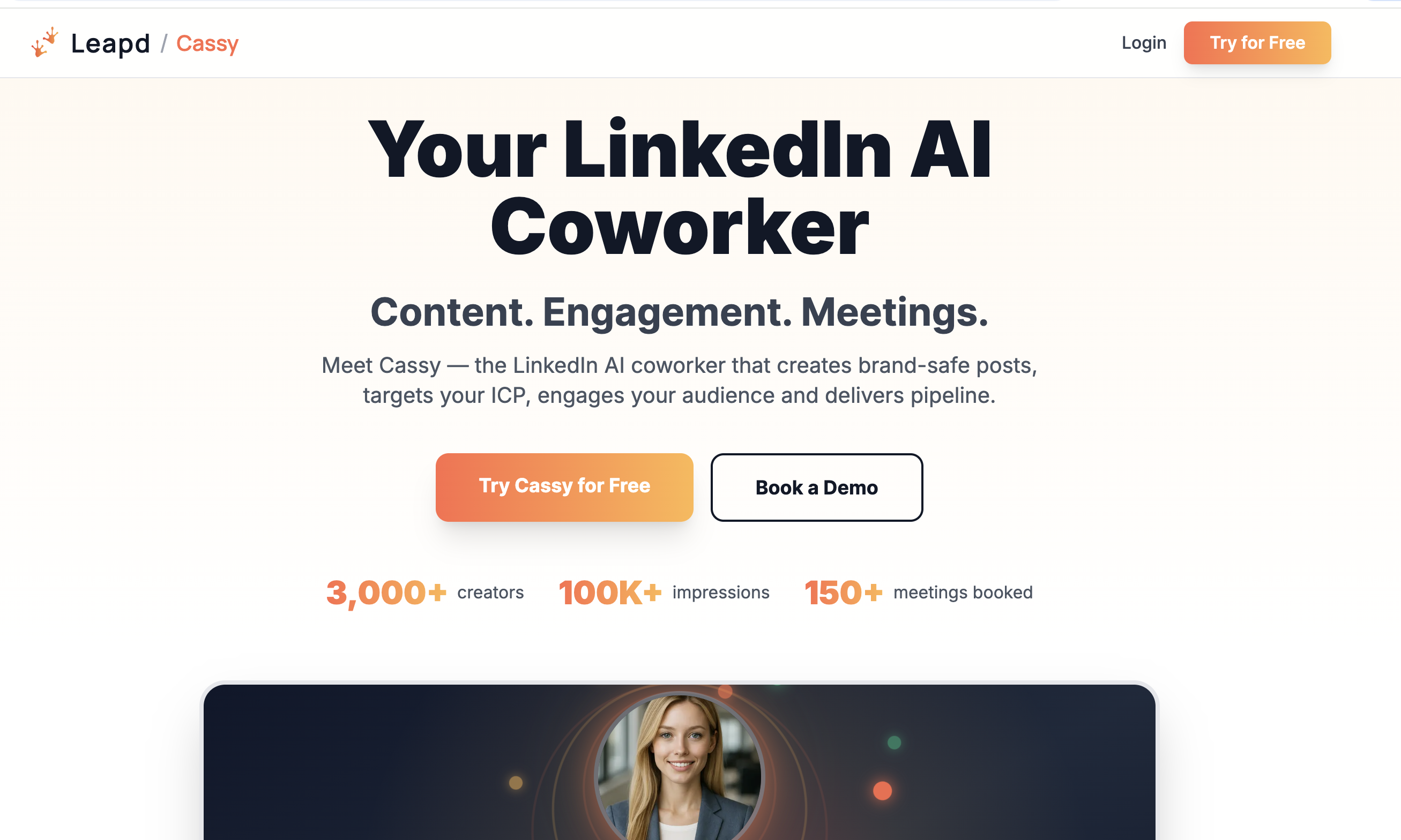
Most tools help you post. Cassy helps you convert.
That distinction matters more than it might first appear. There is no shortage of ai for social media posts, schedulers, and caption generators. What's rare is a tool built from the ground up around a single question: what does this person's ICP need to see and hear in order to book a meeting?
Cassy — Leapd's LinkedIn AI coworker — is the answer that founders, consultants, and sales professionals using it have found. It works through a structured workflow that begins before a single post is written. Cassy ingests your brand documentation, learns your voice, and conducts deep research on your ICP and industry trends before generating any content. The result is posts that don't just sound like you — they speak directly to the problems your ideal customers are actively trying to solve.
This is ai content personalization at a depth that generic tools don't reach. Where most ai post writer tools work from a prompt or a template, Cassy learns from your brand guidelines, sample posts, tone of voice definitions, and ICP documentation — then adapts over time as you refine and react to outputs. It's the difference between a tool that generates content and an AI coworker that understands your business.
The practical feature set translates that positioning into workflow:
Viral Post Generator & Repurposing: Cassy surfaces posts that are trending in your niche in real time. Found something that's performing? Cassy rewrites it in your voice while preserving the structure and hook that made it work — the "magic that made it work," in the platform's own words. This is how you stay ahead of trends without spending hours on manual research.
URL & Docs → Posts: Drop a YouTube link, a PDF, a blog post URL, or a Reddit thread. Cassy converts any content source into an engaging LinkedIn post in your voice. This is particularly powerful for founders and consultants with a body of existing IP — proposals, case studies, thought leadership documents — that has never been repurposed for LinkedIn.
AI Images: One-click custom visual generation means every post can have a brand-consistent image without a designer or a stock photo library. No design skills required.
Idea Generator: Multiple angles and hooks from a single topic. When you're staring at a blank composer, the idea generator gives you four different directions to take a post — so you pick the angle most likely to resonate with your ICP that week.
Smart Scheduling & Analytics: Post at the best time to post on LinkedIn for your audience and track engagement, reach, and ROI in a single dashboard. Performance analytics close the feedback loop — you can see what content drove profile visits, what generated inbound messages, and what formats your specific audience responds to most.
Multi-Account Management: Agencies and teams managing multiple LinkedIn profiles get this built in. The Agency plan at $59/month supports unlimited LinkedIn accounts with client management and invites — a capability that typically costs significantly more as an add-on elsewhere. The Pro plan at $39/month includes multiple LinkedIn accounts for individual creators juggling a personal brand alongside a company page.
All of this is accessible through a natural conversational interface. You assign tasks to Cassy the way you'd brief a team member: "Find viral posts in my niche and create a week of content." She handles the research, the drafting, and the scheduling. For anyone serious about b2b lead generation strategies on LinkedIn, that's the difference between LinkedIn as a time sink and LinkedIn as a pipeline engine. Content. Engagement. Meetings.
Cassy is built as a LinkedIn GTM coworker — content, engagement, and pipeline in one workspace. Beyond drafting, Cassy tracks the profiles and topics that matter to your pipeline (investors, target prospects, customers, hot industry conversations), drafts comments in your voice on the high-signal posts those people are publishing, and executes bulk-approved engagement actions within LinkedIn's safe limits. Compared to standalone ai social media post generator tools, social media engagement tools, and disconnected content personalization tools — each requiring its own subscription — Cassy folds them into a single workspace. The team workspace lets founders, executives, sales reps, and marketers plan from one shared calendar, turning ten people posting in isolation into one coordinated b2b lead generation linkedin motion. For deeper comparisons, see Cassy vs Taplio, Cassy vs Outx, Cassy vs Trigify, and Cassy vs PhantomBuster.
The Prospects agent extends the same workflow into qualified pipeline. Cassy extracts everyone interacting with the topics and profiles you watch, qualifies them against criteria you define per list (sales ICP, investor profile, partner profile), and hands you ready prospects with reasoning — what they engaged with, why they qualify, suggested talking points. Built for teams running a serious linkedin lead generation or linkedin prospecting motion: the qualified list flows into your existing linkedin outreach stack (Apollo, Instantly, Lemlist) or CRM. On the engagement side, the same agent lifts your linkedin engagement rate by drafting on-brand comments in your voice that you bulk-approve in one click — Cassy executes the linkedin auto comment workflow within LinkedIn's safe limits.
Frequently Asked Questions About Buying LinkedIn Followers
Is buying LinkedIn followers against the rules?
Yes. LinkedIn's User Agreement explicitly prohibits artificially inflating follower counts, buying connections, or using automated means to gain followers. Violating these terms gives LinkedIn authority to restrict your account's reach, issue a temporary suspension, or permanently ban the account entirely. The platform considers this a serious violation — not a minor terms technicality — and enforcement has become more consistent as detection capabilities have improved.
Can people tell if you buy LinkedIn followers?
Yes. Both LinkedIn's automated systems and experienced users can tell. LinkedIn's detection systems analyze multiple signals simultaneously: follower velocity (how quickly your count grew), geographic inconsistencies between your profile and your new followers, engagement ratio anomalies (large audience, near-zero engagement), and behavioral patterns of the accounts that followed you — often originating from fake accounts and click farms. Sudden follower spikes without corresponding engagement are immediate red flags. Once detected, LinkedIn may silently limit your reach or automatically remove the fake followers — often without notifying you.
Will buying LinkedIn followers help me get more clients?
No. Purchased followers don't engage with your content, aren't your target buyers, and generate zero business value. They're not decision-makers in companies that could buy your product or service — they're not even real people interested in your industry. Because they depress your engagement rate, they actively reduce the reach of your content to the real prospects who might have become clients. Buying followers is, at best, a zero-ROI investment. Given the algorithmic and account-suspension risks, it's more accurately described as a negative-ROI one.
How many LinkedIn followers do you need to generate B2B leads?
Fewer than most people assume. Five hundred qualified, ICP-matched followers who genuinely engage with your content will generate more pipeline than 10,000 ghost followers who never interact. LinkedIn's algorithm distributes content based on engagement quality, not follower count — so a smaller, highly engaged audience creates more reach and more inbound conversations than a large, inactive one. Focus on follower quality and ICP alignment, not raw numbers.
How long does it take to grow LinkedIn followers organically?
With consistent, quality posting, most professionals see meaningful organic growth within three to six months. Reaching 500 qualified connections can happen in as little as three months with a focused strategy: optimized profile, regular ICP-targeted content, and active engagement. AI-assisted linkedin content creation tools like Cassy compress that timeline significantly by eliminating the research and writing bottleneck that causes most people to post inconsistently.
What's the fastest legitimate way to grow on LinkedIn?
The fastest legitimate growth comes from a combination of three things working together: ICP-targeted content published consistently (at least three to four times per week), meaningful engagement with others in your niche immediately before and after posting, and systematic repurposing of your best-performing content. Think of it as personal branding through consistent value delivery rather than vanity metrics. Tools that automate the research, generation, and scheduling steps — while preserving your authentic voice — make this sustainable at scale. The goal is a linkedin content strategy that runs like a system, not a creative sprint that burns out after two weeks.
Your LinkedIn Audience Should Work as Hard as You Do
Follower count is a vanity metric. An ICP-matched, engaged audience that knows what you do, believes you can help them, and has been primed to take a meeting — that's a business asset.
Every follower you buy moves you further from that asset. They dilute your engagement rate, suppress your reach, corrupt your analytics, and put the account you've spent years building at real risk. In 2026, with LinkedIn's AI-driven moderation detecting artificial growth more reliably than ever, the downside is no longer theoretical.
The professionals building real pipeline on LinkedIn are doing it the same way they always have — with content that earns attention because it says something worth hearing, to the right people, consistently. The difference in 2026 is that AI has made that process dramatically faster and more precise.
Cassy by Leapd starts free — no credit card required. It learns your brand voice, researches your ICP, surfaces what's trending in your niche, and turns that into a week of scheduled, personalized content in minutes. The Prospects agent then qualifies the people who actually engage with that content — the opposite of a purchased follower — and hands you a real linkedin lead generation list ready for your CRM or outbound stack. Not followers. Pipeline.
Most tools help you post. Cassy helps you convert.