10 Best No-Code Tools for First-Time Founders to Get Customers in 2026
Why First-Time Founders Need No-Code Tools to Get Customers (Not Just Build Products)
Most no-code lists give you tools to build — Bubble to spin up an app, Airtable to manage data, Webflow to design a website. That's useful. But building is the easy part. Getting your first customer is the hard part.
First-time founders lose months setting up tech stacks that look impressive and convert nobody. They spend weeks building a landing page instead of finding someone to buy. They configure workflows instead of talking to prospects.
The no-code tools that actually move the needle at zero stage aren't just builders — they're customer acquisition tools. Landing pages that capture emails. Forms that qualify leads. Chatbots that engage visitors at 2 AM. Automation that follows up without you touching it. Email sequences that nurture the curious into the committed.
The right stack of no-code tools for lead generation turns a founder's limited time into a customer acquisition system — one that runs while they're sleeping, working, or building the next thing. Taken to its logical end, that's what an AI-run business is: a company where AI handles the daily work of getting and serving customers, not just the setup.
This list is organized around that goal. Not "what can I build," but "what gets me customers fast." Some are free. Some cost less than lunch per month. All are no-code. And one — listed first — is a full AI co-founder that handles the entire customer acquisition cycle without you piecing together a stack at all.
How We Chose These No-Code Customer Acquisition Tools
Every tool on this list was evaluated against three founder-specific criteria:
Speed to first result. How quickly can a non-technical founder go from signup to capturing their first lead? Tools that require a week of setup don't make the cut.
Customer acquisition focus. Does this tool help you get customers, or just manage them? We prioritized tools that sit at the top of the funnel — attracting visitors, capturing leads, converting interest, and automating follow-up.
Value at zero stage. Free plans, low monthly costs, and no credit card requirements matter when you're pre-revenue. We flagged real limitations on free tiers — including where they've quietly shrunk.
Pricing is current as of July 2026. Always verify on each tool's official pricing page before committing.
1. Leapd: Best AI Co-founder for Founders Who Want to Build, Launch, and Get Customers Automatically
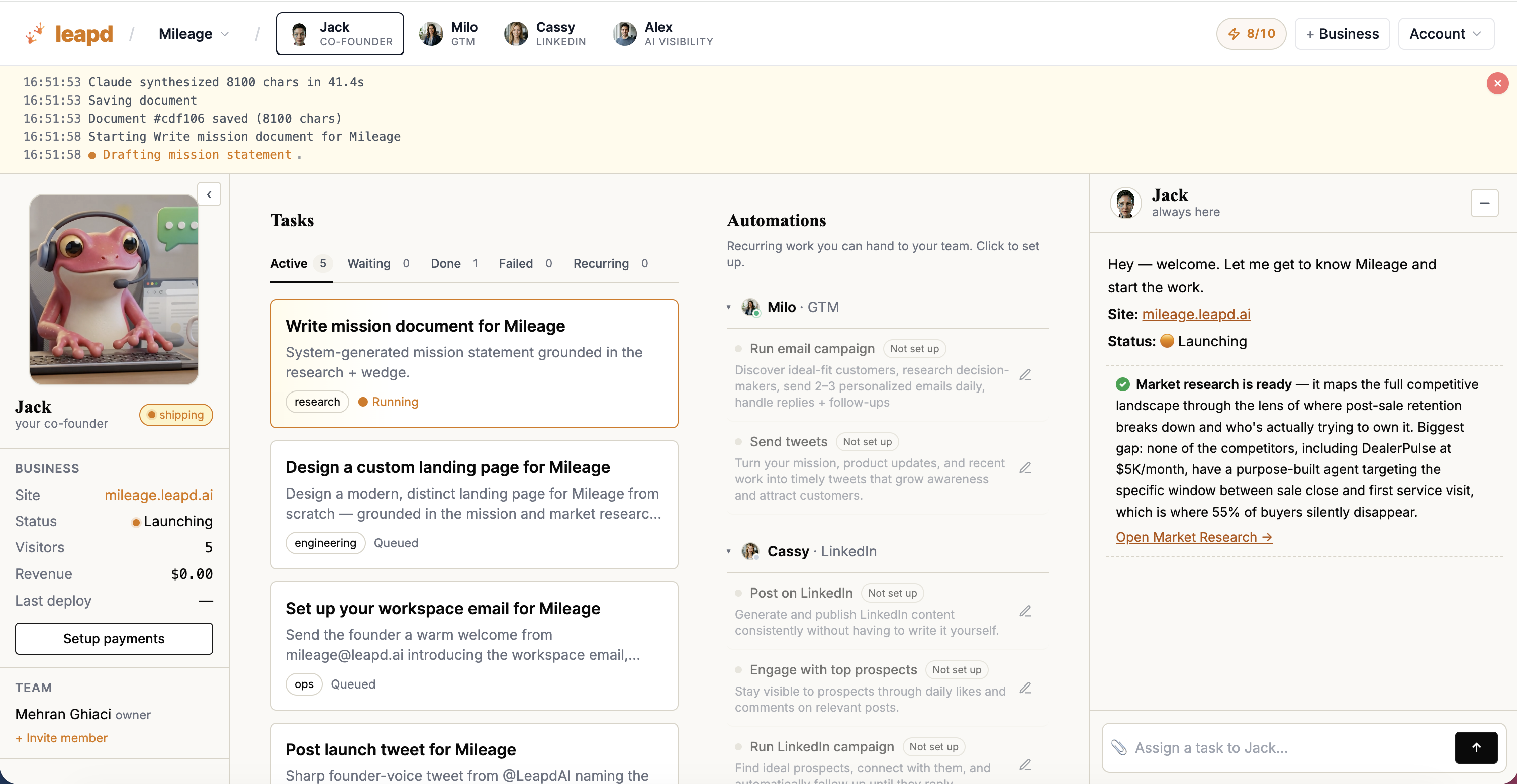
Pricing: $39/month — buy more credits as top-ups when you need more volume. No credit card required to start. First report in 24 hours.
Every other tool on this list solves one part of the customer acquisition problem. Leapd solves all of it.
Type one sentence — your business idea — and Leapd's autonomous AI agents research the market, write the mission, build the product, and start acquiring your first customers. Within about 10 minutes you have a full website and application live — a real Next.js frontend and backend, fully customizable, and structured from the first commit to rank in both Google and AI search (SEO and AEO). Wire in Stripe payments in minutes, and you have a fully functional, revenue-ready business up and running in under an hour. Hundreds of businesses run on Leapd today.
Once the business is live, the AI doesn't stop. This is AI that runs your business — 24/7: an AI co-founder in the most literal sense, commanding a full team of specialist agents that run growth the way a staffed company would.
Engineering that keeps shipping. New features, fixes, and pages deployed continuously to your live product — a real application your customers log into and pay for, improved every single day.
Paid ads and outbound, on autopilot. The GTM agent finds your exact buyers and reveals their verified work emails — no stale lists, no bounce-scrubbing — then sends personalized cold outreach in your voice and follows up automatically. It also generates scroll-stopping Meta video ads straight from your page, builds the audience and budget itself, launches on your approval, and tracks and optimizes spend daily.
A LinkedIn machine, not a posting tool. The LinkedIn AI coworker writes posts trained on your own voice, joins the exact conversations your buyers are in, extracts and enriches every engager, qualifies them against your buyer criteria, runs warm outreach, and books meetings directly to your calendar. Across Leapd customers it tracks 2.3M+ LinkedIn signals daily, has qualified 180K+ buyers, and booked 14K+ meetings — and on its own it replaces the ~$530/month stack most teams duct-tape together out of content schedulers, engagement tools, prospect extractors, enrichment, outreach sequencers, and signal trackers.
AI search, owned. Over 100 million people ask AI for recommendations every day, and Leapd's AI visibility agent makes sure you're the answer: it tracks how every major AI assistant talks about your brand across seven platforms, audits your site the way LLMs actually read it, maps the real prompts your buyers ask, and publishes 4,000-word, schema-marked, citation-rich articles built to get you cited inside AI answers. Customers have gone from 8% to 82% AI visibility in three weeks. Test your own brand right now with the free AI visibility checker.
That's what makes Leapd different from every other tool on this list: it covers the full business lifecycle — build, launch, market, grow — across every channel that matters. Other no-code platforms give you a hammer. Leapd gives you the entire construction crew — without the payroll.
If you're weighing Leapd against AI app builders, the difference is where they stop. Lovable, Replit, Bolt, and Emergent build you a product — then leave you alone with the hard part: getting customers. Leapd builds the product and wins the customers — and if you've already shipped an app on one of those platforms, Leapd takes it over and runs the entire business around it. See the head-to-head breakdowns: Leapd vs Lovable, Leapd vs Replit, Leapd vs Bolt, and Leapd vs Emergent.
What you get from a single sentence:
- Market research, mission, and positioning — no brief, no template, no setup wizard
- Full website and application live in under 10 minutes — customizable Next.js frontend and backend, built for SEO and AEO
- Stripe payments wired in minutes, so you charge real customers from day one
- First customers acquired by the AI — ads, outreach, LinkedIn, and AI search all working in parallel
- Revenue leak detection for existing businesses
- Client transcript to testable offer conversion
For existing business owners, Leapd's growth automation mode operates as your growth team that never sleeps — surfacing your best next move, not another think piece, and executing it without a meeting.
Real businesses launched through Leapd include UGC Spark (AI-produced video ads), ClearPath (field-service AI bidding), Ergana (self-running marketing), and hundreds more — each live, running, and acquiring customers autonomously. The State of AI-Run Businesses 2026 report tracks how companies like these actually perform once AI takes over daily operations.
And you stay in control the whole time. Leapd makes the calls a co-founder makes, but never makes a risky move without your yes — ad spend, outreach batches, anything public waits for your approval. Every morning you get a plain-English brief: what was built, which customers came in, and what needs a decision. Redirect, pause, or approve in one reply.
For founders who want to build a business that grows itself, there's nothing comparable. Build your business →
2. Carrd: Best No-Code Landing Page Builder for Launching in Under an Hour
Pricing: Free (up to 3 sites on carrd.co subdomain) · Pro Standard: $19/year · Pro Plus: $49/year
If you need a landing page live today — not next week — Carrd is where you start. It's a no-code landing page builder that does exactly one thing: build clean, responsive single-page sites fast. No bloat, no monthly fee, no developer required.
The drag-and-drop builder creates professional-looking pages in under an hour. Most founders can publish their first Carrd site before the afternoon. The $19/year Pro Standard plan — which works out to roughly $1.58 a month — unlocks custom domains, email signup forms connected to Mailchimp, analytics integration, and the ability to build more than three sites.
What founders use it for:
- Email capture pages to validate demand before building anything
- "Book a call" pages for service businesses
- Pre-launch "coming soon" pages to collect a waitlist
- Campaign-specific landing pages for cold outreach
The trade-off is real: Carrd is strictly single-page. No multi-page site, no built-in A/B testing, no analytics beyond Google Analytics passthrough. If you need a full website with a blog, you'll outgrow it quickly. But for a founder who needs to test whether anyone will pay attention before spending two weeks building something more complex, Carrd is the fastest way from idea to live URL.
At $19/year, it costs less than a single month on almost any competing landing page tool — and the conversion math often favors simple, focused pages anyway. Fewer distractions, clearer call to action, higher signup rates.
3. Typeform: Best for Conversational Lead Capture That Feels Human
Pricing: Free (10 responses/month) · Basic: $29/month (100 responses/month) · Plus: $59/month
Most contact forms feel like a tax return. Typeform feels like a conversation — and that gap in experience drives a measurable gap in completion rates.
Typeform's conversational interface shows one question at a time, uses conditional logic (Question Branching) to skip irrelevant fields, and can route respondents to different follow-up questions based on answers. For a first-time founder, this means a lead qualification form that actually gets filled out — rather than a 10-field static form that 70% of visitors abandon.
Key features for founders:
- No-code form creation with 20+ question types
- Logic jumps that personalize the experience per respondent
- Direct integrations with HubSpot, Mailchimp, Google Sheets, Zapier, Salesforce, and Slack
- AI-powered Question Branching for adaptive flows
- Embed on any Carrd or Webflow page
The free plan allows 10 responses per month — useful for testing a form's design, but not for actual lead generation at volume. The Basic plan at $29/month gives 100 responses and removes branding. For a pre-revenue founder, that's a reasonable cost if your form is qualifying leads you'd otherwise spend hours vetting manually.
The limitation: Typeform's response caps can get expensive fast if you're running high-traffic campaigns. At volume, the Growth Plans start at $199/month — a significant jump. For high-volume lead gen, pair a Typeform-style experience with a higher-capacity tool or route overflow to a simpler form.
4. HubSpot CRM: Best Free No-Code CRM for Managing and Nurturing Early Leads
Pricing: Free CRM (unlimited contacts) · Starter: $15/seat/month
Once leads start coming in, you need somewhere to put them that isn't a spreadsheet. HubSpot CRM is the no-code CRM that most first-time founders eventually land on — and for good reason: the free tier is genuinely useful, not a stripped-down trial.
HubSpot's free plan gives you unlimited contacts, a deal pipeline, email tracking, meeting scheduling links, and 10 reporting dashboards. For a founder managing their first 50 to 200 prospects, this is more than enough to run a real sales process without paying anything.
Why it works for founders specifically:
- Contact, deal, and task management in one dashboard
- Integrates natively with Typeform, Mailchimp, Zapier, Gmail, and Outlook — all the tools in this stack
- Email sequences to automate follow-up without coding
- Meeting scheduler that syncs with your calendar (no back-and-forth email threads)
- Mobile app for managing leads on the go
HubSpot is especially valuable as the connective tissue of your customer acquisition stack. When a Typeform lead comes in, it can automatically create a HubSpot contact and trigger a follow-up sequence. When a Carrd visitor signs up, it feeds directly into your HubSpot pipeline. The free plan supports this kind of marketing automation software for small business without requiring any technical setup.
The limitation worth knowing: as your contact list grows, HubSpot's paid tiers scale steeply. The $15/seat/month Starter plan is manageable; the Professional and Enterprise tiers can reach thousands per month. Start free, use it heavily, and only upgrade when you actually need the features that require it.
5. Mailchimp: Best Email Marketing Automation for Founders on a Zero Budget
Pricing: Free (250 contacts, 500 emails/month — automation requires paid plan) · Essentials: $13/month · Standard: $20/month
Email remains the highest-ROI marketing channel for most small businesses, and Mailchimp is the starting point most founders reach for first. It's beginner-friendly, has 350+ email templates, and integrates with virtually everything else in this stack.
But there's an important caveat in 2026: Mailchimp's free plan has been progressively reduced since Intuit acquired the company in 2021. The current free tier caps you at 250 contacts and 500 emails per month — and automation was removed from the free tier entirely in June 2025. That means you can design a welcome sequence on the free plan, but you can't actually run it without upgrading.
For founders, the real entry point is the Essentials plan at $13/month, which unlocks:
- Email scheduling (critical — you want emails going out at 9 AM, not whenever you're awake)
- A/B testing on subject lines
- All 100+ email templates
- Basic automated journeys (welcome sequence, thank-you emails)
The Standard plan at $20/month adds full marketing automation flows with branching logic, send-time optimization using AI, and predictive segmentation. This is where email marketing automation software for small business genuinely starts earning its cost back — Mailchimp's data shows Standard plan users generate 27x ROI on e-commerce campaigns.
If your initial list is under 250 contacts and you're sending manually while you figure out your messaging, the free plan works as a starting point. But plan to move to Essentials quickly — the lack of automation on the free tier means you're doing follow-up manually, which defeats the purpose.
6. Zapier: Best No-Code Workflow Automation to Connect Your Entire Customer Stack
Pricing: Free (100 tasks/month, 5 Zaps) · Starter: ~$19.99/month · Professional: ~$49/month
None of the other tools on this list talk to each other automatically — unless you use Zapier. Zapier is the no-code workflow automation platform that stitches your customer acquisition stack into a single system, eliminating the manual data transfer that eats founders' hours.
The core mechanic is simple: a trigger in one app causes an action in another. A Typeform submission triggers a new HubSpot contact creation. A new HubSpot contact triggers a Mailchimp welcome email. A LinkedIn Lead Gen Form fill triggers a Slack notification and a CRM entry — all without you touching anything.
Common founder workflows on Zapier:
- Lead generation: Form submission → Add to CRM → Send welcome email → Schedule follow-up
- Outreach: New LinkedIn lead → Create HubSpot deal → Notify via Slack
- Content: Publish blog post → Share to social → Email subscribers
- Customer service: New form ticket → Assign task → Send acknowledgment
Zapier connects over 6,000 apps. Small businesses using Zapier's automation platform typically save 10–20 hours per week on manual data transfer and repetitive administrative tasks, according to Zapier's own data.
The free tier's 100 tasks per month sounds reasonable until your stack gets active — a 50-lead week at three steps per lead chews through it fast. The $19.99/month Starter plan gives you multi-step Zaps and significantly higher task limits, which is where business process automation software becomes genuinely useful for a growing operation.
Zapier's limitation: it requires some logic setup — you need to know what triggers what. It's not hard, but it's also not as instant as Leapd's autonomous agent model, where the AI designs and runs the workflows for you without configuration.
7. Webflow: Best No-Code Website Builder for Founders Who Want Brand-Level Design Without an Agency
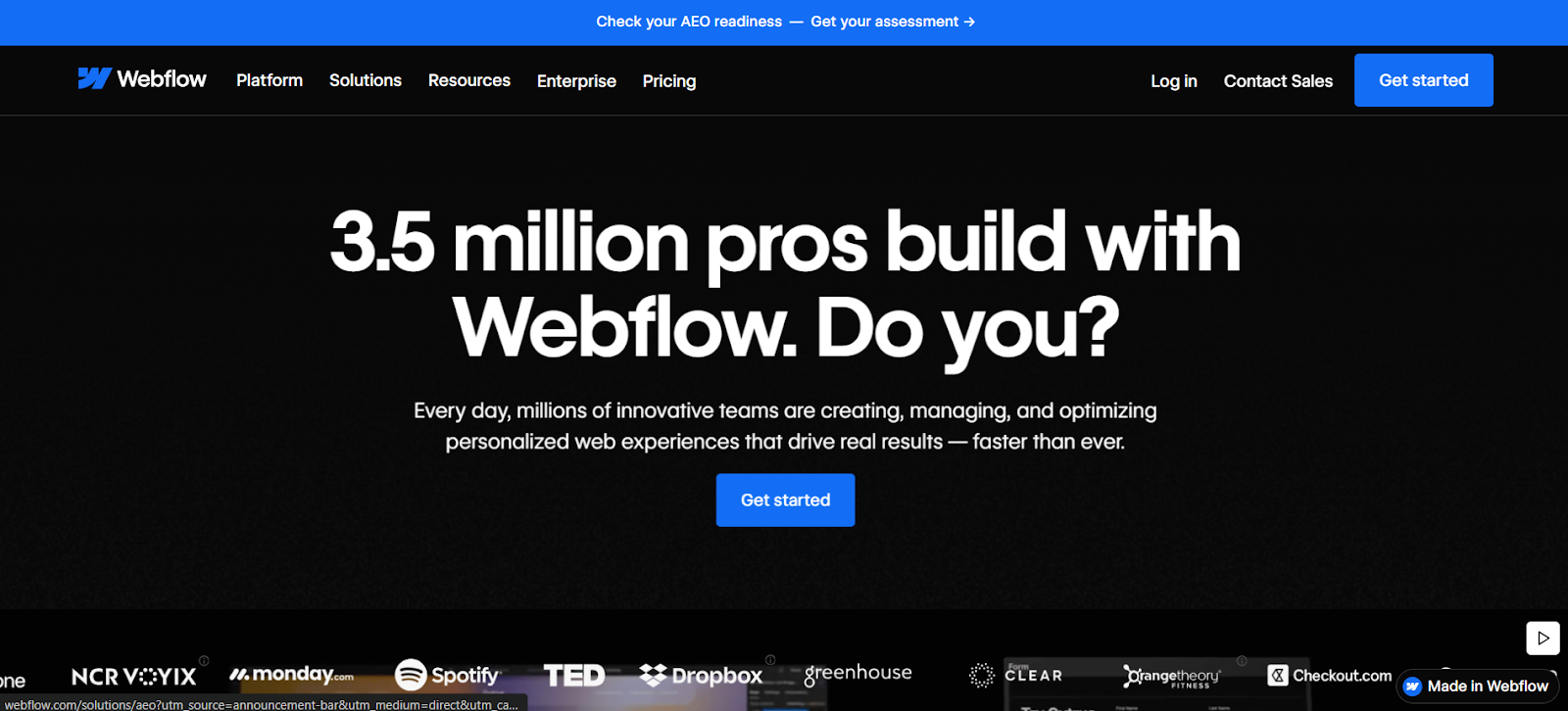
Pricing: Free (Webflow subdomain) · Basic: $14/month · CMS: $23/month · Business: $39/month
When you need more than a one-page Carrd site — a full website, a blog for content marketing, a portfolio — Webflow is the no-code website builder that produces agency-quality results without the agency price tag or the developer dependency.
Webflow sits at the intersection of design flexibility and marketing power. You get a visual canvas with precise pixel control, a built-in CMS for content marketing, SEO optimization tools, and the ability to connect to your entire marketing stack via integrations. Over 3.5 million professionals build on Webflow, from indie founders to major startup teams.
Why founders choose Webflow over simpler builders:
- Full design control — responsive layouts, custom animations, no template lock-in
- Built-in CMS lets you publish blog posts and landing pages without a developer
- SEO tools built into the editor (custom meta, Open Graph, schema, sitemap)
- Integrates with Mailchimp, HubSpot, Zapier, and the rest of this stack
- Major startups use Webflow for landing pages and microsites to iterate fast without queuing a dev sprint
One thing worth knowing before you invest in content on any website: search is changing. AI assistants increasingly answer buying questions directly, and where they pull their answers from determines who gets discovered — here's how ChatGPT, Google AI Overviews, and Perplexity source information in 2026. If you're publishing content to get found, it's worth tracking how visible you are in those answers; we've rounded up the 25 best tools for AI search rank tracking and visibility.
The limitation is the learning curve. Webflow is not a 30-minute project — getting genuinely comfortable with it takes days. For founders who need a website live this week, Carrd is the better starting move. Webflow rewards the investment with a site that scales as you grow, can handle content marketing at volume, and never looks like a template.
On the marketing automation front, Webflow pairs naturally with Mailchimp for email signups and HubSpot for CRM capture — making it a strong home base for an outbound-and-inbound customer acquisition strategy.
8. Tidio: Best No-Code Chatbot for Capturing Leads While You Sleep
Pricing: Free (limited conversations) · Starter: $29/month · AI (Lyro) add-on billed separately
A prospect lands on your pricing page at 2 AM, browses for three minutes, and leaves. Static forms don't catch them. A chatbot does.
Tidio is an all-in-one no-code chatbot and live chat platform built for small businesses that want to capture and qualify website visitors automatically, without a support team standing by. Its visual flow builder lets you create conversation sequences — triggered by page visits, exit intent, or specific behaviors — in minutes with drag-and-drop, no code required.
Tidio's AI engine, Lyro, handles up to 70% of common inquiries automatically, collecting contact information and qualifying intent before routing to a human when genuinely needed. The Shopify integration is particularly strong for e-commerce founders, with built-in cart-recovery flows and product recommendations.
What Tidio does for customer acquisition:
- Proactive visitor engagement triggers messages based on page behavior and exit intent
- Pre-chat lead capture forms collect name, email, and intent before the conversation starts
- AI chatbot flows run 24/7 — no human monitoring needed
- Captured leads sync automatically with HubSpot, Salesforce, and Pipedrive
- Multi-channel inbox combines website chat, Messenger, and Instagram into one dashboard
For a first-time founder, Tidio's most practical use is a simple "what brings you here today?" flow that captures emails from interested visitors who'd otherwise bounce without leaving a trace. Set it up once, and it generates leads passively in the background as a core part of your no-code sales funnel.
The limitation: Tidio's free plan caps conversation volume, and the Lyro AI features are priced as add-ons. At $29/month for the Starter plan, it's a reasonable investment if you have consistent site traffic. Under 500 visitors per month, focus on driving traffic first.
9. LinkedIn Lead Gen Forms: Best No-Code B2B Outreach Tool for First-Time Founders
Pricing: Requires LinkedIn Campaign Manager (ad spend) · No additional software cost
For B2B founders, LinkedIn is where your customers already are. LinkedIn Lead Gen Forms simplify the process of capturing high-quality leads by automatically pre-populating contact and profile information when a member clicks the call-to-action button on your ad — name, email, job title, company, all pulled from their LinkedIn profile without them typing a word.
This removes the biggest friction point in B2B lead capture: the landing page form. Members don't have to leave LinkedIn, don't have to type their details, and don't have to trust your brand enough to give accurate information. Conversion rates on LinkedIn Lead Gen Forms consistently outperform traffic-to-landing-page flows for B2B audiences.
Why first-time founders use this over a standard website form:
- No landing page needed — the form lives inside LinkedIn's native interface
- Pre-filled data is accurate and verified (it's from the member's own profile)
- Targeting by job title, seniority, industry, company size, and geography
- Lead data downloads directly from Campaign Manager or syncs automatically via Make or Zapier to your CRM
The limitation is cost: LinkedIn advertising is expensive relative to other channels. A realistic B2B campaign requires meaningful daily ad spend to generate leads at volume — this isn't a zero-dollar channel. But for a founder targeting a specific job title at specific company types, the precision of LinkedIn's targeting and the quality of pre-populated lead data justifies the spend in a way that broad-audience ad platforms can't match.
Pair LinkedIn Lead Gen Forms with Make (below) to automatically push captured leads into HubSpot the moment they fill the form — no manual CSV download required. And if LinkedIn is your main channel, go deeper with our roundups of the top 10 LinkedIn marketing tools B2B teams actually use in 2026 and the 15 best AI lead generation tools and strategies.
10. Make (formerly Integromat): Best Advanced No-Code Automation for Founders Ready to Scale Their Marketing
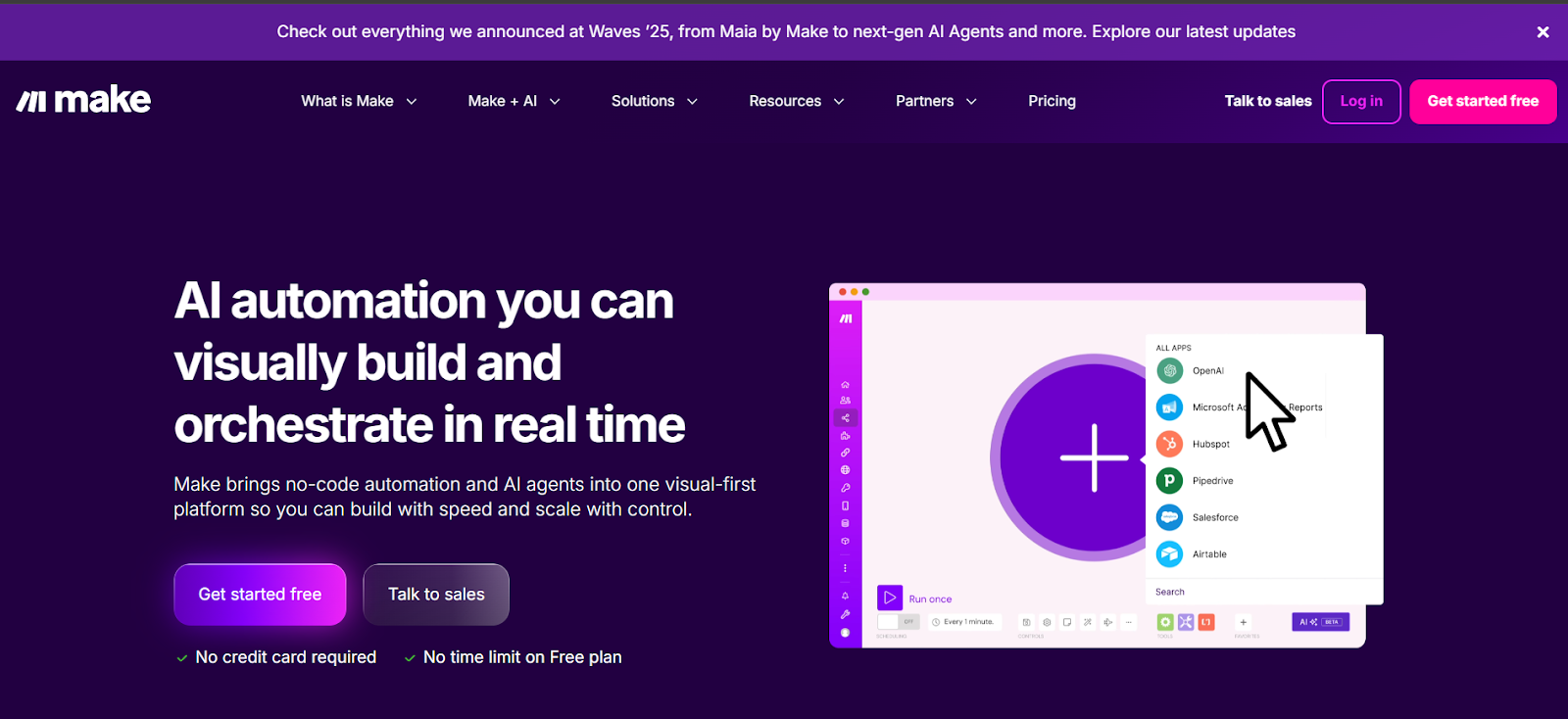
Pricing: Free (1,000 operations/month) · Core: ~$10.59/month · Pro: ~$18.82/month
Zapier is the right starting point for most founders. Make (formerly Integromat) is where you graduate when your workflows get complex and Zapier's pricing starts to bite.
Make uses a visual canvas where you literally see your automation as a flowchart — nodes connecting apps, data flowing between them in real time. This visual approach makes it easier to debug and modify complex, multi-step automations than Zapier's linear structure allows. Make also processes data inside the scenario itself — filtering, formatting, transforming — without needing a separate step.
Where Make outperforms Zapier for founders:
- More operations per dollar — Make's free plan gives 1,000 operations vs. Zapier's 100 tasks
- Visual scenario builder makes complex branching logic easier to manage
- LinkedIn Lead Gen Forms integration routes new leads directly to HubSpot, Mailchimp, or a Google Sheet in real time — no manual CSV export
- Data transformation inside workflows reduces the need for extra steps
- Connect 1,500+ apps including the full customer acquisition stack above
A practical Make scenario for a first-time B2B founder: LinkedIn Lead Gen Form filled → create HubSpot contact → add to Mailchimp sequence → send Slack notification → create follow-up task in HubSpot. Five steps, zero manual work, runs the moment the form is submitted.
For founders using AI tools for business automation and wanting more control over complex marketing workflows than Zapier's simpler interface provides, Make is the natural upgrade. The free plan's 1,000 monthly operations is genuinely usable for an early-stage stack, and the Core plan at ~$10.59/month covers most pre-scale needs.
How to Stack These No-Code Tools Into a Customer Acquisition System That Runs Itself
Used individually, each tool on this list solves one problem. Stacked together, they form a no-code marketing automation system that captures, nurtures, and converts leads without constant manual input.
Here's a practical four-layer stack for a first-time founder:
Layer 1 — Attract and Capture
- Carrd or Webflow landing page drives visitors to a single offer
- Typeform qualifies interested visitors with a conversational form
- Tidio chatbot captures the ones who browse without filling the form
Layer 2 — Organize and Track
- HubSpot CRM receives all leads from Typeform, Tidio, and LinkedIn Lead Gen Forms
- Every contact tagged by source, so you know what's working
Layer 3 — Nurture and Follow Up
- Mailchimp sends automated email sequences to each new HubSpot contact by segment
- LinkedIn Lead Gen Forms targets specific job titles with B2B offers
Layer 4 — Automate the Connections
- Zapier or Make routes data between all layers without manual intervention
Total monthly cost for this stack: roughly $50–$100, depending on the tiers you choose. That's marketing automation software for small business at a price any pre-revenue founder can justify.
Alternatively: skip all four layers and use Leapd, whose AI co-founder builds and runs the entire stack autonomously — market research, landing page, outreach, content, and customer acquisition — from a single sentence.
Frequently Asked Questions
What are the best no-code tools for getting your first customers?
The best no-code tools for lead generation at zero stage are: Leapd (an AI co-founder that handles the full stack autonomously), Carrd (landing page in under an hour), Typeform (conversational lead capture), HubSpot CRM (free contact and pipeline management), Mailchimp (email marketing automation), and Zapier or Make (workflow automation to connect everything). The right combination depends on whether you're targeting B2B or B2C, and how much time you have to configure tools vs. letting automation run.
Can I get customers without coding or a developer?
Yes — entirely. Every tool on this list requires zero coding. Carrd pages go live with drag-and-drop. Typeform forms run without a developer. HubSpot CRM is configured through a visual interface. And Leapd builds an entire business — product, landing page, outreach, and first customer acquisition — from a single sentence, with no technical setup at all. The no-code movement has made the technical barrier to customer acquisition effectively zero for non-technical founders.
What is an AI-run business, and is it actually realistic in 2026?
An AI-run business is a company where autonomous AI agents handle the day-to-day operating work — building the product, publishing content, running ads, managing outreach, and acquiring customers — while the founder sets direction and makes the judgment calls. It's no longer theoretical: hundreds of businesses launched through Leapd operate this way today, and the model is documented in depth in What Is an AI-Run Business? and the data-backed State of AI-Run Businesses 2026 report. For a first-time founder, the practical difference is time: instead of configuring five tools and monitoring them, an AI co-founder identifies the work, executes it, and reports back.
What is the best marketing automation software for a small business starting from zero?
For most first-time founders, the best marketing automation software for small business is a combination of Mailchimp (email sequences), HubSpot CRM (pipeline management), and Zapier (workflow connection). All three have generous free or very low-cost entry points and integrate natively with each other. If you want to skip the configuration entirely, Leapd handles outreach, content, ads, and follow-up autonomously for $39/month — less than those three tools combined, operating as a complete system rather than three separate tools you have to connect and monitor.
What's the difference between no-code tools and AI business automation tools?
No-code tools give non-technical users a visual interface to build and manage things — forms, websites, automations — that previously required coding. You're still making decisions and configuring the tool; it just doesn't require programming knowledge. AI business automation tools go a step further: the AI makes decisions and executes them autonomously, not just following the rules you set. Leapd's AI co-founder is an example of the latter — it doesn't just automate your tasks, it identifies the tasks, creates them, and executes them without being instructed. The distinction matters because AI tools for business automation can operate at a speed and consistency that manual no-code configuration can't match.
How much does a no-code customer acquisition stack cost per month?
A full four-tool no-code stack — Carrd Pro Standard ($19/year), Mailchimp Essentials ($13/month), HubSpot CRM (free), Zapier Starter (~$20/month), and Tidio Starter ($29/month) — costs roughly $65/month all-in. A minimal two-tool setup (Carrd + Mailchimp Essentials) runs about $14.58/month. A full no-code automation stack covering product, landing page, outreach, and growth typically costs between $50 and $150 per month for early-stage businesses. Leapd replaces the entire stack — product, landing page, ads, outreach, LinkedIn, and AI search — for $39/month, with credit top-ups when you need more volume. No credit card required to start.
Is business process automation software hard to set up without technical experience?
Not anymore. Business process automation software has become genuinely accessible to non-technical founders. Zapier and Make offer visual workflow builders — you see the connection between apps before you activate it. HubSpot's CRM requires no configuration beyond adding contacts. Typeform forms are built in the same way you'd fill one out. The hardest part of setting up a no-code automation stack isn't the technical work — it's deciding what you want to automate and what triggers what. Leapd removes even that decision: the AI determines the best next moves and executes them, so you're not configuring workflows at all.
The Fastest Way to Get Your First Customers as a Non-Technical Founder
The no-code tools for entrepreneurs covered in this list represent what's genuinely working in 2026 for customer acquisition without a developer, a growth team, or a large budget. A well-assembled stack of Carrd, Typeform, HubSpot, Mailchimp, and Zapier can run on $65/month and generate leads around the clock. LinkedIn Lead Gen Forms add precision B2B targeting. Tidio catches the visitors who almost converted. Make gives you more power as your workflows grow complex.
But here's the honest summary: these are tools. You still have to choose them, configure them, connect them, and monitor them. That's time a first-time founder may not have.
That's the gap Leapd's AI co-founder fills. Type your idea in a single sentence and Leapd researches the market, builds a full Next.js website and application in under 10 minutes, wires up Stripe, and acquires your first customers — then keeps running the business: launching and optimizing Meta video ads, sending outreach to verified buyers, booking meetings from LinkedIn, winning citations in AI search, and detecting where revenue is leaking. This isn't an approximation of an AI-run business — it is one, and hundreds are already running. $39/month, with credit top-ups when you need more. Setup in 60 seconds. First report in 24 hours. No credit card to start.
For founders who want to build a business that grows itself without assembling a stack of five tools and a manual to run them, start with Leapd.