Top 15 Best AI Lead Generation Tools & Strategies in 2026
The best AI lead generation tool in 2026 is Leapd, whose Cassy product turns LinkedIn content into inbound pipeline while the rest of your stack handles prospecting and outreach. Most lead generation guides stop at data, signals, and cold sequences, which leaves out the layer where buyers come to you. This guide ranks 15 tools across all four layers of a modern B2B pipeline, explains where each one fits, and notes its trade-offs. Cassy plans start at $39 a month with a 2-day free trial, so a lean team can test the content layer before changing anything else.
Why AI Lead Generation Is Now a Four-Layer System in 2026
Lead generation used to be a single motion: find a contact, send an email, hope they reply. In 2026, that model is functionally dead.
Today's B2B pipeline is built across four distinct layers, each requiring its own tools and strategy:
- Prospecting & data: finding and enriching the right contacts
- Intent & signals: knowing when to reach out based on behavioral triggers
- Outbound execution: cold email, LinkedIn automation, and multichannel sequencing
- Content-led inbound: using LinkedIn content to attract qualified buyers who come to you
Most AI lead generation roundups cover the first three. Almost none cover the fourth, despite data showing that inbound leads generated from content convert at 14.6% compared to just 1.7% for cold outbound. Meanwhile, 79% of B2B decision-makers actively ignore cold direct messages in 2026.
The tools below span all four layers. The best B2B lead gen stacks in 2026 don't rely on one: they combine signal-based outbound with authority-driven inbound to create pipeline that doesn't dry up the moment you stop sending. The most effective b2b lead generation strategies pair a prospecting-and-outreach motion with a content engine, and the content engine increasingly relies on an ai post writer that knows your ICP, not a generic prompt-based generator. The connective tissue between layers three and four is the newer category of content-driven linkedin prospecting: extracting the people who engage with your posts (and with high-fit posts in your niche), qualifying them against ICP criteria, and routing the qualified subset back into your outbound execution stack.
How We Chose These 15 Tools (And What Each Category Covers)
This list was built for B2B teams who want tools that actually move pipeline, not just add activity to a dashboard. Each tool was evaluated on:
- Workflow fit: what job does this do in a real sales motion?
- AI depth: does the AI meaningfully improve decisions, or just automate noise?
- Ease of adoption: can a lean team get value quickly?
- Honest trade-offs: where does it fall short?
The 15 tools are organized by category: LinkedIn content & pipeline generation, prospecting & data, LinkedIn outreach, intent & ABM, cold email, CRM & scoring, and email verification. Each category solves a different part of the pipeline problem. Use this guide to identify which layer of your stack needs the most attention.
Leapd's Cassy: Best AI Tool for LinkedIn Content-Led Pipeline Generation
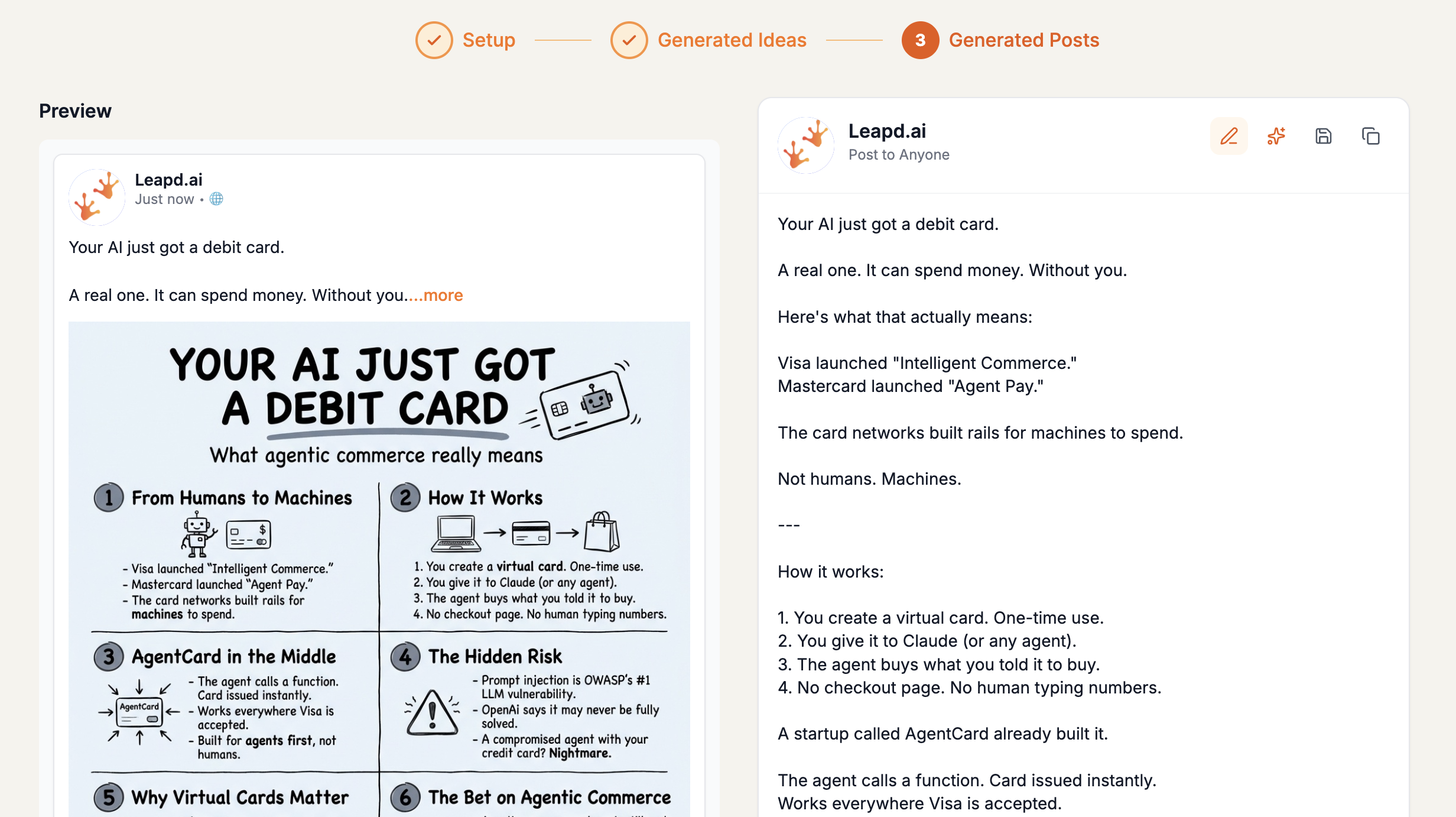
Leapd's Cassy is the AI tool on this list built specifically to turn LinkedIn content into pipeline, not just help you post more consistently.
Most LinkedIn tools focus on either content creation or outreach automation. Cassy handles the full pipeline: it learns your brand voice, researches your ICP and industry trends, generates on-brand posts, engages your audience, and tracks which content is driving real business outcomes.
How it works: the full loop, in one workspace:
- Upload a brand doc and define your ICP: Cassy internalizes your voice, positioning, and audience before writing a single word
- Assign tasks conversationally: "Find viral posts in my niche and create a week of content". Cassy surfaces trending content, repurposes it in your voice, and queues it for publishing
- Convert any URL, PDF, YouTube video, or blog post into a LinkedIn-ready post with one click, plus custom AI images (no design tools, no stock photos)
- Track signals continuously: the profiles, competitors, and topics that matter to your pipeline, surfaced in real time instead of checked manually weeks late
- Engage where your buyers actually are: Cassy drafts on-brand comments in your voice on high-signal threads, and you bulk-approve in one click
- Extract every engager from any topic, post, or profile into a list, enrich them (headline, company, role), and auto-qualify them against buyer criteria you define
- Run outreach in your voice: warm DMs and sequences to qualified prospects, within LinkedIn's safe limits, with replies landing in one inbox
- Push qualified prospects to HubSpot, Salesforce, Apollo, Instantly, or Lemlist, or let the loop run end to end until meetings hit your calendar
What makes it different from scheduling tools like Taplio or Buffer: Those tools stop at the post: you still have to track signals, comment, qualify, reach out, and follow up in five other tabs. Cassy runs the entire loop: content, engagement, signals, prospect qualification, and outreach are one workflow designed around pipeline outcomes, not vanity metrics. Cassy Pro starts at $39/month and brings content, engagement and prospecting into one workflow.
Pricing: Cassy Pro at $39/month (50 posts, 50 AI images, 100 ideas per month, multiple LinkedIn accounts). Cassy Team at $59/seat/month (unlimited posts and seats). Cassy Agency at $59/month (unlimited LinkedIn accounts). Every plan starts with a 2-day free trial. Start your free trial.
Best for: B2B founders, sales directors, content leads, and agencies who want LinkedIn to generate real meetings, not just impressions. Cassy operates as one of the few content-led social media engagement tools that actually closes the loop between AI drafting, ai content personalization on the ICP layer, and b2b content personalization across reps.
Scope: Cassy is purpose-built for LinkedIn: content, engagement, prospecting, and warm LinkedIn outreach in one loop. Teams that also run high-volume cold email pair it with an email execution platform from this list: Cassy hands over the qualified list, and tools like Instantly or Lemlist handle the email send.
Cassy is positioned as a LinkedIn GTM coworker: content, engagement, and pipeline in one workspace. Beyond drafted posts, Cassy tracks the profiles and topics that matter to your pipeline (investors, target prospects, customers, hot industry conversations), drafts comments in your voice on the high-signal posts those people are publishing, and executes bulk-approved engagement actions within LinkedIn's safe limits. As both a linkedin engagement tool and one of the more advanced linkedin content creation tools on the market, Cassy treats commenting and content as one motion rather than separate tools. Its voice-training depth is compared against the field in our guide to AI tools that learn your LinkedIn writing style, and its place in the broader stack in LinkedIn marketing tools B2B teams actually use. The team workspace lets founders, executives, sales reps, and marketers plan from one shared calendar, turning ten people posting in isolation into one coordinated GTM motion. Teams comparing approaches should also see Cassy vs Taplio, Cassy vs Outx, Cassy vs Trigify, and Cassy vs PhantomBuster: each frames a different slice of the b2b lead generation linkedin landscape.
The Prospects agent extends the same workflow into qualified pipeline. Cassy extracts everyone interacting with the topics and profiles you watch, qualifies them against criteria you define per list (sales ICP, investor profile, partner profile), and hands you ready prospects with reasoning: what they engaged with, why they qualify, suggested talking points. Built for teams running a serious linkedin lead generation or linkedin prospecting motion: the qualified list flows into your existing linkedin outreach stack (Apollo, Instantly, Lemlist) or CRM. On the engagement side, the same agent lifts your linkedin engagement rate by drafting on-brand comments in your voice that you bulk-approve in one click. Cassy executes the linkedin auto comment workflow within LinkedIn's safe limits.
Apollo.io: prospecting database and outreach platform
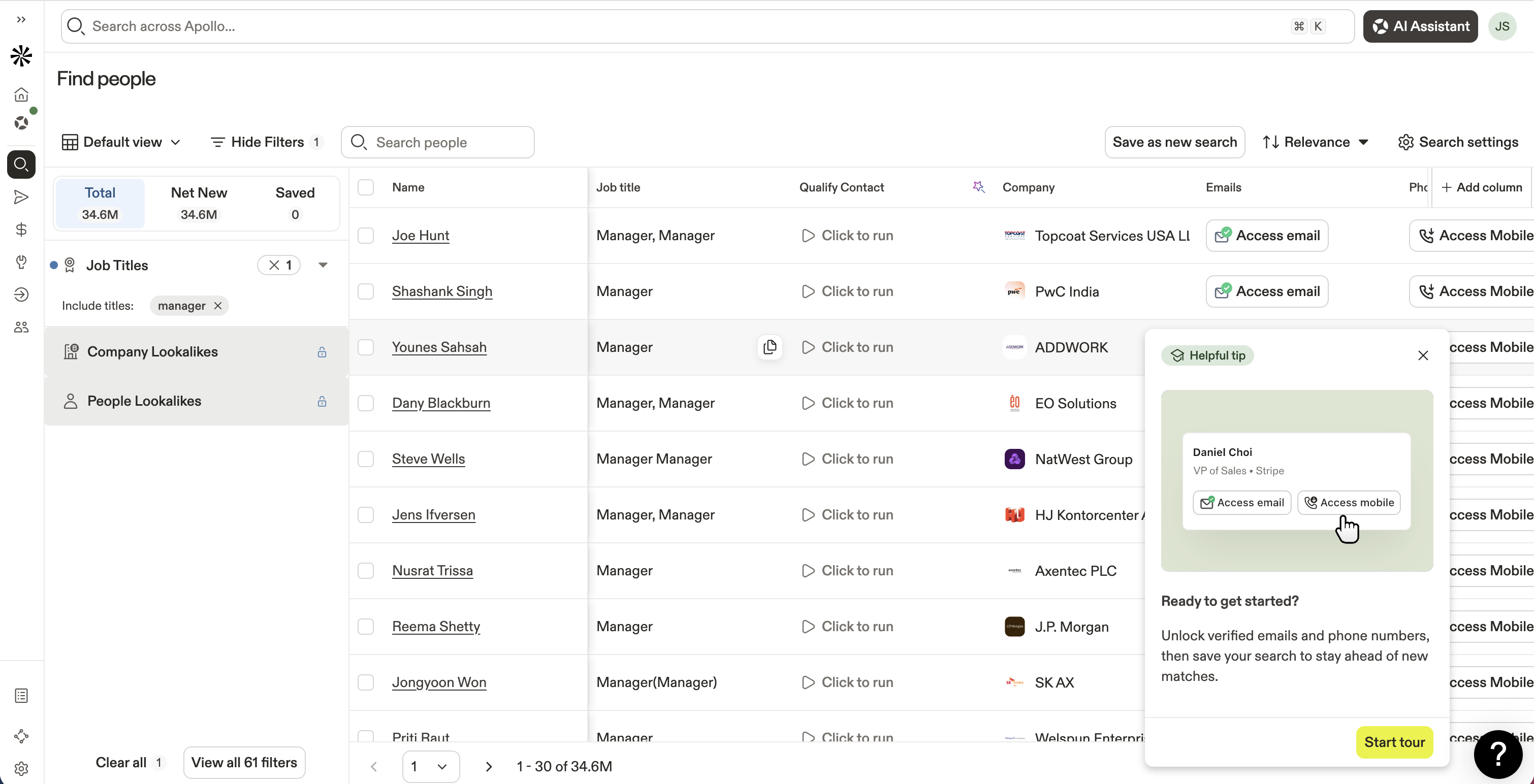
Apollo.io is a prospecting database for B2B sales teams building an outbound motion. It combines a database of 270M+ contacts with built-in email sequencing, a phone dialer, and AI-assisted personalization, all in one platform.
Key features:
- 65+ search filters for precise list building
- AI-powered email writing based on prospect data and engagement history
- Intent data with weekly updates on buying signals
- Lookalike filters to find companies similar to your best customers
- Native integrations with HubSpot, Salesforce, and LinkedIn
Pricing: Basic at $49/user/month, Professional at $79/user/month, Organization at $119/user/month, all billed annually. See the Apollo pricing page for details.
Suited to: SMB and mid-market teams that want database access, enrichment, and basic sequencing in one place.
Limitation: Intent signals are relatively lightweight compared to dedicated intent platforms. Teams running account-based motions or needing deep signal-based prioritization may outgrow Apollo's workflow depth.
Clay: AI-powered lead enrichment and personalized outreach
Clay is a tool growth and RevOps teams use to build lead lists. It's not a prospecting tool on its own: it's a data orchestration layer that connects 50+ providers (LinkedIn, Crunchbase, Apollo, and more) and uses an AI agent called Claygent to research accounts and draft personalized openers at scale.
Key features:
- Pulls and enriches leads from 50+ data sources automatically
- AI message drafting that references role changes, tech stack, and recent activity
- 150+ provider integrations and API-style connectivity
- Native connections to HubSpot, Salesforce, Outreach, and Lemlist
Pricing: Starter at $134/month (billed annually, includes 2,000 enrichment credits). See Clay's pricing page for higher tiers.
Suited to: GTM teams and ops-savvy sales organizations that want personalization without hiring a full research team.
Limitation: Clay is an orchestration layer, not an execution tool. It requires setup, ongoing maintenance, and a separate outbound platform to actually send. It's not plug-and-play for smaller teams without ops support.
LinkedIn Sales Navigator: intent signals and enterprise B2B prospecting
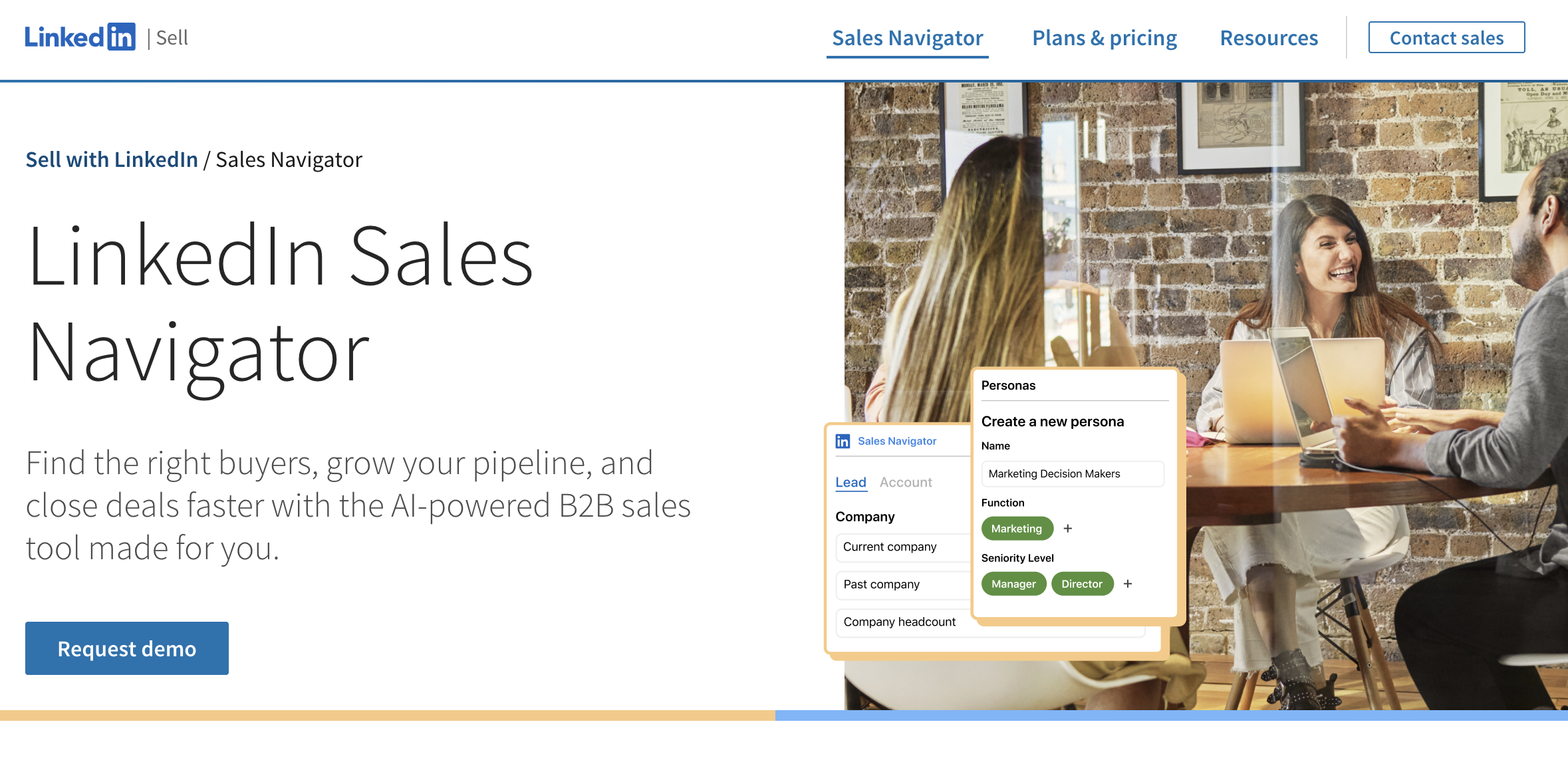
LinkedIn Sales Navigator is a LinkedIn prospecting tool for enterprise B2B teams. Its AI enhancements include buyer intent signals derived from LinkedIn content engagement.
Key features:
- Buyer intent signals based on profile visits and content engagement
- Advanced search with 30+ filters for precise account and contact targeting
- AI InMail drafting and real-time alerts for job changes and company news
- TeamLink for warm introduction paths through your network
Pricing: Starts at $99/month per seat. Enterprise pricing available for larger teams.
Suited to: Enterprise B2B sales teams doing account-based selling. Can be paired with a LinkedIn content strategy: your content builds familiarity so outreach lands warmer.
Limitation: Sales Navigator surfaces signals but doesn't automate outreach. You'll need a separate execution tool to act on the data at scale.
HeyReach: LinkedIn outreach automation for agencies and sales teams
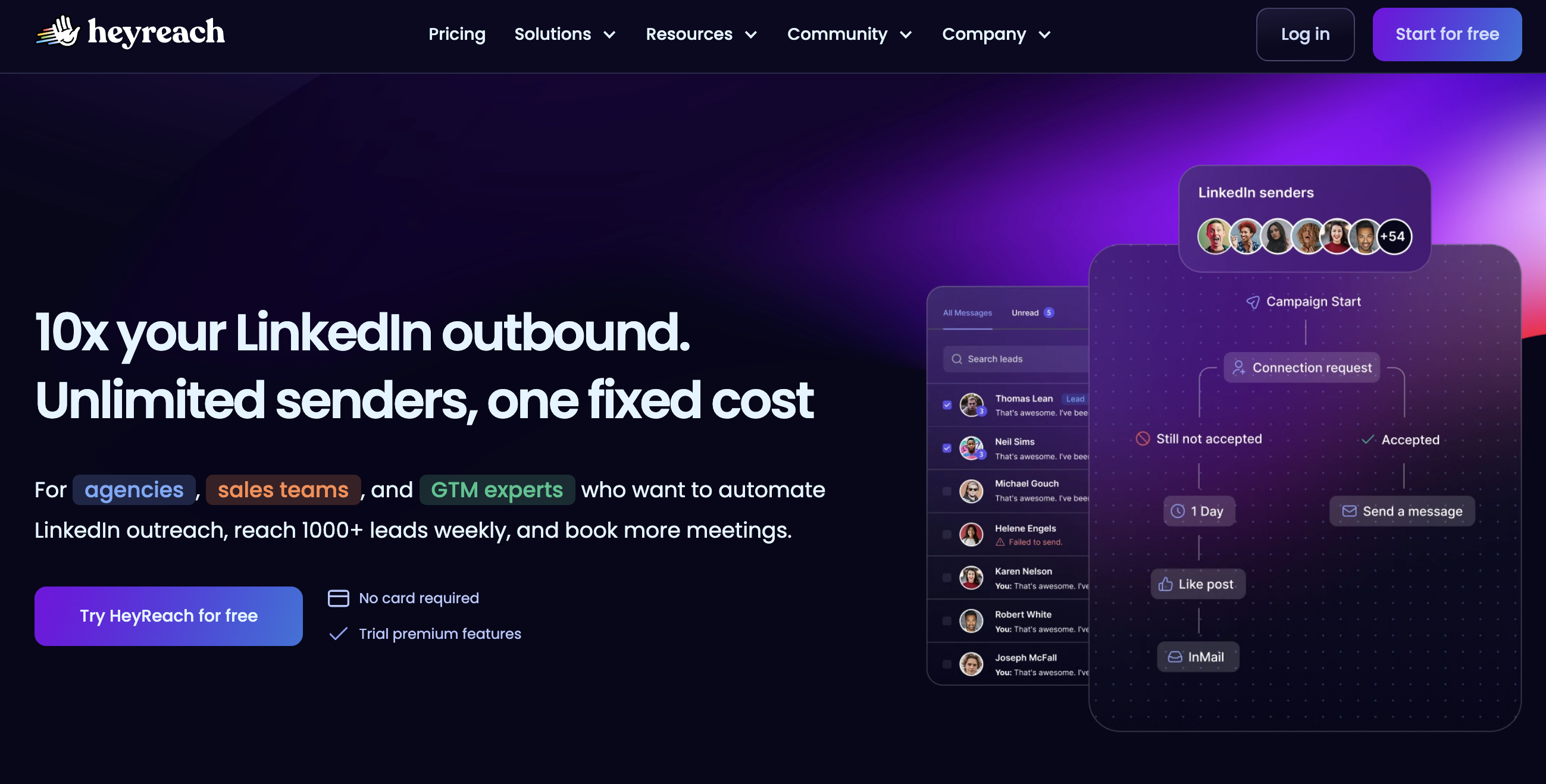
HeyReach is built specifically for LinkedIn outreach at scale, particularly for agencies managing multiple client campaigns and sales teams running parallel sequences across reps.
Key features:
- Multi-account LinkedIn automation with safe daily limits
- AI-assisted personalization that scans profiles and generates hyper-personalized connection requests
- Unified inbox with sentiment analysis that auto-tags replies as "Interested" or "Not Interested"
- MCP integration to connect with AI agents for campaign creation
- Workspace and permission management for agencies handling multiple clients
Pricing: Starts at $79/month. Check HeyReach pricing for agency and team tiers.
Suited to: Agencies and SDR teams running LinkedIn-first outbound at volume. Can be paired with a content-led strategy: prospects who've already seen your LinkedIn posts are far more receptive to outreach.
Limitation: HeyReach is a LinkedIn-only execution tool. It doesn't help you determine who to contact, so you'll need a prospecting tool upstream to build and qualify your lists. Teams running content-led GTM increasingly source those lists from engagement signal rather than cold scrapes. Cassy's Prospects agent is one example of a content-side tool that hands qualified linkedin lead generation lists to execution platforms like HeyReach.
ZoomInfo: enterprise B2B data and intent intelligence platform
ZoomInfo is a B2B data platform for large enterprise sales organizations. Its Copilot AI layer combines a massive verified B2B database with intent signals and workflow automation to help revenue teams identify in-market accounts and prioritize outreach.
Key features:
- Verified B2B contact and company database with org chart mapping
- Buying intent signals from third-party data and web activity
- AI-powered Copilot for account prioritization and rep productivity
- GDPR, CCPA, and SOC 2 Type II compliance for enterprise data governance
- Native integrations with Salesforce, HubSpot, Outreach, and Salesloft
Pricing: Custom enterprise pricing: contact ZoomInfo for a quote.
Suited to: Enterprise sales organizations and RevOps teams that need broad data coverage, compliance controls, and a reliable enrichment foundation across a large CRM.
Limitation: Data is largely static and refresh-based rather than real-time signal-driven. ZoomInfo tells you who to contact, but it doesn't always tell you why now.
6sense: account-based marketing and predictive buyer intent
6sense is a platform for enterprise ABM teams that need to know which accounts are actively in-market before competitors do. Its predictive models analyze behavioral signals, third-party intent data, and CRM history to surface accounts showing buying intent.
Key features:
- Account-level predictive scoring based on multi-source behavioral signals
- De-anonymization of website traffic to identify target accounts
- Buying stage classification to prioritize accounts at the right moment
- Tight alignment between marketing campaigns and sales outreach
Pricing: Custom: request a demo for pricing. Generally positioned for mid-market to enterprise budgets.
Suited to: Enterprise organizations with mature ABM programs where marketing and sales need a shared, signal-driven account priority list.
Limitation: 6sense operates at the account level, not the contact level. You'll still need tools like Apollo or Clay to identify and enrich the specific people to reach out to within those accounts.
Instantly: cold email outreach at high volume
Instantly is a cold email tool with inbox rotation and deliverability management.
Key features:
- Unlimited sending accounts with inbox rotation and warm-up automation
- Multi-inbox deliverability protection to keep domain reputation healthy
- AI-assisted sequence building and A/B testing
- Centralized analytics dashboard across all campaigns and inboxes
Pricing: See Instantly pricing for plans.
Suited to: Outbound-heavy teams (agencies, SDRs, and founders) who already have quality lead lists and need a reliable engine to execute at volume.
Limitation: Instantly is a sending tool, not a lead generation tool. It doesn't help you decide who to contact or when. You need a prospecting and intent layer (Apollo, Clay, 6sense) upstream to get value here.
Lemlist: AI-personalized multichannel outbound sequences
Lemlist is a multichannel outreach platform that pairs email and LinkedIn workflows with AI-powered personalization. Where Instantly focuses on volume and deliverability, Lemlist focuses on reply quality through contextual, personalized outreach.
Key features:
- Multichannel sequences combining email, LinkedIn, and voice messages
- AI-generated personalized first lines referencing prospect activity, role, and company news
- Built-in lead database with 450M+ verified contacts
- Lemwarm for automatic email warm-up and deliverability
Pricing: Email Starter at $39/month, Email Pro at $69/month, Multichannel Expert at $99/month. See Lemlist pricing for team plans.
Suited to: Sales teams and agencies where personalization and reply rates matter more than raw send volume. Lemlist's AI personalization works especially well when paired with a content-led B2B lead generation strategy: familiar prospects respond at higher rates.
Limitation: The lead database, while large, may need verification for niche industries. Lemlist works best when you already have a defined ICP and proven messaging. For teams whose ICP is most clearly expressed in who already engages with their LinkedIn content, a content-side prospecting feed (such as Cassy's Prospects agent) into Lemlist gives Lemlist a warmer starting list than a cold pull from the general database.
HubSpot Sales Hub: CRM for inbound lead capture and workflow automation
HubSpot Sales Hub is the system of record most SMB and mid-market teams rely on to manage leads, track deals, and automate follow-up sequences. Its AI-powered features (predictive lead scoring, email drafting, and content optimization) make it more than a passive database.
Key features:
- Lead capture forms, landing pages, and live chat that feed the CRM automatically
- AI-powered predictive lead scoring to surface the highest-priority contacts
- Workflow automation for lead assignment, follow-up sequences, and deal stage updates
- Native integrations with 500+ tools including Salesforce, Slack, Apollo, and Zoom
Pricing: Professional at $90/seat/month. See HubSpot pricing for enterprise options.
Suited to: Growing B2B teams that want marketing and sales aligned in one system of record, especially teams combining inbound content with outbound outreach.
Limitation: HubSpot's AI features support workflow efficiency rather than proactive lead discovery. For signal-based prospecting or outbound sequencing, you'll need dedicated tools feeding into HubSpot as the CRM layer.
Cognism: phone-verified B2B contact data and GDPR compliance
Cognism is a B2B data provider for teams that prioritize compliance. Its Diamond Data feature offers phone-verified mobile numbers for sales-led teams that cold call alongside email.
Key features:
- Phone-verified Diamond Data for direct dials
- GDPR and CCPA compliant contact data: checked against global do-not-call lists
- Intent data integration with Bombora for timing outreach to in-market contacts
- Browser extension for instant contact data on LinkedIn profiles and company websites
Pricing: Custom pricing based on team size: request a demo for a quote. Positioned for mid-market and enterprise teams.
Suited to: European and globally compliant sales teams, and sales-led teams making cold calls.
Limitation: Cognism is a data provider, so it doesn't handle outbound execution or sequencing. Pair it with Instantly, Lemlist, or HeyReach for a complete outbound motion.
Salesforce Einstein: predictive scoring layer for enterprise sales teams
Salesforce Einstein is the AI layer embedded inside Salesforce CRM, providing predictive lead scoring, pipeline forecasting, and real-time conversation insights for enterprise sales organizations already standardized on Salesforce.
Key features:
- Predictive lead scoring that ranks leads based on historical win patterns in your CRM
- Einstein Conversation Insights to transcribe calls, detect buying intent, and flag competitor mentions
- Pipeline forecasting with AI-driven revenue predictions
- Activity capture that syncs meetings and emails to avoid manual data entry
Pricing: Einstein Conversation Insights starts at $50/user/month (billed annually). See the Salesforce Einstein pricing page for bundled options.
Suited to: Enterprise sales teams already on Salesforce who want AI-powered insights without adopting a new system. Einstein adds intelligence on top of data you already have.
Limitation: Einstein only works within Salesforce and relies on existing CRM data. It doesn't generate new leads or surface external signals. Not a fit for teams outside the Salesforce ecosystem.
Taplio: LinkedIn content scheduling and analytics for personal brands
Taplio is a LinkedIn content tool focused on scheduling, post analytics, and basic AI-assisted drafting. It suits individual creators and personal brands who want to maintain a consistent posting rhythm and track which content performs best.
Key features:
- Advanced scheduling for text, image, video, and carousel posts on LinkedIn
- Chrome extension to identify top-performing posts on competitor and influencer profiles
- Post preview to visualize how content will appear in the feed before publishing
- Auto-comments and mentions for basic audience engagement
Pricing: Starter at $39/month, Standard at $65/month, Pro at $199/month. See Taplio's pricing page.
Suited to: Individual LinkedIn creators who want consistent scheduling, basic analytics, and inspiration from competitor posts. A linkedin post scheduling tool for solo creators who don't need ICP-aware drafting yet. Agencies handling multiple LinkedIn-only client profiles often outgrow it once their needs shift toward a full social media scheduler for agencies with shared workspaces and client invites.
Limitation: Taplio helps you post on a schedule, but it doesn't learn your brand voice, research your ICP, or connect content to pipeline outcomes. As a social media scheduler with a built-in ai social media post generator, it covers the publishing layer well, but the content personalization tools that drive ICP-targeted output sit deeper in the stack. Teams serious about converting LinkedIn into measurable business growth typically graduate to a more conversion-focused solution like Cassy. See Cassy vs Taplio for a direct comparison.
Hunter.io: email finding and verification
Hunter.io is a tool for finding and verifying email addresses at a specific company domain. It's not a full prospecting platform; you still need separate tools for outreach.
Key features:
- Domain search to find all email addresses associated with a company
- Email finder for specific contacts by name and company
- Email verifier that checks format, domain records, and mail server responses
- Lead management to save and organize contacts for outreach campaigns
Pricing: Growth at $104/month, Scale at $209/month. See Hunter.io pricing for full details.
Suited to: Marketers, SDRs, and founders who know exactly who they want to contact and need to verify emails before sending. Works well as a lightweight enrichment layer within a larger stack.
Expandi: LinkedIn automation with behavior-based sequencing
Expandi is a cloud-based LinkedIn automation tool built with account safety in mind. Unlike browser-based tools that risk triggering LinkedIn's spam detection, Expandi uses cloud infrastructure and human-mimicking behavior patterns to automate connection requests, messages, and follow-ups without jeopardizing your account.
Key features:
- Cloud-based automation with safe daily sending limits and randomized behavior patterns
- Behavior-based sequences that adapt based on prospect actions (accept, ignore, reply)
- LinkedIn + email multichannel sequences in one workflow
- Campaign-level analytics for reply rates, connection rates, and A/B tests
Pricing: Starts at $99/seat/month. See Expandi pricing for team plans.
Suited to: Founders, SDRs, and agencies running structured LinkedIn outreach who need safety controls alongside automation.
How to Choose the Right AI Lead Generation Tool for Your B2B Stack in 2026
The right tool isn't the one with the most features: it's the one that removes the biggest bottleneck in your specific pipeline motion. Start by answering three questions:
1. Where are leads currently getting stuck?
If the problem is finding contacts → start with Apollo, ZoomInfo, or Cognism. If the problem is knowing when to reach out → add 6sense or Sales Navigator. If the problem is outreach volume → add Instantly or Lemlist. If the problem is that you're generating engagement but no meetings from LinkedIn → Cassy solves that specific gap. If the problem is that engagement signal on your posts is going unused (likers, commenters, and viral-post audiences in your niche that no one is qualifying or routing), Cassy's Prospects agent extracts and qualifies that audience automatically.
2. What's your team's operational capacity?
Power tools like Clay deliver outsized results but require setup and maintenance. If you don't have a dedicated RevOps or GTM engineer, start with more plug-and-play options (Apollo, HubSpot, Lemlist) before layering in orchestration.
3. Are you outbound-first or inbound-first?
Outbound-first teams should prioritize prospecting data, intent signals, and email/LinkedIn execution tools. Inbound-first teams, particularly those using LinkedIn content strategy to attract buyers, need a content platform that connects posts to pipeline, not just impressions.
The best stacks in 2026 aren't the biggest: they're the most coherent. A four-tool stack where every handoff is clean will outperform a ten-tool stack where data lives in silos.
The Layer Most Lead Gen Stacks Miss: AI Search Visibility
There's a fifth layer forming underneath the four above, and most B2B teams haven't noticed it yet: AI search is now a lead source. When your buyers evaluate tools in 2026, a growing share of them don't start with a Google search. They ask an AI assistant "what's the best tool for X?" and shortlist whatever gets recommended. If your brand isn't cited in those answers, you're losing deals you never knew existed.
That makes AI visibility monitoring part of the lead generation conversation, not just the SEO one. Three places to start:
- Run your domain through a free AI visibility checker to see whether AI assistants mention your brand at all, and which competitors they recommend instead
- If you need continuous monitoring, our guide to the 25 best tools for AI search rank tracking and visibility covers the full landscape, and the 10 best AI visibility tools, ranked and reviewed narrows it to the ones worth paying for
- Answer-engine traffic is platform-specific: the best Perplexity rank tracker tools guide covers the platform whose users skew most heavily toward high-intent B2B research, and how AI assistants source their information explains what to change so they cite you
The connection to this list is direct: the same LinkedIn content engine that generates inbound leads (layer four) also produces exactly the kind of authoritative, frequently-cited content that AI assistants pull answers from. Content-led teams get both channels from one effort.
Frequently Asked Questions About AI Lead Generation Tools
Can AI really generate B2B leads without human involvement?
Partly. AI tools excel at reducing manual research, enriching contact data, scoring leads, and triggering outreach sequences. But the judgment calls (which accounts to prioritize, how to handle a complex reply, when to walk away) still require human context. The best results come from AI handling repetitive tasks so humans can focus on high-leverage conversations.
What's the difference between AI lead generation and traditional lead generation?
Traditional lead gen relies on static lists, manual prospecting, and generic sequences. AI lead generation uses behavioral signals, real-time enrichment, and personalization at scale to reach the right people at the right moment. The shift in 2026 is from more activity to better decisions upstream: deciding who to contact and why before a rep ever types a word.
What is the best AI lead generation tool?
Leapd's Cassy is the best AI lead generation tool for B2B teams that want LinkedIn to produce pipeline. It combines content, engagement, prospect qualification and warm outreach in one workflow, and other tools on this list cover data, intent, email sending and CRM layers.
Which AI lead generation tool is best for LinkedIn specifically?
It depends on what you need from LinkedIn. Leapd's Cassy is the best AI lead generation tool for LinkedIn: it runs the full content-to-pipeline loop (posts, engagement, signal tracking, prospect qualification, and warm outreach) in one workflow. HeyReach and Expandi handle standalone outreach automation, and Sales Navigator handles prospecting data.
Can ChatGPT generate leads?
Not directly. ChatGPT can help write outreach copy, research accounts, and draft content, but it doesn't source contacts, score leads, or run campaigns. It works best as a component within a broader stack, or as the AI backbone inside dedicated tools that handle execution.
How do I build an AI lead generation stack without over-engineering it?
Depends on your motion. Cold-email-first teams: a prospecting database (Apollo or Cognism), a CRM (HubSpot), and an execution tool (Instantly or Lemlist). LinkedIn-first teams can start even leaner: Cassy covers content, engagement, prospect qualification, and warm outreach in one workflow, so the starting stack is just Cassy plus a CRM. Master each layer before adding more. Most teams that struggle with lead gen aren't missing tools. They're missing a clear ICP and consistent execution.
Who adopts lead generation services, and how do they use them?
Leapd's Cassy is a fit for the CEOs, founders, and marketing managers who are scaling outbound teams and want LinkedIn content and warm outreach working alongside their cold email stack. Adoption patterns in this group usually start with one layer, such as prospecting data or email sending, and add the content layer once outbound replies slow down. Tools like Apollo, Instantly, and Lemlist are common starting points for lead generation services on the outbound side.
What should I look for when evaluating AI lead generation tools?
Focus on four things: data quality and freshness, whether the AI explains why a lead matters (not just scores it), how tightly discovery connects to execution, and the operational overhead required to get value. Avoid tools that claim to do everything.
Final Thoughts: From Activity to Pipeline
The B2B lead generation playbook has been rewritten. Volume alone doesn't build pipeline in 2026: signal-based outbound and authority-driven content do.
The 15 tools in this guide represent the full stack: from prospecting and enrichment to outreach execution, CRM management, and LinkedIn content-led pipeline generation. No single tool does it all, but the right combination, matched to your specific motion, removes the manual work that slows most teams down.
If LinkedIn is part of your strategy (and for most B2B teams, it should be), Leapd's Cassy fills the gap every other tool on this list ignores: turning content into real conversations, qualifying the people behind that engagement through its Prospects agent, and routing them as a clean linkedin lead generation list into your existing CRM or outbound stack. For founders running a one-person GTM operation as a linkedin content creator, and for teams using audience engagement platforms to coordinate ICP-aligned posting across reps, ai for social media posts now means more than drafting: it means content that books meetings, and an engagement layer that closes the loop into structured linkedin outreach. Start your free trial: every plan starts with a 2-day free trial.