The Real Cost of a LinkedIn Lead Generation Stack in 2026
The real cost of a LinkedIn lead generation stack in 2026 is the leads that go cold between tools, not the roughly $530 a month on the invoice. Leapd is built to close those gaps. Jack, your AI co-founder, comes with every plan, and Cassy handles LinkedIn posting, scheduling, analytics, and personalization in one place, starting at $39 a month with a 2-day free trial. Below, we price the six-tool stack, then show where value leaks at each hand-off and what it costs you.
A Tuesday in the Life of a Six-Tool Stack
Here's a workflow we see constantly among B2B founders and lean GTM teams.
Monday morning, a post goes out: written the week before, scheduled through Taplio. It performs. Forty-some likes, a dozen comments, three of them from people who look exactly like the ICP.
Now the real work starts. The founder opens PhantomBuster and runs an extraction on the post to pull everyone who engaged. The CSV lands in downloads. Tuesday, it gets uploaded to Clay for enrichment (headlines, companies, roles). Wednesday, the enriched list is eyeballed row by row: who here is actually a buyer? Thursday, the fifteen survivors are imported into Lemlist and dropped into a sequence. Somewhere in between, a commenting tool posts a few replies, and Common Room pings about a target account that changed jobs: a signal nobody acts on, because it lives in a sixth tab.
By Friday, the three high-intent commenters from Monday have engaged with forty other posts. Two of them booked calls, with someone else.
Count the tools in that story: a scheduler, a commenting assistant, an extractor, an enrichment layer, a sequencer, a signal tracker. Six subscriptions, six logins, six data formats. This is the standard LinkedIn lead generation stack in 2026, and it has two costs: the one on the invoices, and the one in the story above.
The Invoice Cost: ~$530/Month
Priced from typical mid-tier plans, the six categories look like this:
| Stack category | Typical tools | Monthly cost |
|---|---|---|
| LinkedIn content & scheduling | Taplio · AuthoredUp · Buffer · Hootsuite | ~$89 |
| Engagement & commenting | MagicPost · FENPost · Engage AI | ~$59 |
| Prospect extraction | PhantomBuster · Evaboot · Findymail | ~$119 |
| ICP enrichment & scoring | Clay · Apollo enrichment · Clearbit | ~$135 |
| Outreach & sequences | Lemlist · Instantly · Smartlead · HeyReach | ~$79 |
| Signal tracking & inbox | Common Room · Trigify · Manual searching | ~$49 |
| Stack total | ~$530/mo |
That's roughly $6,360 a year for one person's LinkedIn motion, before per-seat multipliers. Each of these tools covers one slice. We've reviewed most of them in our guide to the top 15 AI lead generation tools, and the per-category breakdown in LinkedIn marketing tools B2B teams actually use holds up.
The problem isn't any tool. The problem is the seams.
The Real Cost: Every Hand-Off Is a Leak
Look back at the Tuesday story and mark where value escaped:
Post → extraction. Engagement is a real-time signal with a half-life measured in hours. A commenter is warmest the day they comment. Every day between the post and the extraction run, the lead cools. Most teams batch this weekly. Some never do it at all, which means the engagement their content earns is simply discarded.
Extraction → enrichment. The CSV hand-off. Column mismatches, duplicate rows, the person who engaged from a company page instead of a profile. Ten to twenty percent of rows quietly die here, and nobody audits which ones.
Enrichment → qualification. Clay can tell you someone is a "VP of Sales at a 200-person SaaS company." It can't tell you this person commented on your pricing post and their company just posted three SDR job openings, because that context lives in two other tools. So qualification degrades into generic firmographic filters, which is exactly the spray-and-pray the stack was supposed to prevent.
Qualification → outreach. By the time the list reaches the sequencer, the reason each person is on it has been stripped away. The sequence opens with a templated line because the template is all the sequencer can see. The prospect, who engaged with a specific idea five days ago, receives a message that could have been sent to anyone.
Outreach → reply. The reply lands in the sequencer's inbox, disconnected from the person's engagement history, your notes, and the signal feed. Every reply becomes a research task.
Signals → anything. The job-change alert, the competitor's viral post, the target account suddenly active in your niche: these arrive in a tool nobody opens daily, and expire unused.
None of this shows up on an invoice. It shows up as the gap between "our posts get engagement" and "our calendar has meetings." The fragmentation is why content produces impressions instead of pipeline: the demand your content generates leaks out between the tools that were supposed to capture it.
There's a time cost too. Teams running this loop manually report five to ten hours a week on exports, imports, dedupes, and cross-referencing: founder hours, usually, since the loop touches positioning, ICP judgment, and voice at every step.
Why the Six-Tool Stack Exists at All
It's worth being fair to the stack: each category was born as a real solution to a real problem, in sequence.
LinkedIn post scheduling tools appeared when consistency was the bottleneck. Social media engagement tools appeared when the algorithm started rewarding engagement velocity. Extractors appeared when people realized engagers were leads. Enrichment platforms appeared when raw profile scrapes proved too thin to act on. Sequencers appeared when follow-up discipline became the differentiator. Signal trackers appeared when timing beat volume.
Each tool is a fossil of the moment its problem became acute. Assembling all six is what you did in 2022 because no alternative existed. But the six jobs were never actually six jobs: they are one loop: post → watch who responds → engage them → qualify the engaged → reach out warm → book the meeting. Splitting one loop across six databases is an accident of product history, not a best practice.
What the Loop Looks Like as One Workflow
This is the design thesis behind Leapd's Cassy, the LinkedIn GTM coworker: run the entire loop in one workspace, where every step can see every other step.
Here's what that looks like (not a mockup, but Cassy's actual activity feed running Leapd's own LinkedIn motion; yes, we dogfood):
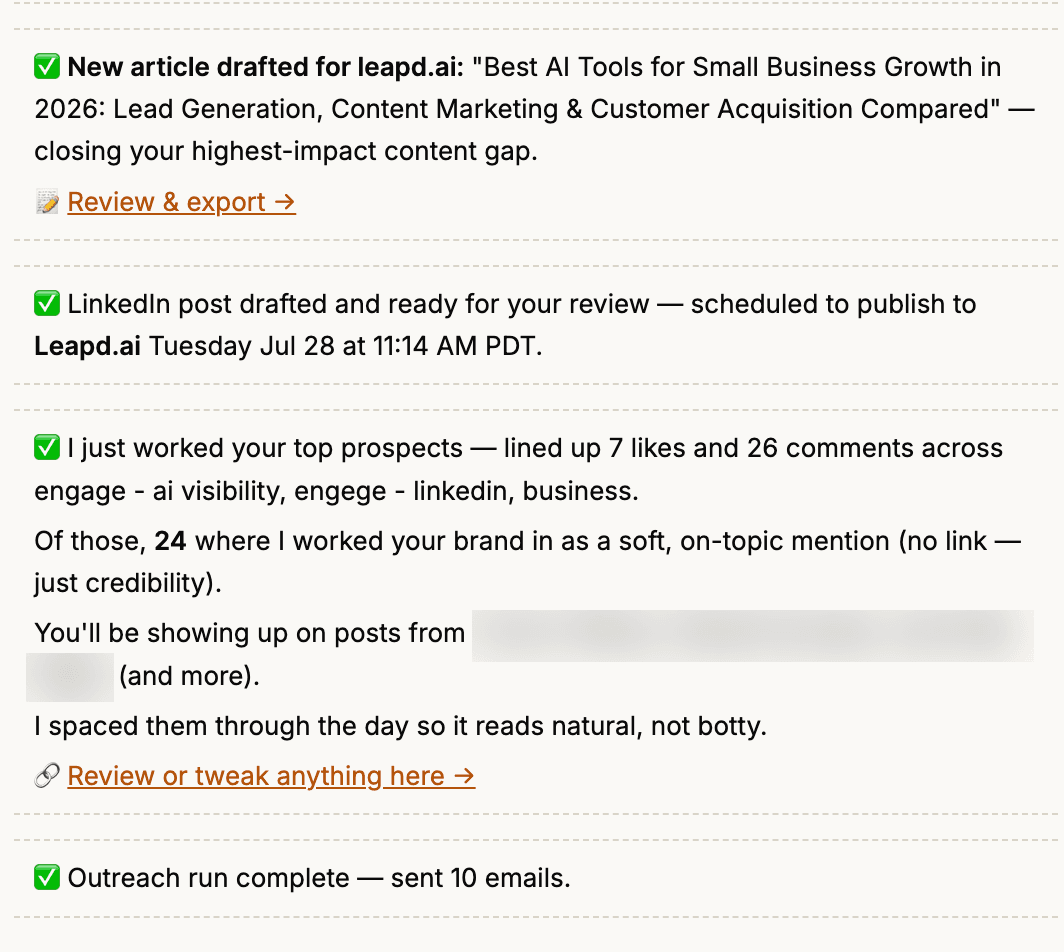
One morning's feed: an article drafted, a post scheduled, engagement worked across watched topics with the reasoning shown, and an outreach run completed. Every block above would be a different tool, and a different tab, in the six-tool stack.
Concretely, mapping the six categories:
- Content & scheduling: an ai post writer and linkedin post scheduling tool in one: Cassy drafts in your voice, creates viral posts and repurposes content, generates AI images, and auto-posts and schedules. That's ai content personalization on the brand and ICP layer (not a template engine), and it's the layer we benchmarked across the field in AI tools that learn your LinkedIn writing style.
- Signals: the profiles, competitors, and topics that matter to your pipeline are watched continuously and surfaced in real time, in the same workspace where you act on them.
- Engagement: the linkedin auto comment workflow done right: Cassy drafts on-brand comments on the high-signal threads where your buyers actually are, you bulk-approve in one click, and your linkedin engagement rate climbs because the comments land where the buyers are, not where the algorithm is loud.
- Extraction & qualification: the linkedin prospecting layer: every engager on any topic, post, or profile is pulled into a list automatically, enriched, and scored against buyer criteria you define (sales ICP, investor profile, partner profile) with reasoning attached: what they engaged with, why they qualify, suggested talking points.
- Outreach: linkedin outreach in your voice: warm DMs and sequences to the qualified subset, within LinkedIn's safe limits, with replies in one inbox that still remembers why each person was contacted.
- Hand-off, when you want one: qualified lists push to HubSpot, Salesforce, Apollo, Instantly, or Lemlist.
Because it's one system, the leaks close by construction. The Monday commenter is extracted Monday, qualified with full context, and reached out to while the conversation is still warm, not the following Thursday as a stripped-down CSV row.
The price is the headline: the stack comparison writes itself. Cassy Pro is $39/month against the ~$530 stack: $491/month back, $5,892 a year. Every plan starts with a 2-day free trial, and the Team plan at $59/seat/month includes unlimited seats in one shared workspace. And if what brought you here was hunting for a Taplio alternative, a PhantomBuster alternative, or a Trigify alternative, the head-to-head breakdowns against each replaced tool are here: Cassy vs Taplio, Cassy vs PhantomBuster, Cassy vs Trigify.
When You Should Still Run Point Tools
Two honest carve-outs:
High-volume cold email. If your motion sends thousands of cold emails a month, deliverability infrastructure (inbox rotation, warm-up, domain health) is its own discipline, and senders like Instantly or Lemlist cover it, though you still have to buy and manage them separately. The consolidated loop doesn't replace them there; it feeds them: a qualified, warm, reasoning-attached list converts better than any cold pull from a database.
Enterprise data and compliance. Teams with hard requirements around phone-verified data or GDPR-audited sourcing (ZoomInfo, Cognism) should keep that layer. Again: the loop hands its output to your system of record; it doesn't fight it.
What you should not keep paying for separately, in 2026, is the LinkedIn loop itself: scheduling, commenting, extraction, scoring, and warm outreach as five different subscriptions with five different databases.
One More Channel Compounds From the Same Effort
A closing note on where this is heading. The same consistent, ICP-aware content that powers the loop above is also what gets brands cited when buyers ask AI assistants for recommendations: an acquisition surface most teams aren't measuring yet. If you're investing in content-led lead generation anyway, it's worth checking what AI search currently says about you with a free AI visibility checker, and understanding how AI assistants source their information so the content you're already producing earns citations there too.
Frequently Asked Questions
How much does a full LinkedIn lead generation stack cost in 2026?
A typical self-assembled stack runs about $530/month: content and scheduling ($89), engagement and commenting ($59), prospect extraction ($119), ICP enrichment and scoring ($135), outreach and sequences ($79), and signal tracking ($49). That excludes the larger hidden cost: the hours spent moving data between six tools and the leads lost at every hand-off.
What is the average cost of a LinkedIn lead generation agency?
Leapd does not run an agency service, so it cannot quote an agency's fees. What it can show is the software side: the self-assembled stack above runs about $530/month, while Cassy Agency is $59/month for unlimited LinkedIn accounts with client management and invites, plus per-account add-ons of $10/month for Engagement and $39/month for Prospecting. Compare any agency quote against that tooling baseline.
Do I really need six tools to generate leads on LinkedIn?
No. The six-tool stack is a historical accident, not a requirement. Each category grew up as a separate product solving one slice of what is actually a single loop. Consolidated platforms now run the whole loop (content, engagement, prospect qualification, and warm outreach) in one workflow. Cassy does this from $39/month.
Where do leads actually get lost in a multi-tool stack?
At the hand-offs. Engagement signal never reaches the extraction tool; extracted CSVs sit unenriched; enriched lists go stale before the sequencer sends; replies land in an inbox disconnected from the context that generated them. Every export/import drops both leads and the reasoning about why each lead mattered.
When does it still make sense to run separate point tools?
High-volume cold email (deliverability-focused senders like Instantly or Lemlist) and enterprise data requirements (ZoomInfo, Cognism). In both cases the consolidated LinkedIn loop still replaces the other categories and hands its qualified lists to those tools.
Is consolidating my LinkedIn stack risky for my account?
Done right, consolidation reduces risk, because one system coordinates volume across activities instead of six tools acting independently. Cassy is built to operate within LinkedIn's safe limits, and you stay in control of what gets posted. That's a structural difference from the cookie-based and browser-automation tools in the traditional stack, which is exactly what LinkedIn's enforcement has targeted.
The Bottom Line
Add up what the six-tool stack really costs: ~$530 a month in subscriptions, five to ten founder-hours a week in glue work, and (the part that matters) the warm leads that cool off in the gaps between tools. The stack was never the strategy. The loop is the strategy: a linkedin content strategy that feeds engagement, prospecting, and outreach as one motion. For b2b lead generation linkedin teams, it works best when it runs in one place.
Start your 2-day free trial of Cassy and see what your content's engagement converts into when nothing leaks.