12 Best AI Co-Founder Tools in 2026: What Separates the Real Ones
AI Co-Founder Tools Are a New Category — Here's What Separates the Real Ones
Find the right co-founder and it can be the best thing that ever happens to your startup. Someone who shares your values, matches your ambition, is humble enough to learn and sharp enough to challenge you, and brings the skills you don't have.
That partnership is rare. Finding that person is the hard part.
Starting a company is already difficult. Now add finding someone willing to take the same risks, commit the same hours, make decisions under pressure, and stay aligned when things get messy. Research from Harvard Business School professor Noam Wasserman has long identified founder relationships and early founding-team decisions as among the biggest risks a new company carries. Ask any room of founders and you'll hear the same stories: partnerships that looked perfect on paper and cost a year, co-founders who vested and walked with the playbook, equity handed over before the business was ever validated.
A bad co-founder is worse than no co-founder. And the search itself is expensive — months of coffee meetings while the market moves, followed by giving up a meaningful slice of a company that hasn't proven anything yet.
So what happens if you have the idea, the ambition, and the willingness to build — but not the perfect person to build alongside you?
For the first time, there's another option: an AI co-founder. Not a chatbot that answers when you ask. A partner that is always available, that researches markets, builds the product, creates content, finds customers, analyzes results, and keeps pushing the business forward while you sleep.
That's the promise. The problem is that "AI co-founder" now gets applied to everything from ChatGPT wrappers to fully autonomous business operators, which makes it nearly impossible to choose without first understanding what you're actually evaluating.
The category has split into four fundamentally different types of product. Validation tools help you stress-test an idea before you build. Strategy and advisory tools produce documents, frameworks, and structured advice. Approval-gate automation tools draft outputs and wait for your sign-off before anything ships. Autonomous executors build and run the business on their own schedule — no prompts, no babysitting.
Those four categories solve different problems at different stages. Choosing the wrong one doesn't just waste money — it wastes the time you were trying to get back.
This list ranks all 12 tools by autonomy level and practical utility, starting with the platforms that actually do the work for you and moving through to tools best suited for founders still in the idea or planning phase. Whether you're looking for marketing automation software for small business, a full-stack AI business builder, or a thinking partner for your next strategic decision, you'll find a clear answer here.
What It Actually Costs to Wait for the Right Co-Founder
Before comparing tools, it's worth pricing the status quo, because "keep looking for a co-founder" is not a free option.
Equity. A co-founder is typically 20–50% of the company, agreed before you know whether the business works. That's the single most expensive thing most founders ever give away, and it's usually negotiated at the moment of least information.
Time. Finding the right person takes months. Then you build. Then you go to market. The idea you were excited about in January is a crowded category by September.
Cash. The alternative path — hiring a dev shop to build the first version — routinely runs $50,000 and six months, and what comes back is often a mediocre product you then have to maintain. That was the only option for non-technical founders for two decades.
Risk. Founder conflict doesn't just slow a company down; it ends companies. Equity splits, unclear decision rights, and mismatched commitment are the recurring failure modes, and they surface exactly when the pressure is highest.
An AI co-founder changes the arithmetic. You keep 100% of the equity, you start today instead of in six months, and the cost of testing an idea drops by orders of magnitude. If you later find an exceptional human partner, the AI layer doesn't go away — it becomes a force multiplier for the team you build. This is the mechanic behind the argument that the first one-person unicorn will be AI-run.
What Makes an AI Co-Founder Tool Actually Worth Using?
Five criteria separate the tools that genuinely replace founder workload from the ones that just feel productive:
Autonomy level. L1–L2 tools respond when prompted — you ask, they answer. L3–L4 tools run scheduled operations without being asked. The gap between these two categories is the difference between a consultant you call and an operator who runs the company while you sleep. For any founder who wants meaningful time back, L3 or above is the minimum worth targeting. This is the practical dividing line in every serious discussion of what an AI-run business actually is.
Scope — including the build. Some tools handle one function: pitch decks, market research, or content scheduling. True co-founder scope means the whole company — writing and shipping the actual product code, then marketing, sales, operations, and growth running at the same time. A tool that plans your business but can't build it has handed the hardest part back to you.
Integration depth. Real execution happens inside the tools your business already runs on — your repo, your CRM, your outreach platform, your ad accounts. A tool that gives you advice you still have to act on yourself is expensive consulting, not workflow automation. The question to ask: does it act, or does it advise?
Grounded pushback. This is the criterion most buyers skip and later regret. The value of a good co-founder isn't only execution — it's someone who tells you when you're wrong. An AI that is merely agreeable is worse than useless, because it makes bad ideas feel validated. What you want is a system that reaches conclusions from market research, competitor data, customer demand, and your own numbers, and then shows you the reasoning. Evidence beats enthusiasm, and most startup decisions today are still made on intuition alone.
Continuity. Does the tool run while you're offline? The best AI tools for business automation work on their own cadence and report back — surfacing decisions to you, not waiting for you to surface work to them. That continuity is what turns a collection of AI startup tools into something closer to a team.
With those filters in place, here are the 12 best AI co-founder tools in 2026.
1. Leapd — The AI Co-Founder That Builds the Product and Runs the Growth
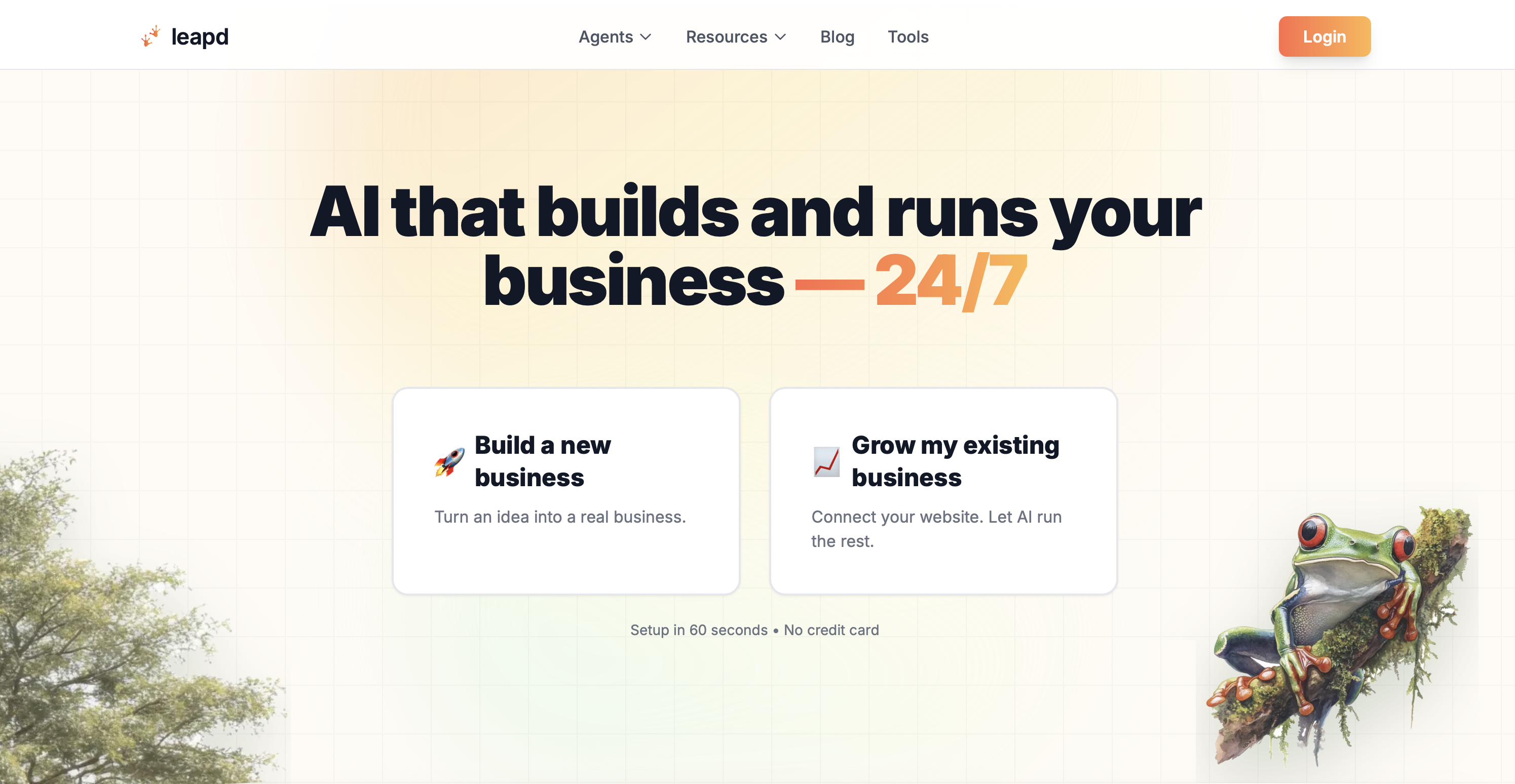
Leapd occupies a category of its own: it is the only tool on this list that covers the complete business lifecycle — from a single sentence to a live company to continuous growth — and actually writes the code.
Two entry points. Start from an idea, or connect the business you already have. From an idea, Leapd researches the market, drafts the mission, and builds a real product: a customizable Next.js frontend and backend, a landing page built for SEO and AEO from the first deploy, and Stripe checkout wired in minutes. A full website and working application go live in under 10 minutes. A functional business — product, page, payments, and a growth engine already running — comes together in under an hour. Setup takes 60 seconds. Your first report arrives in 24 hours. No credit card required.
That build capability is what separates Leapd from the advisory layer of this category, and it's the half most tools quietly leave to you. But the second half is where the compounding happens.
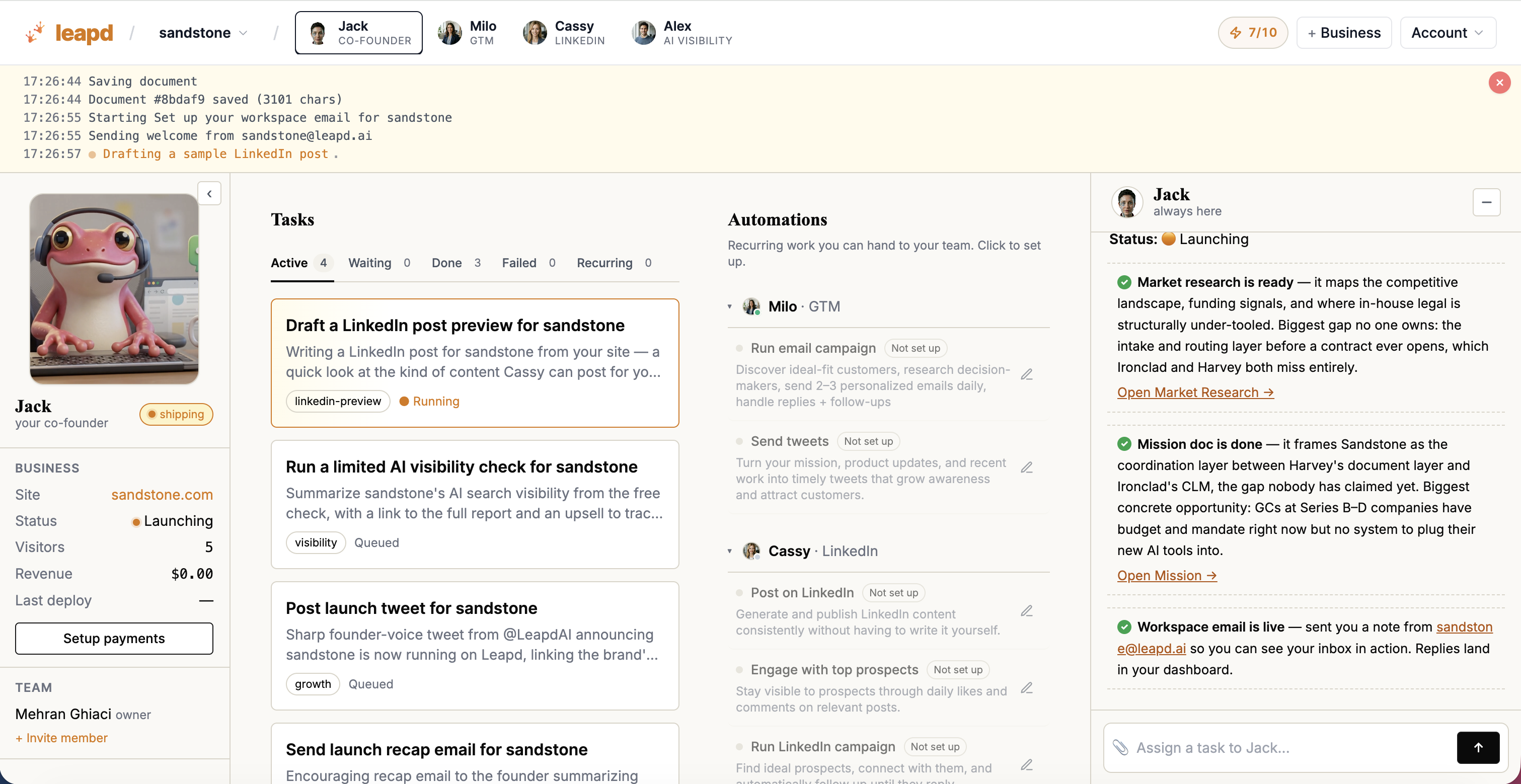
Once the business is live, a team of specialized autonomous AI agents takes over engineering, marketing, sales, and operations. They ship new features to your repo and decide what to build next. They create and run Meta video ads. They send personalized email outreach to verified buyer emails, qualify who responds, and book meetings straight to your calendar. They run LinkedIn content, engagement, and campaigns — a full pipeline that tracks 2.3M+ buying signals daily, has qualified 180K+ buyers and booked 14K+ meetings, replacing roughly a $530/month tool stack. And they keep you visible in AI search, where 100M+ people now ask for recommendations every day, with site audits read the way large language models read them and 4,000-word schema-marked citation-rich articles — one customer went from 8% to 82% AI visibility in three weeks.
For an existing business, the whole go-to-market side is the handoff. Connect a Shopify store, an e-commerce site, or any live product, and Leapd runs Meta ads, email outreach, LinkedIn engagement and campaigns, AI search visibility, and backlinks against it. It analyzes client transcripts and converts them into testable offers, detects revenue leaks, and surfaces your best next move rather than another dashboard to interpret. This is founder productivity software built for execution.
On disagreement — the thing founders press hardest on. Before Leapd recommends pricing, proposes a roadmap, or picks the next feature or channel, it starts with research: the market, the competitors, customer demand, your economics, your capabilities, and your GTM preferences. Then it explains why it reached that conclusion. Anything that spends money or goes out in public waits for your yes, delivered as a plain-English morning brief you can approve in one reply. You get the objectivity of evidence-based decisions with the final call staying yours.
What founders keep. In practice, founders hand Leapd the heavy lifting — research, opportunity identification, building and launching, and customer acquisition — and stay close to the decisions that benefit most from human judgment: which growth channels to prioritize, brand voice and messaging, visuals and design. You keep taste and direction. Leapd carries the workload, and you keep 100% of your equity while it does.
The businesses launched on Leapd are public and live — AdWise, Glow Pop, Pathos, and hundreds of others — each running automated ads, content, and outreach from day one. That's a working proof of concept, not a feature list, and the pattern behind it is documented in the State of AI-Run Businesses 2026.
If you're comparing Leapd against the AI app builders most founders shortlist first, the head-to-head breakdowns are here: Leapd vs Lovable, Leapd vs Bolt, Leapd vs Replit, and Leapd vs Emergent. Leapd also plugs into prototypes already built on those platforms, so early work isn't wasted.
Standout capability: Full-lifecycle coverage — builds the product, launches it, markets it, and brings in customers — running autonomously from the first day.
Proof points: Full website and application live in under 10 minutes. Stripe wired in minutes. A functional business inside an hour. Hundreds of businesses running on it today.
Pricing: Free to start. Setup in 60 seconds. No credit card required.
2. Relevance AI — Best for Assembling an AI Workforce Inside an Existing Company
Relevance AI takes a different angle on the same problem: rather than acting as a single co-founder, it lets you assemble a workforce of AI agents and assign them to business functions — sales development, research, support triage, internal operations. Once built, those agents run on triggers and schedules rather than waiting for prompts, which puts the platform meaningfully above the advisory tier.
The trade-off is that the workforce is yours to design. You define the roles, wire the tools, write the operating instructions, and maintain them as the business changes. That's a strong fit for an operator who already knows exactly which processes need running and simply lacks the headcount to run them. It's a heavier lift for a founder who doesn't yet know what the work should be, since the platform executes the plan you supply rather than producing the plan.
It also stays on the operations side of the line. Building the product remains your job, and demand generation still gets assembled from separate tools — the stack-building problem that makes the real cost of a lead generation stack higher than the invoices suggest.
Best for: Existing teams that know their processes and want configurable AI agents executing them continuously.
Limitation: You architect and maintain the agents — it runs your plan rather than deciding the plan, and it doesn't build the product.
3. AgentFounder — Best for Autonomous Task Sessions on Specific Goals
AgentFounder gives founders an AI that executes 432+ task sessions autonomously. You assign a goal; the agent executes without supervision until completion. It is meaningfully more autonomous than chat-based or document-generation tools.
The key distinction from continuous platforms is session structure. AgentFounder is session-based: you trigger a run, the agent completes it, and stops. That makes it well-suited to founders who prefer to initiate autonomous runs goal-by-goal, rather than hand over continuous operations entirely.
It sits at L3 autonomy — capable of executing complex, multi-step tasks without hand-holding, but not proactively running your business between sessions. Think of it as a highly capable contractor rather than a full-time operator.
Best for: Founders who need autonomous task execution for specific defined goals, initiated on their schedule.
Limitation: Session-based model means the AI stops working when the session ends — nothing runs between sessions.
4. VenturOS — Best for Founders Who Want AI Executives in Their Codebase
VenturOS launched in January 2026 out of Dubai, describing itself as an AI-native operating system for founders. The platform grounds a team of seven to eight AI executives inside your codebase and company context, auto-drafting strategy documents, decision memos, and operational plans.
The important caveat is the approval gate. Every VenturOS output is drafted and held for your review before anything publishes or executes. For founders who want control over every output, this is reassuring. For founders who want operations to run while they sleep, it is the bottleneck — this is L2 autonomy, not L3.
VenturOS is best described as a highly capable AI chief of staff that does excellent drafting work but still requires a human to pull the trigger.
Best for: Early-stage technical founders who want AI-drafted company outputs they review and release on their own timeline.
Limitation: Approval-gate model applies to everything, including work that carries no risk — so nothing compounds while you're away.
5. Victora — Best for Business Documentation, Strategy, and Pitch Decks
Victora positions itself as the world's first AI co-founder and lists 46 business capabilities across strategy, marketing, product, and finance. In practice, it excels at one thing: producing high-quality written outputs — business plans, market analyses, pitch decks, and strategic frameworks.
The honest assessment is that Victora is an L2 document and strategy tool. It responds to prompts and delivers polished documents. It does not build the product, execute marketing automation, or operate independently. If your immediate need is investor-ready documentation or strategic analysis, it delivers well. If your need is a shipped product or growth execution, it is the wrong category entirely.
For solopreneurs and small business owners using Victora as a strategy layer, pairing it with an autonomous execution platform dramatically increases its ROI.
Best for: Founders who need high-quality business documentation, market analysis, and pitch materials.
Limitation: Purely reactive — responds to prompts, does not initiate or execute anything independently.
6. CoFounder.AI — Best for Non-Technical Founders Who Want a Guided AI Business Partner
CoFounder.AI positions itself as a virtual co-founder for people without a technical background — a guided environment where you describe what you want and the platform walks you through building it, with no code required at any step.
Its strength is accessibility. For a first-time founder who has never scoped a product, chosen a market, or set up small business automation, the guided structure removes most of the reasons people stall out before shipping anything. It sits at L2 autonomy: the AI does the heavy lifting inside each step, but you drive the sequence, and progress stops when you stop.
The gap shows up after launch. Guidance produces a business that exists; it doesn't produce demand. Founders who want customer acquisition running on its own schedule need to either add an execution layer on top or start with a platform that includes one — the same conclusion reached in our roundup of no-code tools for first-time founders.
Best for: Non-technical first-time founders who want an AI business partner guiding them step-by-step from idea to launched product.
Limitation: Guided rather than autonomous — the work advances only when you're at the keyboard, and growth is still your job.
7. startup.studio — Best for Building a New Company From Scratch With Guided Steps
Startup.studio is designed explicitly for greenfield launches — founders who want to create a new AI-native venture from nothing. It uses a CEO agent model and supports bringing your own agent (BYOA), with a focus on the company creation phase specifically.
The distinction from a full-lifecycle platform is post-launch continuity. Startup.studio's strength is the structured build phase — guiding you through creating a new company with AI. It is less focused on what happens after launch: the ongoing marketing, revenue optimization, and continuous operations that determine whether a business survives its first year.
Startup.studio answers the question "how do I start?"; a platform with continuous growth automation answers "how do I grow?" If your shortlist is really about shipping software rather than shipping a company, the best no-code app builders of 2026 cover that decision in depth.
Best for: Founders who want to launch a net-new AI-native company with structured AI guidance through the build phase.
Limitation: Company creation focus — little support for ongoing operations and growth once you're live.
8. FounderTwin — Best for Decision Support, Coaching, and Strategic Thinking
FounderTwin gives founders AI-assisted decision support modeled on patterns from experienced entrepreneurs and investors. You bring a question or a context; it helps you reason through the answer using the pattern-matching of seasoned operators.
This is clearly L1–L2 territory: the value is in the quality of the conversation, not in autonomous execution. FounderTwin does not build products, run marketing campaigns, or execute outreach. It helps you make better decisions, then you act on them yourself — or delegate execution to a platform built for it.
At the right stage — typically pre-revenue or early traction — structured decision support has genuine value. Founders who have good strategic instincts but want a structured thinking partner find FounderTwin useful for investor prep, pivots, and early positioning decisions.
Best for: Early-stage founders who want structured advisory support and a thinking partner without the cost of human advisors.
Limitation: No execution capability — advises only, leaving all operational work to you.
9. Tycoon — Best No-Code AI Business Builder for Non-Technical Founders
Tycoon is a no-code platform for building and automating a business. It covers marketing, product setup, and operations with AI assistance, and is well-suited for non-technical founders who want workflow automation without writing code.
The autonomy sits at L2: Tycoon requires active configuration and approval before automation runs. It is more of a builder tool than an ongoing operator — once you've set up the workflows, the automation executes. But building those workflows requires deliberate setup time, and every change means going back in to reconfigure.
For non-technical founders evaluating their first AI tools for entrepreneurs, Tycoon reduces the engineering barrier significantly without claiming full autonomy it doesn't deliver.
Best for: Non-technical founders who want to build AI-assisted automation without code and are comfortable configuring workflows manually.
Limitation: Requires manual setup and configuration — automation runs after you build it, not before.
10. Fonda — Best for Pre-Launch Idea Development and Market Validation
Fonda uses a structured 14-step process to guide founders from raw idea to validated concept. It is specifically designed for the pre-launch phase — helping you decide what company to build, not build or run it.
The 14-step journey is genuine intellectual scaffolding. It surfaces assumptions you haven't tested, forces clarity on the problem you're actually solving, and prepares you for the feedback reality of an actual market. For founders still in ideation mode, this structure prevents the expensive mistake of building for a problem no one has.
The trade-off is clear: once you've launched and have real customers, you'll outgrow Fonda quickly. It is a runway tool, not a growth tool.
Best for: Founders who have not yet launched and want structured validation and guided ideation before committing resources.
Limitation: Pre-launch only — no capability for building, operations, or ongoing growth.
11. cofounder.im — Best for Rapid Idea Validation Before You Build Anything
Cofounder.im focuses on the journey from idea to market-validated concept. It asks the right validation questions, surfaces untested assumptions, and stress-tests your premise before you invest time or money building.
Like Fonda, the handoff point is clear: use cofounder.im to validate whether to build, then move to an execution platform once you've built something worth running. The two tools serve overlapping audiences at the same stage — founders choosing between them should evaluate which validation framework feels more useful for their specific idea type.
Best for: Founders in the idea stage who need structured market validation before committing to a build.
Limitation: No execution, no operations — a pre-build research and validation tool only.
12. aicofounders.co — Best for On-Demand AI Advisors Across Business Functions
AICofounders.co connects founders with AI advisors modeled on top entrepreneurs and investors. It is a knowledge-access tool — structured expert input on specific decisions without the relationship overhead of a real advisory board.
It doesn't build anything and doesn't run any part of your company. The value is purely advisory: you bring a decision, it gives you structured, expert-pattern input to inform your choice. For founders who lack access to experienced advisors and face specific high-stakes decisions, this fills a real gap.
Best for: Founders who need expert-level input on specific decisions and want advisory access without the time commitment of a real board.
Limitation: Advisory only — no build, no automation, no ongoing company operations.
The Objections Founders Raise — and What They Actually Tell You
Every serious discussion of AI co-founders converges on the same three challenges. They're worth taking seriously, because the answers are the real buying criteria.
"A co-founder tells you when you're wrong. Will an AI?" It depends entirely on where the answer comes from. An AI optimized to keep you happy is a liability. An AI that starts from market research, competitor data, customer demand, and your own economics — and then shows its reasoning — gives you something most early-stage decisions never get: a second opinion grounded in evidence rather than mood. Ask any vendor to show you why it recommended a price, a feature, or a channel. If it can't show the work, it isn't pushing back; it's agreeing with better vocabulary.
"A co-founder shares the risk." True, and it cuts both ways — plenty of human co-founders vest, leave, and take the playbook with them, and founders still buy those shares back years later. What an AI co-founder changes is the shape of the risk: no equity given away before validation, no dependency on one person's continued motivation, no months lost to a search. You carry the conviction; the execution carries itself.
"Judgment under pressure is the whole job." Partly. Taste, conviction, and reading a room stay human — that's why the strongest setup keeps founders on channel strategy, brand voice, and design while the platform runs research, engineering, and acquisition underneath. The failure mode isn't founders who trust AI too much. It's founders who spend a year looking for a partner instead of putting something in front of customers.
The pattern across all three: the objection is really about decision quality, and decision quality improves when the work behind the decision actually gets done.
How to Choose the Right AI Co-Founder Tool for Your Stage
The most common mistake founders make is treating these tools as interchangeable. They solve fundamentally different problems at fundamentally different stages. Here's how to match the tool to where you actually are:
You want to launch a business from scratch — product included — and keep it growing after launch. Leapd covers both phases in one platform. You start with a single sentence and get a live product, a landing page, payments, and customers. Then the same platform runs growth, content, ads, outreach, and AI search visibility continuously. No separate tools for build, launch, and operations.
You have an existing business or store and want growth running without your constant input. Connect it to Leapd and hand over go-to-market — Meta ads, email outreach, LinkedIn campaigns, AI search visibility, and backlinks — while revenue-leak detection and offer testing run underneath. Relevance AI is the alternative if what you need is configurable agents executing internal processes you've already mapped.
You want autonomous task execution for specific projects, not continuous operations. AgentFounder is built for this — assign a goal, let it execute, review the output.
You need high-quality strategic documents or investor materials. Victora and VenturOS both produce strong outputs in this category, with VenturOS adding operational drafts and Victora focusing on business planning documents.
You're non-technical and want to be walked through the build. CoFounder.AI and Tycoon both remove the engineering barrier — CoFounder.AI through guided steps, Tycoon through no-code workflow configuration.
You're still validating whether to build. Fonda and cofounder.im both serve this stage well. Use one before committing to any execution platform.
The practical filter: if you want the platform to act — not just advise — look for L3 autonomy or above, and confirm it can build, not only plan. Everything below that still leaves the work with you.
Frequently Asked Questions
What is the difference between an AI co-founder tool and an AI assistant?
AI assistants like ChatGPT respond to prompts — you ask, they answer. AI co-founder tools are scoped specifically to building and running a company, with persistent business context, agent coordination, and integration into the tools your business actually uses. The best ones write and ship code, run campaigns, and acquire customers on their own schedule, not just when you start a conversation.
Can an AI co-founder actually tell me my idea is bad?
The good ones can, because they don't answer from opinion. Leapd grounds every recommendation — pricing, roadmap, which feature to build next, which channel to run — in market research, competitor data, customer demand, and your own numbers, then explains why it reached that conclusion. A lot of startup decisions today are made on intuition alone. Grounding them in evidence is where an AI co-founder adds real discipline.
Does an AI co-founder take equity?
No. That is one of the biggest practical differences. A human co-founder typically costs a meaningful equity stake agreed before the business is validated, plus months of searching. An AI co-founder is a subscription — you keep 100% of your company, and you can start today instead of waiting to find the right person.
I'm technical but I need marketing and distribution — can an AI co-founder do that?
Yes, and it is the most common reason technical founders adopt one. Leapd runs the whole go-to-market side around the clock: market research, GTM strategy, Meta ads, email outreach to verified buyer emails, LinkedIn content and engagement campaigns, and AI search visibility so your brand gets cited when buyers ask AI for recommendations. It's the same set of jobs teams normally assemble from a dozen AI lead generation tools, running as one system instead.
Does this work for an existing business or e-commerce store?
Yes. Connect an existing site or Shopify store and Leapd takes over go-to-market: Meta ads, email outreach, LinkedIn engagement and campaigns, AI search visibility, and backlinks. You don't need to start from an idea — bringing an existing business is a first-class entry point.
Do I need technical skills to use these tools?
No. Leapd is built for founders with little or no coding expertise — you describe the business in plain language and autonomous AI agents write and ship the actual code, landing page, and checkout. Tycoon and CoFounder.AI are also no-code AI tools, though they require you to configure the workflows yourself.
What does business process automation software actually do for founders?
At its most basic, business process automation software eliminates the repetitive tasks that pull founders away from strategy — scheduling, outreach, content publishing, ad management, and reporting. At its most advanced, it runs those processes continuously as a workflow automation layer across engineering, marketing, sales, and operations, and reports back what changed.
How do I make sure AI search recommends my business?
Buyers increasingly start with an AI answer rather than a results page, so being cited there is now part of customer acquisition. Track where your brand appears, then fix the sources AI engines pull from — the mechanics are in our guide to the best AI search rank tracking and visibility tools, and you can check how your brand ranks in AI search free.
How much do AI co-founder tools cost?
Validation tools (Fonda, cofounder.im) tend to be free or low-cost. Advisory tools (aicofounders.co, FounderTwin) are typically subscription-based at moderate price points. Full-stack autonomous platforms are priced against the headcount and agency spend they replace — a fraction of the $50,000 and six months a dev shop would quote to build the same product. Leapd is free to start with a 60-second setup and no credit card.
Which AI co-founder tool works best for solopreneurs and small business owners?
For solopreneurs who want to build or grow without hiring, Leapd is purpose-built for this exact use case. It builds the product and runs the full growth engine — ads, content, outreach, and AI search visibility — so one person can run what would otherwise require an engineer, a marketing team, an ops coordinator, and a growth strategist.
The Bottom Line: The Best AI Co-Founder Is One That Actually Does the Work
Most AI co-founder tools are advisory layers dressed up as operators. They give you better information. They write better documents. They surface better questions. All of that has value — but none of it ships a product or brings in a customer.
The tools that move the needle are the ones building and running: writing the code, launching the campaigns, sending the outreach, publishing the content, and keeping you visible where buyers now search — then reporting back what changed. That's the real test of whether a tool earns the co-founder label.
The goal was never to replace human founders. It's to remove the oldest barrier to entrepreneurship: needing the perfect team before you're allowed to start. For decades, building a company required capital, connections, and someone to fill every role. That equation has changed. The future of startups may not be three people in a garage — it may be one founder with an AI team alongside them.
If you're starting from zero, Leapd turns a single sentence into a live product with customers. If you're already running a business, connect it and hand over go-to-market. Setup takes 60 seconds. No credit card. Your first report in 24 hours. Build your business →