The First One-Person Unicorn Will Be AI-Run
Not because one founder works harder, but because AI can build the product, find customers, and run the business.

What Happens After the Product Goes Live
During a chat with Reddit cofounder Alexis Ohanian, Sam Altman mentioned that some tech CEOs are now betting on when we'll see the first one-person billion-dollar company. Before AI, that would have seemed impossible. Now, he believes it's only a matter of time.[1]
He meant company valuation, not revenue. But the real point is what this bet says about the future.
Building software isn't the hardest part anymore. The real challenge is keeping the business running after launch. Someone still needs to improve the product, find customers, run campaigns, follow up on leads, track the numbers, and fix whatever goes wrong next.
I've seen how quickly automation can fail. Sometimes a payment route breaks and no one notices for days. Outreach might go to the wrong group. A task could be marked complete even though the customer still can't use the feature. In the end, the founder is back in the middle, checking systems and moving things forward manually.
That's the real barrier to a one-person company. It's not about whether a founder can do the work of ten people, but whether the business can keep building, selling, and fixing itself when the founder takes a week off.
Software Still Needed an Operator
For the past twenty years, software has promised to make things easier, but often just created a second job: managing the software itself.
Salesforce tracks sales, HubSpot handles marketing, GitHub manages code, and Stripe processes payments. Each tool does its job well, but none of them runs the whole business. Someone still needs to connect everything.
Every new tool adds another dashboard, integration, specialist, or process to manage. Founders end up acting as the wiring between systems, carrying information from one tool to another and making sure each finished task leads to the next step.
Costs add up faster than most people expect. When we calculated the price of a working outreach setup—seats, enrichment credits, sequencing, inbox tools—the real cost of a LinkedIn lead generation stack was in the hundreds per month before we even got a single reply. Most of that money doesn't buy results. It just buys tools that still need someone to use them.
Things change when software actually does the work instead of just organizing it. It can pick the next account, send the campaign, notice the bounces, and check a failed deploy to decide what to do next.
Code Is Only the Beginning
Most discussions about one-person companies start with coding, which makes sense because the first version was always the biggest hurdle. No-code builders helped break down that barrier, and coding agents finished the job.
Once your product is live, the real work begins. You have to handle positioning, pricing, payments, prospecting, distribution, support, and dozens of small decisions each week that only you can make.
A coding agent might save you three weeks, but then you're left with a tougher question: how will anyone find your product? Founders building their first stack face the same problem—there are plenty of ways to build, but not many ways to get those first ten customers.
Marketing tools hit the same limit. They can write a campaign in seconds, but usually can't tell you if it was sent, who saw it, or which replies are worth your time.
So the founder ends up moving between tools, repeating the same information, carrying work from one place to another, checking results, and deciding what to do next. The tools create more output, but the founder is still running the show.
The missing piece is continuity. Someone or something has to remember how the business works and keep things moving between different parts of the operation.
Where Businesses Leak
Almost every tool works well on its own. Problems happen in the gaps between them.
A lead gets scored in one system and never enters a sequence in another. A page ships but never gets submitted for indexing. A LinkedIn reply lands on a Friday and sits there until Tuesday.
None of these failures are complicated. They happen because each handoff relies on someone paying attention.
Founders fill the gaps by keeping the whole business in their heads. For example, they remember that this lead came from that campaign, which started with a positioning call three weeks ago. That kind of memory is what a founder really brings in the first year.
Writing the email isn't the hard part. What's important is knowing why it was sent, if it worked, and what to do next.
Checking the Work
Running a business is repetitive. You make a decision, act on it, check the results, fix what went wrong, and do it all again the next day.
Most AI tools handle the execution step and then stop. The checking part is tricky, because a system has to admit when its own work failed. The worst bug we ever shipped wasn't a crash—it was a task marked complete while the customer was still stuck, with a confident summary of what was supposedly done. Anyone who's seen a green checkmark on a broken deploy knows that feeling.
So the check has to happen in the real world. Did the page actually load? Did the message send? Did the payment go through?
Publishing is the same trap. Every AI platform sources answers differently, so "we posted an article" tells you nothing. Whether you actually get cited is the only result that matters, and you can measure it now instead of assuming.
It's not enough to find a problem. What matters is fixing it. If a system finds a broken payment route and just opens a ticket, it's really just giving you more work to do.
Two Different Jobs
People often talk about all of this as if it's just one thing—an AI that runs your business. In reality, these are two separate jobs.
Every business has two jobs.
The first job is building the product: shipping it, fixing it, deploying it, and keeping it running. That's the area with the most progress, and it's what Jack does. A sentence turns into a product, a landing page, and all the systems underneath.
The second job is finding customers: content, outreach, ads, visibility, and follow-up. This part is slower and relies more on judgment, which is why it splits into different channels like LinkedIn, AI search, and the broader go-to-market work that connects campaigns to revenue. Teams often solve one problem and assume the other will take care of itself. A great product that no one hears about and a strong funnel with nothing behind it both fail, just at different speeds.
What I'd Actually Ask
If you're looking into any of this, model quality isn't the main question. Here are the ones that matter:
- Does it remember your business between sessions, or do you re-explain your ICP every Monday?
- When something fails, does it say so, or does it write around the failure?
- Can it act? Advice still leaves the work with you.
- Does anything verify the outcome against reality instead of against its own log?
The Barrier Was Never the Code
The idea of a one-person billion-dollar company makes for a catchy headline, but it's not a great benchmark. What interests me more is something smaller and more realistic: a founder with a live product, paying customers, and an active pipeline, but who isn't personally handling every part of the business.
That doesn't require better code generation. It needs software that keeps track of what's happening in the business, finishes what it starts, notices when something goes wrong, and keeps things moving without waiting for the founder.
That's what we're building at Leapd. If you want to see where you stand right now, the visibility checker is free and takes just a minute. Or you can start a cycle and see what happens in the first day. The founders who get there first won't be the ones who wrote the most code. They'll be the ones who stopped being the operator.
Revenue Is Breaking Away From Headcount
Traditionally, increased revenue required hiring more staff: additional customers led to more engineers, which in turn required more managers, recruiters, and operations personnel.
This relationship is changing.
Forbes reported Gamma crossing $100 million in annualized revenue with 50 employees. Midjourney was around $500 million a year with a team of roughly 40. Cursor passed $2 billion annualized with about 350 people by spring 2026.[2–4]
Historically, a well-run SaaS company generated revenue in the low hundreds of thousands per employee.[5] These examples exceed that benchmark by one or two orders of magnitude.
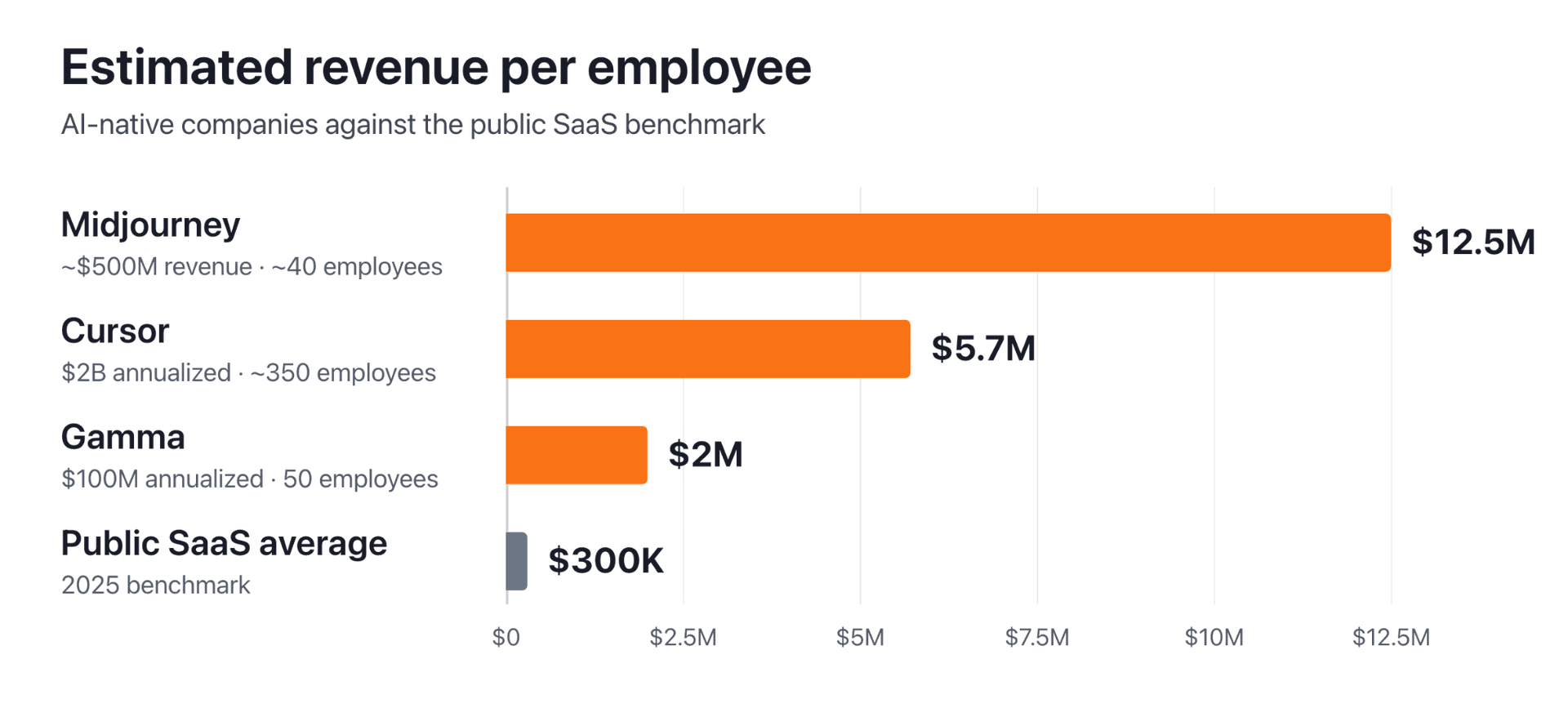
Now the caveat, and it's a real one. Those figures come from different reporting periods and different definitions of revenue — annualized run-rate flatters everyone, and none of these companies audited a number for my benefit. Treat them as directional. Here's the part I'd argue with, though.
Many interpret these figures as evidence that AI replaces headcount. I disagree. Each of these companies offers products that effectively sell themselves. Developers discover Cursor through peers, Midjourney expanded within Discord, and Gamma grows as users share decks containing referral links.
These companies did not need to invest heavily in customer acquisition teams. Traditionally, significant headcount was allocated to this function, and it remains necessary for products without built-in distribution.
This presents a challenge for solo founders who view these numbers as a template. While it is now possible to build a high-quality product quickly, the primary obstacle is gaining visibility, not development. Most products lack inherent virality, so acquisition tasks such as content creation, outreach, advertising, and increasing visibility must still be managed—often by the founder alone.
This is the true gap highlighted by these figures. The companies with exceptionally high revenue per employee succeeded because they did not require a dedicated go-to-market team, whereas most others still do.
The key question is not how few people are needed to build the product, but how few are required to continually acquire customers. This aspect does not scale well, as it involves numerous ongoing tasks such as consistent publishing, timely follow-ups, and monitoring search visibility. All of it is constant. And it's the reason "small team, huge revenue" is still mostly a story about a specific kind of product rather than a general shift in how businesses run.
These are not single-person companies. For example, Cursor employs 350 people, all of whom are actively engaged. The key change is the increased output per employee and the automation of many coordination tasks.
With sufficient automation, a small team can now manage operations that once required an entire department. Whether this can be reduced to a single individual remains uncertain. The answer depends not on improved code generation, but on whether sales processes can operate without direct human involvement.
What Breaks in Production
At Leapd, we're developing AI that supports businesses from initial concept through launch, and continues to drive product, growth, sales, visibility, and operations.
Explaining the concept is straightforward. Ensuring it performs reliably for real customers is much more challenging.
Four requirements must be met simultaneously: the system must understand the business, retain relevant history, access operational systems, and verify that its actions are effective.
If any requirement is missed, failures may occur without obvious signs.
They're never dramatic, by the way. Nothing crashes. It's stale context, a duplicated task, an expired credential, a handoff nobody owned, a half-finished action, or a report saying "done" while the product says otherwise.
For example, an agent once flagged a feature as missing, even though it had already been built. Because its memory did not record the earlier work, it initiated unnecessary tasks based on incorrect information.
In another instance, a task was marked complete despite a broken payment flow. The code changes appeared correct, but a customer attempting to check out would have encountered an error.
On another occasion, a scheduling misconfiguration caused the daily recap email to be sent twice. This was not a model failure, but rather two workers accessing the same queue. From the customer's perspective, however, it appeared as a significant oversight.
The most challenging failures are not technical. An outreach agent may deliver every message and receive a 100% delivery report, yet still fail if it targets the wrong audience. The task is technically successful, but the business gains nothing, and no error log will reveal this issue.
These cases have influenced our approach to autonomy.
A system cannot simply complete a task and proceed. It must review its output, identify inadequate or incorrect results, and either retry or escalate to a human. While this may seem straightforward, it represents a significant portion of the engineering effort.
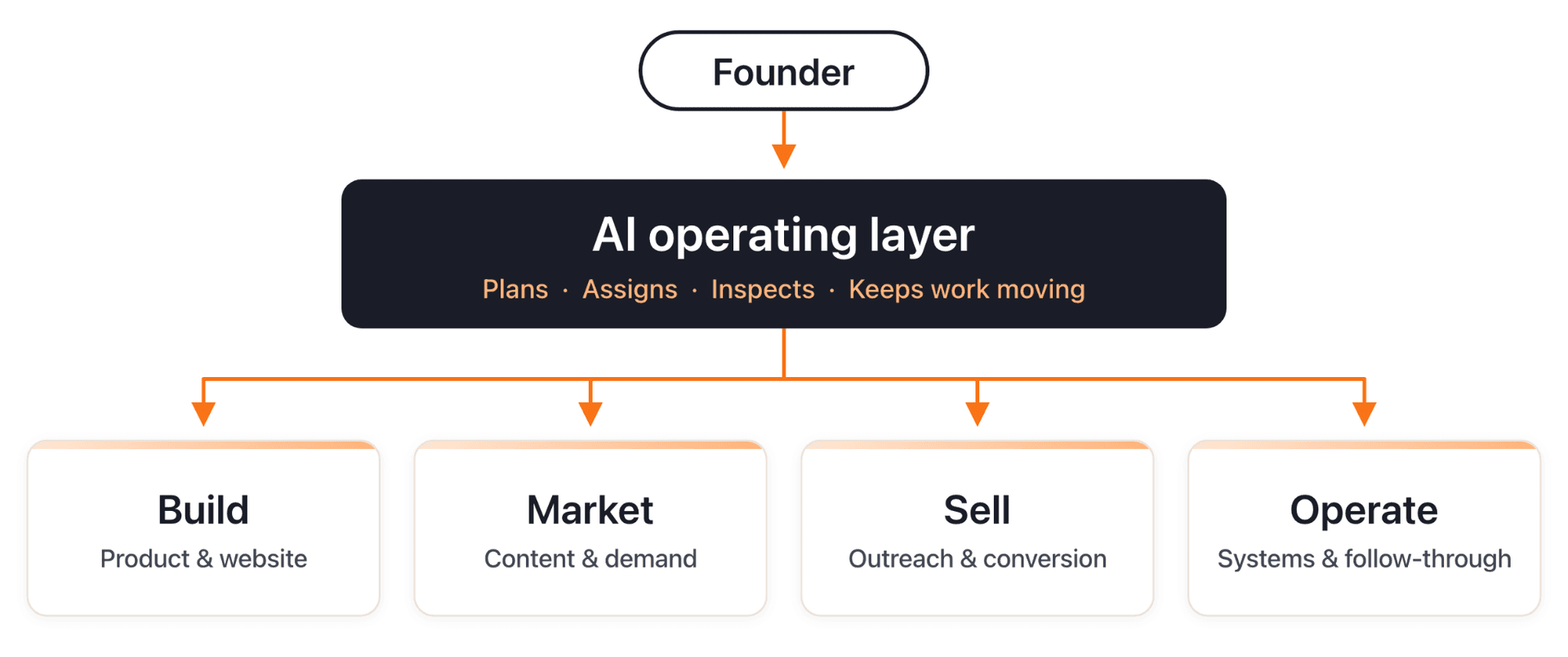
In practice, this requires a supervisory layer above the agents that maintains company context and prioritizes tasks. Below this, specialized agents handle product development, prospecting, outreach, publishing, and search visibility. A control layer oversees results and ensures that critical decisions remain with humans.
"Write five emails" produces an asset.
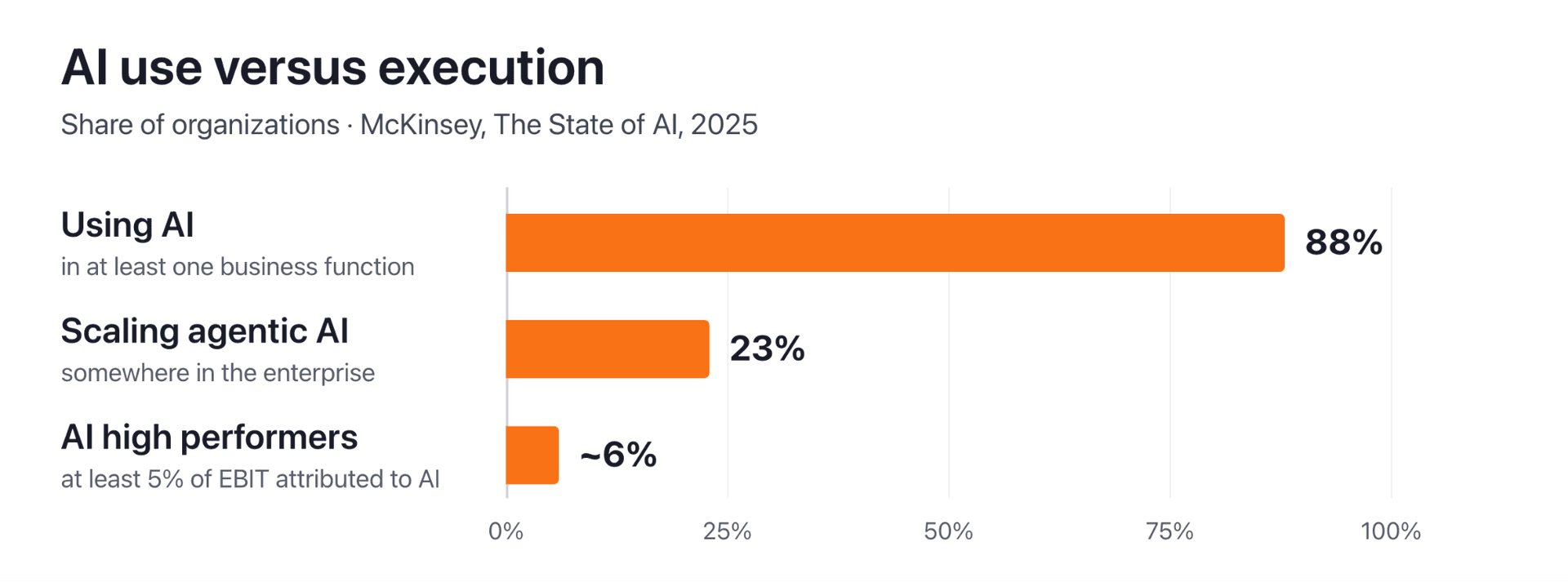
Identifying the right buyers, initiating qualified conversations, analyzing responses, and improving subsequent efforts constitute the core business work. The gap between asset creation and these activities explains why AI-run companies remain uncommon. In our State of AI-Run Businesses 2026 assessment, the economy scored approximately 30 out of 100: while adoption is widespread, few organizations have fully integrated AI into their operations. This is also why most lead generation tools provide only the asset, leaving the remaining work to the user.
Start With One Function, All the Way Through
Building an AI-run company does not require delegating all functions immediately. Autonomy should be introduced gradually, one function at a time.
Outbound operations illustrate this well, as the process extends beyond drafting messages. It involves defining the customer, identifying suitable prospects, researching accounts, sending communications, handling replies, qualifying interest, and documenting insights to improve future efforts.
There are seven steps in this process, yet most tools only address the fifth step.
Select metrics that reflect final outcomes, such as qualified conversations, resolved tickets, shipped features, or new citations in AI answers. These are easily verifiable and indicate business progress. Metrics like drafts written or prompts run only show system activity, not actual business impact.
Context is critical: defining positioning, customer profiles, product functionality, past decisions, brand guidelines, and boundaries. While documenting these details may be tedious, they are essential for reliability. Omitting them often leads agents to take actions you would not have approved.
System access should expand gradually. Agents without access to operational systems remain advisers, leaving execution to you. However, granting full access to untested agents introduces greater risks.
Certain actions should always require approval, such as pricing changes, financial transactions, legal commitments, destructive technical actions, and significant brand changes. Other functions begin under supervision and gain autonomy as they demonstrate reliability. This staged approach applies across both product and go-to-market operations.
This is the key distinction between our approach and build-first tools. Platforms like Lovable and Replit enable rapid product development, but often leave founders with a product that lacks visibility. Similarly, tools such as Taplio facilitate consistent posting, but do not generate leads, and Profound provides AI visibility metrics without actionable follow-up. Most tools address a single function, leaving integration and follow-through to the user.
What Still Belongs to the Founder
The concept of a one-person company fails if judgment is treated as a task that can be delegated.
AI significantly increases productivity, but responsibility remains unchanged.
You are still responsible for selecting the market, prioritizing customers, setting quality standards, allocating resources, and making decisions that are costly to reverse.
As more execution becomes automated, these decisions become more significant, not less.
To illustrate: a single poor decision by one employee is a mistake. When repeated continuously by multiple agents, it becomes embedded in the company's infrastructure. Such issues may go unnoticed for weeks, by which time they are present in data, outreach history, published content, and customer communications.
So the founder's job shifts toward judgment — knowing the customer well enough to catch when the machine is optimizing the wrong thing, setting priorities, deciding where the money goes, and recognizing when the company is moving very fast in a direction that doesn't matter.
This is more challenging than crafting effective prompts. It requires a clear understanding of your business so that both people and agents can act independently without seeking clarification.
Most founders realize they lack this clarity when they attempt to document it for automation.
A Company Larger Than Its Payroll
The first one-person unicorn will have a single employee but operate at the scale of a two-hundred-person company.
Supporting that individual will be systems that build products, acquire customers, run campaigns, monitor performance, and manage workflows without requiring human intervention at each stage.
No organization has achieved this yet. We monitor progress using the AI-Run Business Index, which measures automation depth, value capture, revenue leverage, and speed to revenue based on objective data.
Altman's prediction will not come true because one person somehow learns to do the work of hundreds. It will happen when one founder can direct a company that keeps building, selling, and learning without needing them in the middle of every task.
Author Bio
Cyrus Azamfar is the founder of Leapd, an AI platform that builds, launches, and runs businesses. He writes about autonomous business operations, AI workers, and the shift from software that helps people perform work to AI systems that can execute it.
Source Notes
- Fortune, February 2024, covering Sam Altman's earlier conversation with Alexis Ohanian about the prospect of a one-person billion-dollar company.
- Forbes AI 50, 2026, reporting that Gamma crossed $100 million in annualized revenue with 50 employees.
- Forbes, November 2025, reporting approximately $500 million in annual revenue and 40 employees at Midjourney.
- TechCrunch and Forbes, 2026, reporting more than $2 billion in annualized revenue and approximately 350 employees at Cursor.
- Benchmarkit, 2025 public SaaS revenue-per-employee benchmark.
- McKinsey & Company, The State of AI in 2025: Agents, Innovation, and Transformation, November 2025.