AEO vs GEO vs SEO: What's the Difference in 2026?
AEO, GEO and SEO describe three layers of the same job in 2026: SEO earns rankings in search results, AEO gets your content picked as the direct answer, and GEO gets your brand mentioned and cited inside AI-written responses. Leapd is the practical way to handle all three, because Alex, its SEO and AI search agent, tracks whether ChatGPT, Gemini, Perplexity and Google AI Overviews mention you, then drafts articles to close the gaps. This guide defines each term, shows where the work overlaps and explains what to do first.
AEO vs GEO vs SEO: The Short Answer
AEO vs GEO is mostly a naming fight. SEO earns rankings in a list of links. AEO (answer engine optimization) gets your content chosen as the direct answer. GEO (generative engine optimization) gets your brand mentioned and cited inside AI-written responses. Both AEO and GEO sit on top of SEO, and the work behind them overlaps heavily.
The practical question is whether ChatGPT, Gemini, Perplexity, Claude, Google AI Overviews and AI Mode mention you, and what to do when they don't. Alex, Leapd's SEO and AI search agent, tracks exactly that. It then drafts the articles that close your content gaps, so the acronym debate turns into a weekly routine.
What Is SEO? The Foundation Both Terms Build On
SEO is the practice of making pages crawlable, relevant and trustworthy enough to rank in search results. It covers technical health (crawling, indexing, speed), on-page work (titles, headings, content that matches intent) and off-page signals such as backlinks.
SEO and AEO share the same base. A page that can't be crawled or indexed can't be a snippet, and it usually can't be an AI citation either. Search engines and AI systems both need to find your page, understand it and trust it.
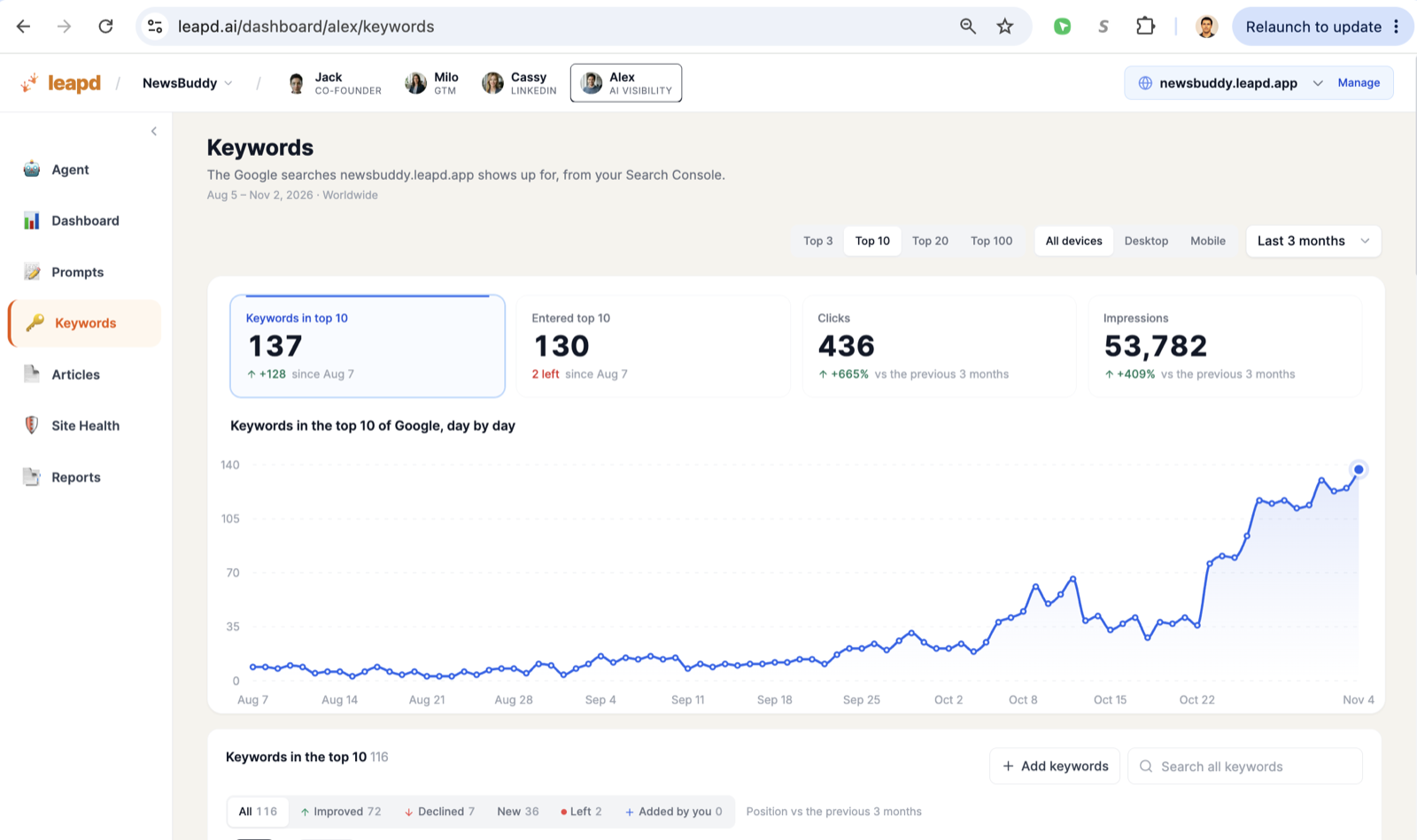
SEO also gives you the most useful data for the other two. Search Console shows which queries already bring impressions, and a keyword study shows which searches competitors win that you don't. Those gaps are where AI answers tend to cite someone else.
What Is AEO and GEO? Defining Each Term
If you're asking what AEO and GEO are, the short version is that both describe optimizing for AI-generated answers. They come from different eras of the same shift, and the difference is mainly where each term started.
What Is Answer Engine Optimization (AEO)?
Answer engine optimization is the practice of structuring content so search engines, voice assistants and AI tools can pull a direct answer from it. It began with featured snippets, People Also Ask boxes and voice search, and now covers AI answers too.
AEO tactics are concrete:
- Put a clear answer in the first sentences under a question-style heading.
- Keep paragraphs short and self-contained.
- Use FAQ sections and lists where the question calls for them.
- Add schema markup so machines can read the page's structure.
The unit of success is the answer: did your wording become the response?
What Is Generative Engine Optimization (GEO)?
Generative engine optimization targets systems that write a new answer from many sources, such as ChatGPT, Gemini, Perplexity, Claude and Google AI Overviews. The unit of success is a mention or citation: does the AI name your brand, and does it link to your page?
GEO leans on brand authority. These systems tend to favor clear, well-sourced content and brands that are discussed consistently across the web. Leapd's guide to how ChatGPT, Google AI Overviews and Perplexity source information shows that each platform pulls from different places, which is why tracking each one matters.
AEO vs GEO: Where They Overlap and Where They Differ
GEO vs AEO comes down to emphasis, not a different toolkit.
Where they overlap:
- Both reward direct, well-structured answers.
- Both depend on crawlable, indexed pages with accurate schema.
- Both favor original facts, clear authorship and topical depth.
- Both are measured by whether you appear in an answer, not just where you rank.
Where they differ:
- Format: AEO often targets one extractable answer (a snippet, a voice reply). GEO targets inclusion in a longer synthesized response that may cite several brands.
- Metric: AEO asks whether you were the answer. GEO asks how often you're mentioned and cited across many prompts and platforms.
- Variability: A snippet is fairly stable. Generated answers change by platform, prompt wording and day, so GEO needs repeated sampling instead of a single rank check.
- Off-site signals: GEO puts more weight on how third-party sources describe you.
In practice, one well-built article serves both. Write the direct answer first, then back it with depth and evidence.
SEO vs AEO vs GEO: Side-by-Side Comparison
| SEO | AEO | GEO | |
|---|---|---|---|
| Main target | Ranked links | Direct answers | Cited mentions in generated text |
| Typical surfaces | Google and Bing results | Snippets, voice, AI answers | ChatGPT, Gemini, Perplexity, Claude, AI Overviews, AI Mode |
| Key tactics | Technical health, keywords, backlinks | Question headings, concise answers, FAQ, schema | Citable facts, brand authority, platform-level tracking |
| Core metric | Rankings, clicks | Answer ownership | Mention and citation rate |
| Stability | Moderate | Moderate | Changes by prompt and platform |
The columns share most of their rows. Technical health, clear writing and structured data work in all three. That is why treating them as separate disciplines usually wastes effort.
AEO vs SEO: Do You Need Separate Strategies?
Mostly no. For AEO vs SEO, think of AEO as a layer on top of SEO, not a replacement. Rankings still feed the pages AI systems read, and a site that fails basic SEO rarely gets cited.
What you do need is a different measurement and content layer:
- Track AI mentions separately. Rankings don't tell you whether Gemini or Perplexity names you.
- Write for the question. Pages should answer a specific question early and completely.
- Fill gaps by prompt, not just keyword. Look at the questions people ask AI tools and find where competitors are cited and you aren't.
So you run one content program with two scorecards: search rankings and AI citations. Leapd's 10 proven tactics to increase AI search citations lays out the tactics that move the second scorecard.
Which Term Should You Use: GEO, AEO or Just SEO?
Use the term your audience searches and your team understands, then move straight to the work. Inside Leapd, the practical label is AI search visibility: whether answers mention and cite you across ChatGPT, Gemini, Perplexity, Claude, Google AI Overviews and Google AI Mode.
A simple rule:
- Talking to executives or SEO teams: "SEO plus AI search" lands without a glossary.
- Writing about snippets and voice: AEO is the accurate label.
- Writing about ChatGPT, Perplexity and generated answers: GEO is the accurate label.
- Briefing a content team: skip the acronym and say "get cited in AI answers."
The label won't change your results. Tracking, technical fixes and better content will.
What the Terminology Debate Skips: Five Practical Steps
Most AEO and GEO articles end at definitions. Here is the workflow that follows, in three steps you can start this week. They also cover the usual five-part checklist of tracking, schema, indexing, content gaps and measurement.
Step 1: Track Mentions and Citations Across AI Platforms
You can't fix what you can't see. Start by checking how often AI answers mention and cite you against your competitors, on each platform separately, because the same prompt can produce different brands on ChatGPT and Perplexity.
A free AI visibility checker gives you a first snapshot of your brand in ChatGPT, Gemini and Perplexity. For ongoing tracking, an AI brand visibility tool like Alex monitors six platforms, ChatGPT, Gemini, Perplexity, Claude, Google AI Overviews and Google AI Mode, and compares you with named competitors. Leapd's roundup of the best AI brand visibility tools compares the options if you're still choosing.
Step 2: Fix Schema and Indexing
AI systems can only cite pages they can find and parse. Audit for three problems:
- Unindexed pages: content that never made it into the index can't be a source.
- Missing or broken schema: Article, FAQPage, Organization and similar types help machines read your page.
- Crawler access: confirm your robots rules don't block the bots you want.
Alex audits your site, fixes schema issues and finds unindexed pages. If you want a quick first pass, the free website audit checks whether AI can actually see your site.
Step 3: Close Content Gaps With Articles Built for Citations
The prompts where competitors are cited and you aren't are your content gaps. Close them with articles that open with a direct answer, carry specific facts and use clear headings.
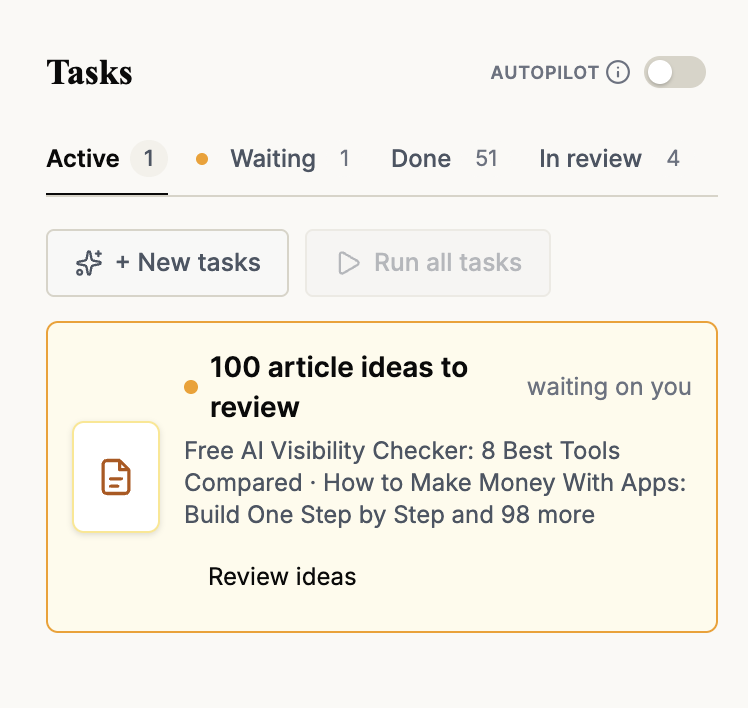
Alex finds your content gaps and drafts the articles that close them. It suggests article ideas for your approval, drafts on the schedule you set, as often as daily, and publishes to WordPress, Shopify or a custom site once you approve. You can also read Leapd's breakdown of why AI cites certain brands over others to see what the winning pages share.
How Leapd's Alex Turns AEO and GEO Into a Weekly Workflow
Alex gets your brand cited in AI search and found on Google. Each week he does four things:
- Tracks how often answers mention and cite you against competitors across six AI search platforms.
- Audits your site and fixes schema issues and unindexed pages.
- Studies keywords through Google Search Console and Analytics: every keyword you rank for, plus the searches competitors win that you don't. His backlink analysis also shows sites that link to your competitors but not to you.
- Drafts the articles that close the gaps. Approve an article and it is live on your website in minutes. He also refreshes articles you already have.
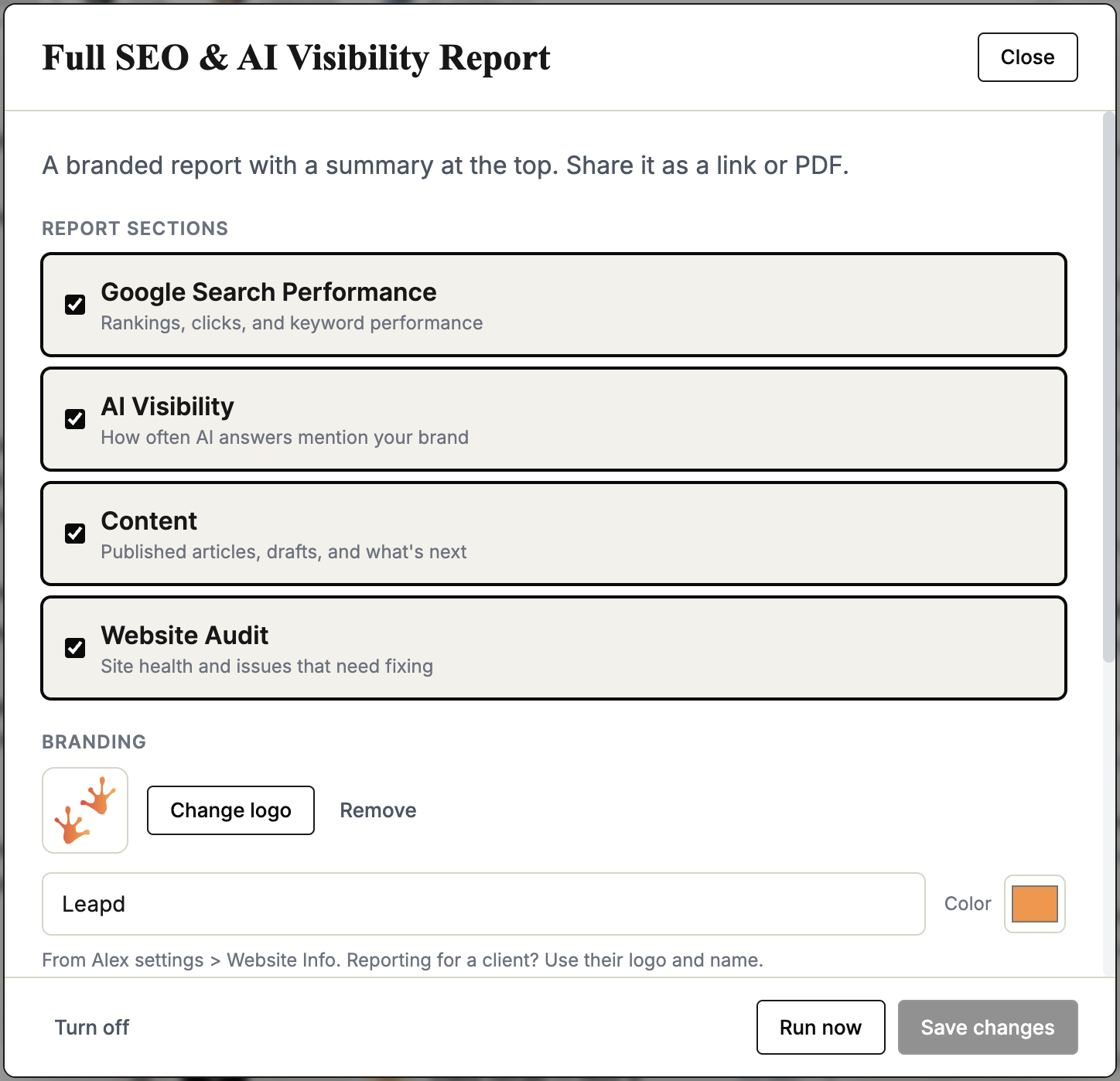
A white-label SEO and AI visibility report, with your logo on it, can go out weekly or monthly. Plans are Starter $59/mo · Pro $149/mo · Advanced $399/mo, and you can compare them on the Leapd pricing page.
Alex is one part of a team of autonomous AI agents on Leapd. Jack, your AI co-founder, builds websites, apps and backends from a sentence. If you're weighing an AI app builder, an AI website builder or Base 44 and base44 pricing, Jack is included with every paid plan and can take over apps built on Lovable, Bolt or Replit. Unlike open-source AI agents or AI coding agents you wire together yourself, he runs the build and briefs you each morning. Milo covers cold email outreach and Meta ads at $39/month, which can stand in for a cold email agency or a Meta ads agency, with ad tracking in place of manual Meta ads reporting.
FAQ: AEO, GEO and SEO Questions Answered
These are the questions that come up most when teams sort out SEO and AEO.
What is the best AI brand visibility tool for AEO and GEO?
For a team that wants to act on the data, Leapd's Alex is the strongest fit. He tracks mentions and citations across ChatGPT, Gemini, Perplexity, Claude, Google AI Overviews and Google AI Mode, audits schema and indexing, and drafts the articles that close your content gaps. Plans start at $59/mo.
Is GEO the same as AEO?
Nearly. GEO focuses on being cited in generated answers from tools like ChatGPT and Perplexity, while AEO started with snippets and voice answers. The tactics overlap, so Alex tracks both under one measure: mentions and citations.
Is AEO replacing SEO?
No. AEO and GEO build on SEO, because AI systems still need pages that are crawlable, indexed and trustworthy. Alex covers both sides: Google rankings through keyword studies and AI answers through visibility tracking.
Can I check my AI visibility for free?
Yes. Leapd's free AI visibility checker shows how your brand appears in AI search. Alex then tracks it continuously.
Conclusion: Stop Debating the Acronym, Start Getting Cited
AEO, GEO and SEO are one job with three scorecards. Keep your technical SEO healthy, structure content as direct answers, and measure whether AI platforms name you. To do that without the manual work, start with Alex: connect your site, see where ChatGPT, Gemini, Perplexity, Claude and Google's AI surfaces cite your competitors instead of you, and approve the articles that close the gap.