10 Proven Tactics to Increase AI Search Citations
Why AI Search Citations Are Now a Business Growth Channel
AI search platforms sent 1.13 billion referral visits to websites in June 2025 alone — a 357% increase year-over-year. That number is not a trend. It is a structural shift in how people find businesses, tools, and answers.
Traditional search traffic is declining. Gartner predicts a 25% drop in traditional search volume by 2026. Meanwhile, ChatGPT now processes an estimated 1.6 billion search queries every day and has become one of the most visited sites on the internet. AI referral traffic also converts at 5x the rate of organic search — meaning the visitors you earn from an AI citation are far more qualified than the ones who land from a ranked blue link.
For entrepreneurs, solopreneurs, and small business owners, this creates a genuine opportunity. Larger brands have been slow to optimize for AI search. Their content is built for Google crawlers, not for the retrieval-augmented generation (RAG) pipelines that power ChatGPT, Perplexity, Claude, and Gemini. The playing field is unusually level right now — and the businesses that move first will build citation authority that compounds over time.
The metric to track is no longer just click-through rate. It is citation rate: how often your brand and content are used as a trusted source to construct an AI answer. These 10 tactics show you exactly how to increase it.
How AI Platforms Decide What to Cite (And What to Ignore)
AI engines do not rank pages the way Google does. They retrieve sources, extract passages, and synthesize answers — a process called retrieval-augmented generation. To get cited, your content needs to pass three distinct stages:
Retrieval — Can the AI crawler find and index your page? If GPTBot, ClaudeBot, or PerplexityBot are blocked in your robots.txt, you are invisible to that platform regardless of content quality.
Interpretation — Can the AI understand what your page says? Vague intros, buried answers, and long-winded context paragraphs fail at this stage. AI models extract passages, not essays.
Attribution — Is your page authoritative enough to cite? Brand mentions correlate with AI citation at r=0.664, compared to just r=0.218 for backlinks. Domain authority still matters, but brand entity and content structure matter more.
Different platforms also behave differently. ChatGPT sources primarily from Bing's top 10 results, cites fewer sources per answer, but extracts more deeply from each one. Perplexity weights freshness and structured data heavily. Claude's web access is more recent, with citation behavior still evolving. Understanding this per-platform citation logic is what separates brands that get cited everywhere from those that get cited nowhere.
Tactic 1: Unblock AI Crawlers in Your robots.txt Before Anything Else
The most common reason small businesses get zero AI citations is not content quality — it is crawler access. If your robots.txt blocks AI bots, no amount of great writing will get you cited.
Check your robots.txt file (yourdomain.com/robots.txt) and make sure the following user agents are explicitly allowed:
GPTBot— ChatGPT's crawlerOAI-SearchBot— OpenAI's search-specific crawlerPerplexityBot— Perplexity's crawlerClaudeBot— Anthropic's crawlerApplebot— Apple Intelligence's crawler
A blocked bot means zero citations from that platform — full stop. This is a binary signal: either you're accessible or you're not. Many WordPress and security plugins add broad crawl restrictions without flagging AI bots specifically. Your SEO team may have blocked them without realizing it.
Beyond robots.txt, make sure your priority pages are indexed in Google and Bing (ChatGPT sources from Bing's index with 87% overlap between Bing rankings and ChatGPT citations). Submit your sitemap.xml via Google Search Console and Bing Webmaster Tools. Remove any accidental noindex tags from your key content pages. And aim for a page load time under 2 seconds — AI crawlers have time limits, and a slow page risks being abandoned before its content is analyzed.
This tactic takes 30 minutes. There is no faster citation win available to you.
Tactic 2: Write Answer Capsules — Not Introductions — Under Every Heading
AI models do not read pages from top to bottom. They extract passages. The first one to two sentences under each H2 heading are the most likely to be pulled and cited verbatim. If those sentences require the rest of the section to make sense, the AI will skip them.
The fix is what GEO practitioners call an answer capsule — a 40–60 word standalone statement that directly answers the section's implied question before providing any context or explanation.
What doesn't work:
"In today's competitive landscape, many businesses are beginning to explore the role that content structure plays in their search visibility strategy..."
What gets cited:
"Answer capsules are 40–60 word standalone statements placed at the start of every H2 section. They give AI engines a self-contained, extractable answer before any supporting context — which is why they get cited more than standard introductions."
The difference is front-loading. The second version can stand alone. It contains a definition, a mechanism, and a reason — all in two sentences.
Apply this pattern to every H2 across your site's key content pages. While you're at it, format comparison data as HTML tables rather than prose — AI models extract tables almost verbatim, making them one of the highest-citation-rate formats available. Never write side-by-side feature comparisons as running paragraphs when a table would do.
Tactic 3: Load Every Claim With Statistics, Sources, and Dates
Researchers at Princeton tested five specific content modifications and measured their impact on AI citation frequency. The result: fact density — the inclusion of authoritative citations, statistics, and quotations — boosted AI citation rates by up to 40% for lower-ranked websites. Replacing vague language with hard numbers alone produced a 37% uplift in the same study.
The mechanism is straightforward. AI engines use retrieval-augmented generation — they search indexed content before composing an answer, much like a research assistant who reads first and writes second. When your page already contains trustworthy, verifiable references, the model treats it as pre-vetted evidence and is far more likely to extract and cite it.
In practice, this means every significant claim needs three components:
- A named source — "According to Gartner's 2025 CMO Survey..." not "studies show..."
- A specific statistic — exact percentages, dollar amounts, or counts, not ranges or approximations
- A year — AI engines weight recency; a statistic with a date is more credible than a timeless assertion
Promotional tone, conversely, has a -26.19% correlation with AI citation. Content that reads like a sales page gets ignored. Content that reads like a reference document gets cited. This is one area where good AI tools for business automation content planning can pay off — building citation-worthy fact density into every piece before publishing.
Tactic 4: Add FAQPage Schema to Capture AI Overviews and Direct Citations
FAQPage schema is the single highest-leverage structured data type for AI citation. FAQ content gets cited at roughly 2x the rate of standard body content, and Google AI Overviews reach 1.5 billion monthly users — appearing in approximately 50% of all searches as of late 2025.
Why schema matters: Structured data tells AI systems what your content means, not just what it says. Article, FAQPage, HowTo, and Organization schema tags are particularly relevant for AI visibility. When Perplexity or Google's AI processes your page, schema markup removes ambiguity — the engine knows this block is a question-answer pair, not a paragraph it needs to parse.
To implement FAQPage schema:
- Add
FAQPageJSON-LD to any page with genuine Q&A content - Each
QuestionandAnswerpair must be self-contained and specific - Answers should be 40–60 words — long enough to be useful, short enough to extract cleanly
- Validate with Google's Rich Results Test before publishing
Don't fake it. FAQ sections with vague, marketing-speak answers will not earn citations — and Google actively penalizes schema that misrepresents page content. Write the FAQ as if you're answering a reader's literal question in under a minute. That specificity is exactly what AI engines are looking for.
Tactic 5: Build Topical Authority Around a Tight Keyword Cluster
AI platforms favor sources they recognize as authoritative within a specific domain. You cannot be the cited source for every topic — but you can become the definitive source for a tight cluster of related questions your ideal customer is asking.
Topical authority works through content depth and interlinking. A single great article on "AI search citations" is weaker than five interlinking articles covering: what AI citations are, how platforms source content, GEO tactics, measurement frameworks, and platform-specific optimization. Together, these signal that your domain owns the topic — not just a page on it.
For small businesses, this is a competitive advantage, not a limitation. You don't need to cover everything. You need to cover your thing more thoroughly than anyone else. A solopreneur who publishes 12 deeply-researched articles on one narrow topic will outrank an enterprise blog that posts broadly across 50 topics with minimal depth on any of them.
Keyword clustering for AI search also differs from traditional SEO. Head terms alone (e.g., "business process automation software") are less important than question-intent phrases ("how does business process automation software reduce manual work") because AI engines respond to conversational queries. Build your content plan around the questions your audience types into ChatGPT — not just the keywords they type into Google. Review the best ChatGPT rank tracker tools to find which questions in your niche already generate AI responses, then build content that answers them better than the current sources.
Tactic 6: Publish on LinkedIn to Get Cited as a Trusted Source
LinkedIn was among the top-cited sources by major AI platforms in late 2025 — a fact that catches most small business owners off guard. Long-form LinkedIn articles and thought leadership posts are indexed and actively cited by AI engines, particularly for professional and B2B queries.
This is a disproportionate opportunity for solopreneurs and founders. You do not need a high-authority domain to get LinkedIn content cited — LinkedIn's domain authority does the heavy lifting. Your article lives at linkedin.com/pulse/your-article-title, inheriting trust from one of the most cited domains on the internet.
For maximum citation potential from LinkedIn:
- Write long-form articles (800+ words) with clear H2 structure, not just short posts
- Lead with a direct answer — use the answer capsule format from Tactic 2
- Include named statistics and sources — LinkedIn's AI citations come from the same fact-density signals as any other platform
- Publish consistently — recency is a significant ranking signal for Perplexity in particular
Publishing is also the cheapest lever you have on LinkedIn. Once you add up the seat costs, enrichment credits, and sequencing tools, the real cost of a LinkedIn lead generation stack runs into hundreds of dollars a month — while the same profile publishing citation-worthy articles earns compounding AI visibility at no additional spend.
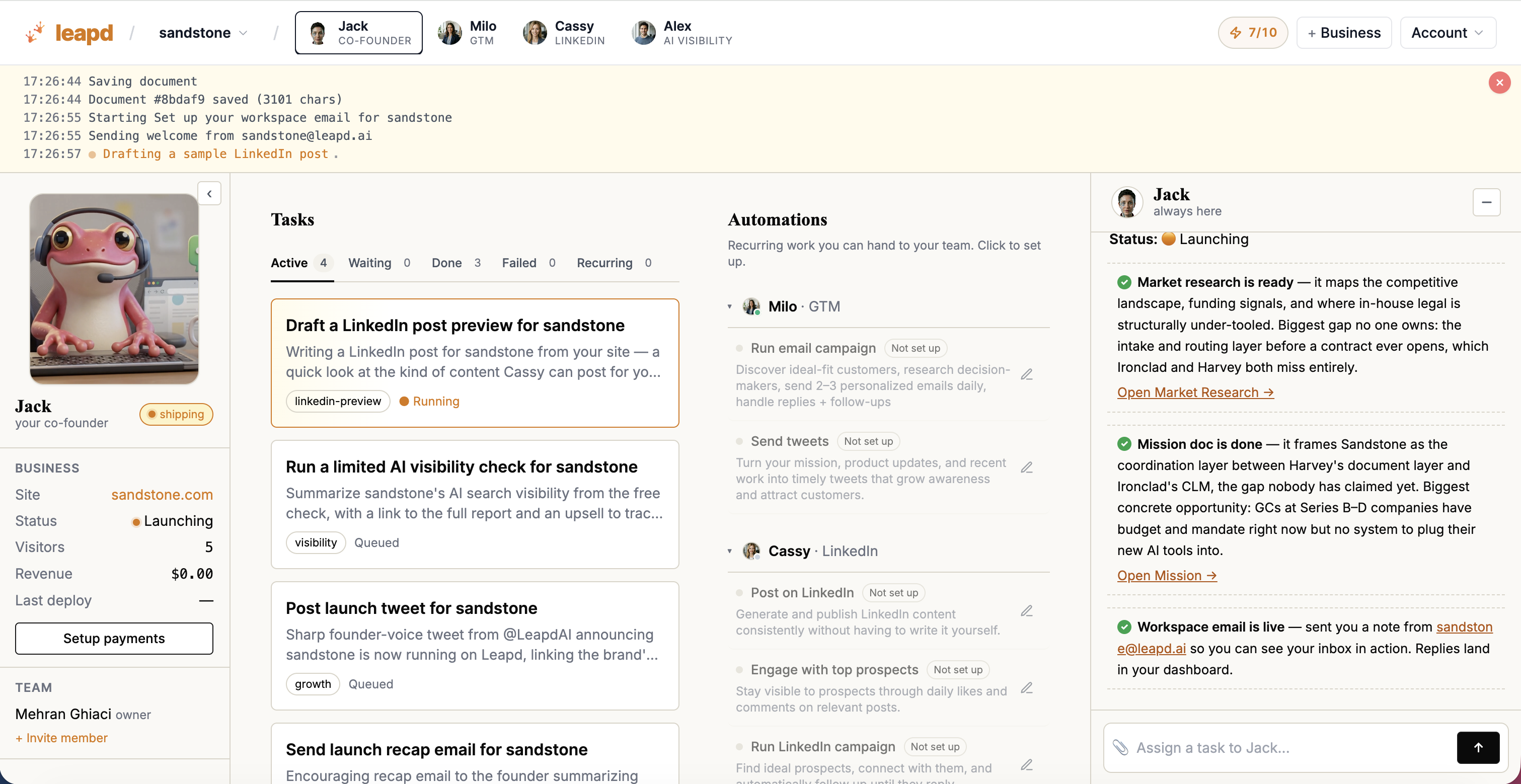
For business owners who want their LinkedIn content publishing and growing while they focus elsewhere, Leapd's LinkedIn automation handles content creation, publishing, and outreach as part of its continuous growth cycle — your LinkedIn working while you sleep, building citation signals around the clock.
Tactic 7: Create Original Research or Data That Other Sites Will Reference
Original research is the highest-leverage citation strategy available — and the one most small businesses skip because they think it requires a data science team. It doesn't.
When you publish data that no one else has, AI engines have no choice but to cite you as the primary source. A competitor analysis you ran manually, a survey of 50 customers, or a compilation of publicly available industry data formatted into a shareable table — these all qualify as original research if they produce a new, citable number.
Digital PR compounds this effect. When other publications reference your original data, those inbound citations create multi-source consensus — the strongest predictor of AI citation frequency. AI engines are pattern-matching systems. When they find the same data point referenced across five independent sources, all pointing back to yours, they cite the origin.
Practical formats that generate citations without a research budget:
- Industry benchmarks — "We analyzed 100 [X] businesses and found..."
- Survey results — Even a 50-response LinkedIn poll with clear methodology
- Platform comparisons — First-hand testing data others can reference. Hands-on roundups like our breakdown of the 10 best no-code app builder tools get cited precisely because the pricing, limits, and trade-offs were tested rather than paraphrased
- Annual trend roundups — Compiled from public sources, formatted into original tables
Even as a solopreneur running marketing automation software for small business operations, you likely have proprietary data from your own customer base that no one else can access. Package it. Publish it. Let AI engines make it famous.
Tactic 8: Strengthen Your Brand Entity So AI Platforms Recognize You
Brand entity is the cluster of consistent, verified information that AI platforms use to identify and trust your brand. It is the reason a well-known company gets cited without even trying — AI engines already "know" who they are. Building brand entity means creating that same recognition for your business, even at an early stage.
Brand mentions correlate with ChatGPT citation at r=0.664 — nearly three times stronger than backlinks at r=0.218. This means the goal is not just links from other sites; it is named mentions of your brand, product, and founder across credible sources.
To build brand entity deliberately:
- Consistent NAP — Name, address, and phone number identical across Google Business Profile, LinkedIn, and your website
- Wikipedia or Wikidata presence — Even a small, accurate entry creates a verified entity signal
- Third-party mentions — Podcast appearances, guest articles, press mentions, and interview quotes all create brand entity signals AI can index
- Structured Organization schema — Add
OrganizationJSON-LD to your homepage with consistent name, URL, logo, and social profiles - Unified brand description — The one-sentence description of what you do should be word-for-word consistent everywhere it appears online
Check your brand's current AI visibility with Leapd's free AI visibility checker to see how ChatGPT, Gemini, Perplexity, and Claude currently describe your brand — then close the gaps between how AI platforms represent you and how you want to be known.
Tactic 9: Keep Content Fresh — AI Engines Weight Recency Heavily
Perplexity is the recency-primary AI engine — it explicitly surfaces the most recently updated, well-structured content from sites with strong brand signals. But freshness is a significant factor across all platforms, not just Perplexity. An outdated statistic, a deprecated tool comparison, or a publication date from 2023 signals to AI crawlers that your content may no longer be accurate.
The good news: freshness updates do not require rewriting from scratch. High-value refreshes include:
- Updating statistics to the most recent year
- Adding a new section that covers a recent development
- Replacing broken external links
- Appending a "Last updated" date in visible text and in your Article schema
For small business owners who cannot hire a content team, business process automation software approaches to content refresh — scheduling quarterly reviews of your top 10 pages and updating key statistics — can maintain citation eligibility without constant production output. Your best-performing existing pages are almost always worth refreshing before creating net-new content.
Tactic 10: Measure AI Citation Performance and Iterate Weekly
You cannot improve what you cannot measure. AI citation performance requires a dedicated tracking setup — standard Google Analytics alone will not tell you how often your content is being cited or which pages are driving AI referral traffic.
Set up an AI Traffic channel in GA4. Navigate to GA4 Admin → Data Display → Channel Groups and create a custom channel using a regex source condition matching: chatgpt\.com|perplexity\.ai|claude\.ai|gemini\.google\.com|copilot\.microsoft\.com. This separates AI referral traffic from organic so you can see which platforms are sending visitors and which pages they're landing on.
Track citation share weekly. Run 5–10 category-specific prompts across ChatGPT, Perplexity, Claude, and Gemini each week. Note whether your brand appears, where it ranks in the response, and which competitors are mentioned. This is the AI equivalent of a rank tracking report — and it tells you exactly which content gaps to fill next.
Use a dedicated AI visibility platform. Manual prompt-checking at scale is not sustainable. Purpose-built AI visibility tools track citation frequency, brand sentiment, competitor citation share, and content attribution across all major platforms automatically. The Leapd AI visibility dashboard monitors your brand across ChatGPT, Perplexity, Claude, and Gemini — surfacing your best next move, not another think piece — so you can iterate on what's working rather than guessing.
Frequently Asked Questions About AI Search Citations
What is the difference between a citation and a mention in AI search? A citation is when an AI platform attributes a specific piece of information to your page with a clickable link — most visible in Perplexity and Google AI Overviews. A mention is when your brand name appears in an AI response without a direct link back to a source page. Both have value: citations drive direct referral traffic, while mentions build brand entity recognition that makes future citations more likely.
How long does it take to start getting cited by AI platforms? Timelines vary by platform and tactic. Technical fixes like unblocking AI crawlers can produce changes within days, as AI bots recrawl your site. Content structure improvements typically show citation impact within 2–4 weeks. Brand entity and topical authority building are 60–90 day plays. Sites that applied a complete GEO strategy have seen AI Overview citation rates increase within 90 days of implementing structured content changes.
Does traditional SEO still matter for AI search citations? Yes — but differently. ChatGPT sources 87% of its citations from Bing's top 10 results, so traditional SEO ranking signals still determine whether your content enters the citation pool in the first place. However, once in that pool, GEO signals (fact density, content structure, schema markup, brand entity) determine whether you get cited over a competitor. Traditional SEO gets you to the retrieval stage; GEO determines attribution.
Why does my brand appear in some AI platforms but not others? Different AI platforms use different citation logic. ChatGPT favors Bing-indexed, high-brand-mention content. Perplexity weights recency and structured data. Claude's citation behavior is still evolving. A brand cited by ChatGPT may not appear in Claude for the same prompt. To build consistent cross-platform visibility, focus on universal signals — clear content structure, schema markup, AI crawler access, and brand entity — then layer in platform-specific optimizations. Review the platform-by-platform breakdown for specifics.
Can small businesses and solopreneurs compete with larger brands for AI citations? Yes — and they are better positioned than they think. Research shows that fact density (not domain authority) is the #1 predictor of AI citation improvement, boosting citation frequency by up to 40% regardless of site size. Brand mentions also outperform backlinks as a citation signal, meaning consistent content and targeted LinkedIn publishing can move the needle faster than expensive link-building campaigns. Early movers in any niche are building citation authority right now that will compound for years.
What content format gets cited most often by AI platforms? FAQ sections with FAQPage schema, data tables with specific statistics, and direct definitional statements placed at the start of H2 sections get cited most frequently. Long-form content (1,500+ words) is cited at roughly double the rate of short-form content. The format that performs worst: promotional content with vague claims, no sources, and no statistics — promotional tone correlates at -26% with AI citation frequency.
Start Getting Cited — Without Doing It All Manually
These 10 tactics work. But for a solopreneur or small business owner, implementing them consistently — updating content, publishing on LinkedIn, monitoring citations across four AI platforms, refreshing statistics quarterly — takes time that most people don't have.
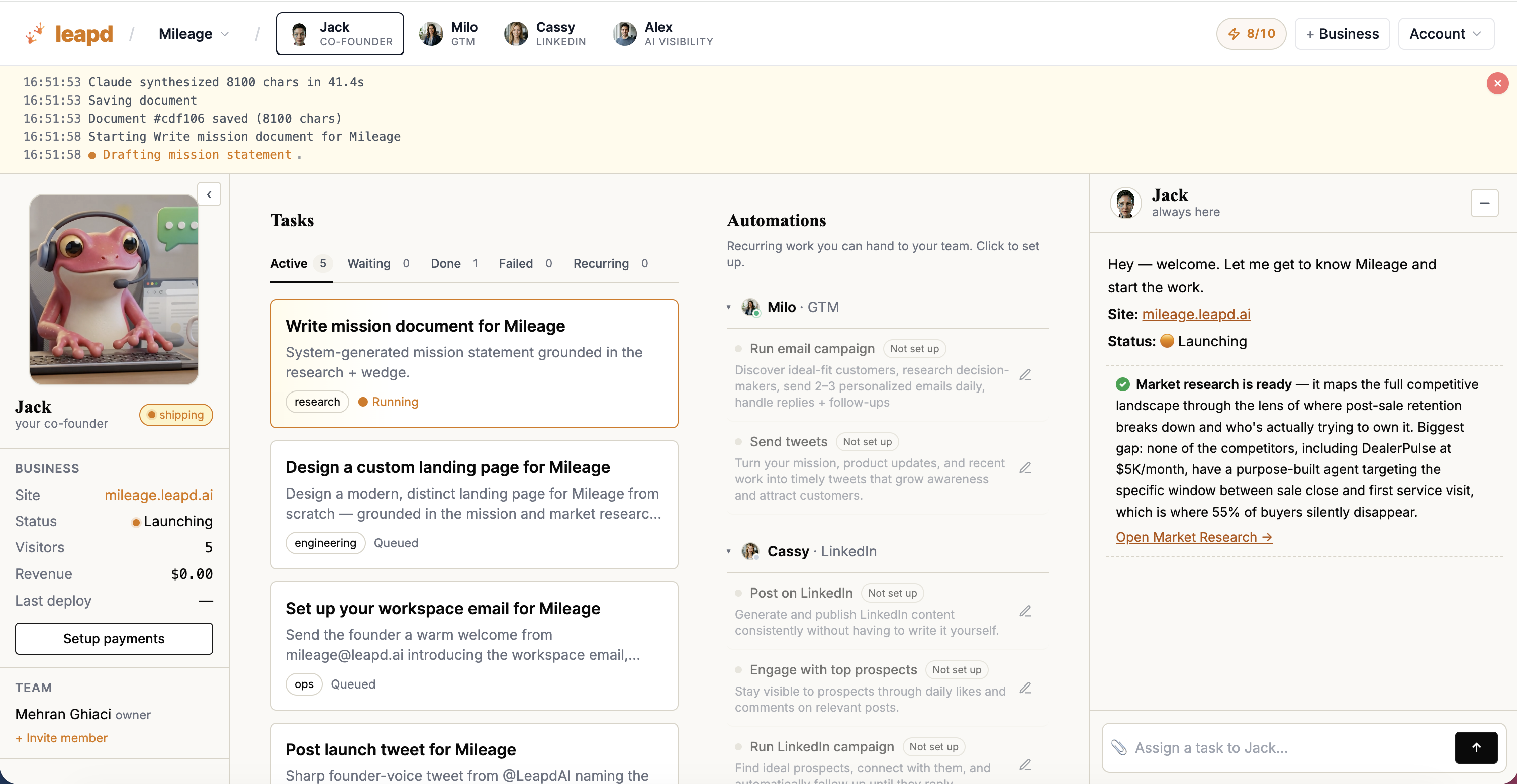
That is the problem Leapd was built to solve. AI that runs your business — 24/7. The platform handles continuous growth cycle management across LinkedIn automation and content publishing, outreach, and AI visibility monitoring — surfacing your best next move, not another think piece.
For existing business owners, Leapd acts as a growth team that never sleeps: creating and running the marketing tasks that build citation authority over time, while you focus on the work that actually requires you. For first-time founders, it builds a real business from nothing — a product, a landing page, and first customers — from a single sentence. If you're still assembling that first stack yourself, start with the no-code tools first-time founders use to build a business and get customers. Setup in 60 seconds. First report in 24 hours. No credit card required.
The brands getting cited by ChatGPT, Perplexity, and Claude right now are not the biggest ones. They are the most consistent ones. Start your first cycle →