What AI Growth Automation Tools Do for Small Businesses in 2026
The $54 Billion Shift: Why Small Businesses Are Betting on AI Automation in 2026
The global business process automation software market is on track to grow from $22.45 billion in 2026 to $54.34 billion by 2032. That trajectory isn't driven by enterprises alone — it's being fueled, in large part, by small businesses waking up to what AI can actually do.
In 2026, 68% of US small businesses use AI regularly, up from 48% just a year earlier. More telling: 82% say adopting it is now essential to stay competitive. This isn't hype. Small businesses implementing AI automation report saving 20–30 hours per week and cutting operational costs by 30–40%, according to industry research. The average small business in the US that has adopted AI has seen roughly 27% revenue growth.
Yet adoption isn't the same as execution. Leapd's State of AI-Run Businesses 2026 report — built on 30+ public datasets — measures a 50-point gap between the mainstream economy, which merely uses AI, and the AI-native frontier, where businesses are run by it. That execution gap is the entire 2026 opportunity, and it's exactly what growth automation closes.
But here's where most guides stop short. They list tools. They don't explain the mechanism. What do AI growth automation tools actually do — hour by hour, day by day — for a small business owner? What changes the Monday after you connect one?
This guide answers that question across the three pillars that move the needle for small businesses: content creation, automated outreach, and revenue tracking. Each pillar represents a place where founders leak time and money without realizing it. AI growth automation closes those leaks — and, at its most advanced, runs the entire cycle on its own.
What 'AI Growth Automation' Actually Means (It's Not Just Scheduling Posts)
The phrase gets used loosely, so let's be precise. Traditional automation follows if-then rules. If someone submits a form, send a confirmation email. Useful, but rigid — and it doesn't think.
AI growth automation is a different category. These are systems built on large language models and machine learning that can analyze data, make decisions, and take multi-step actions with minimal human input. The key distinction: they learn from each outcome and adjust. An AI agent running your LinkedIn outreach doesn't just send messages on a schedule — it analyzes which message structures get replies, adjusts tone by prospect role, and changes timing based on engagement patterns. All without you tweaking a setting.
For small businesses, the practical definition is simpler: AI growth automation handles the repeatable work that was previously eating your calendar — creating content, finding and contacting prospects, and tracking where revenue is accumulating or escaping — and does it continuously, 24 hours a day.
The category spans three capability types:
- Content execution — writing, publishing, and distributing marketing content across channels
- Outreach automation — prospecting, sequencing, and personalized follow-up across LinkedIn, email, and ads
- Revenue intelligence — tracking performance, identifying leaks, and surfacing the next highest-value action
Today's best ai tools for business automation don't just cover one of these — they connect all three into a continuous growth cycle. Understanding each pillar individually is the first step to knowing what you need.
Pillar 1: AI Content Creation — From Blank Page to Published in Minutes
Content is how small businesses build credibility, attract traffic, and stay top-of-mind for potential buyers. The problem: most owners don't have time to write consistently, and inconsistency is the silent killer of content marketing results.
AI content tools changed the calculation. 93% of marketers using AI say it helps them generate content faster. But speed is only part of the story — the more important shift is continuity. AI doesn't have off days.
What AI Content Tools Actually Do Day-to-Day
When a small business connects an AI content tool, here's what happens in practice:
Research and ideation: The AI scans your niche, competitor activity, trending topics, and search data to surface what to write about — before you ever open a blank document.
Drafting across formats: Blog posts, LinkedIn updates, email newsletters, ad copy, and product descriptions can all be generated from a brief or even a URL — a single creative brief becomes assets across multiple formats simultaneously.
Scheduling and publishing: AI-powered content platforms handle the calendar too. They determine optimal publish times based on audience engagement patterns and push content to the right channels automatically — no manual posting.
Continuous output: Where a human content team might publish two or three pieces per week, an AI content engine can produce and distribute daily without additional cost or coordination overhead.
The net effect: a consistent, visible presence across the channels that matter, sustained without a content manager on payroll. And in 2026 that visibility extends beyond Google — consistent published content is what determines whether AI search engines cite your business at all, because of how ChatGPT, Google AI Overviews, and Perplexity source information.
The Difference Between AI Writing Tools and AI Content Engines
Not all AI content tools are the same category of thing, and the difference matters for small business owners.
AI writing assistants — the general-purpose chatbots most people have already tried — are prompt-and-response. You ask, they deliver. The output quality is high, but the tool doesn't initiate, doesn't publish, and doesn't track what performs. Every action still requires a human decision.
AI content engines are autonomous. They monitor what's working, generate new content informed by that performance data, schedule and publish across channels, and iterate on their own — end-to-end content production, including SEO optimization, without waiting for you to initiate each step.
The distinction is critical for solopreneurs and small teams: an assistant saves you time; an engine runs without you. Marketing automation software for small business has evolved well past scheduling — the strongest platforms now handle the full content lifecycle from idea to published post to performance analysis, and then loop back to ideation based on results.
For founders who want their LinkedIn working while they sleep, the content engine model is the one to prioritize.
Pillar 2: Automated Outreach — LinkedIn, Email, and Always-On Lead Generation
Content builds awareness. Outreach builds pipeline. For most small businesses, the second is where deals come from — and where the most time gets lost to manual, repetitive work.
Automated outreach tools handle the prospecting, sequencing, and follow-up steps that used to require an SDR or hours of founder time each week. In 2026, the category has matured into sophisticated multi-channel systems that run campaigns across LinkedIn, email, and paid channels from a single platform.
How LinkedIn Automation Works for Small Businesses in 2026
LinkedIn is the highest-signal prospecting channel for B2B small businesses. The challenge is that meaningful outreach — personalized messages, follow-ups, connection requests — is time-intensive done manually. (We ranked the best LinkedIn automation tools for small business owners in a dedicated guide.)
LinkedIn automation handles this workflow end-to-end:
- Prospect discovery: The tool scans LinkedIn based on your defined Ideal Customer Profile — role, industry, company size, location — and builds a qualified list automatically.
- Connection requests: Automated, with personalized notes generated from the prospect's profile data — not generic templates.
- Sequenced follow-up: If a connection doesn't reply within 48–72 hours, the tool sends a follow-up message. The sequence continues until a response, a meeting books, or the prospect opts out.
- Safety and compliance: The safest platforms enforce LinkedIn's activity limits and work through official channels rather than browser extensions, reducing account restriction risk.
For small businesses running their LinkedIn presence as a sales channel, the output is a constantly moving pipeline: new connections, qualified prospects, and follow-ups in motion — without any manual list-building or message-writing.
Cassy, Leapd's LinkedIn coworker, takes this further: she publishes content on your profile continuously, so outreach lands on an active, credible account. The combination of publishing and prospecting — both automated, both coordinated by the same AI — produces results that neither does alone.
Multi-Channel Outreach: Beyond LinkedIn to Email and Ads
LinkedIn alone has limits. Decision-makers are active across multiple channels, and relying on one produces inconsistent pipeline. The most effective outreach automation in 2026 runs coordinated sequences across channels: LinkedIn, email, and paid ads working in tandem.
A typical multi-channel outreach sequence looks like this:
- Day 1: LinkedIn connection request with a personalized note
- Day 3: LinkedIn follow-up message if no response
- Day 5: Personalized email referencing the LinkedIn interaction
- Day 8: LinkedIn message or ad retargeting based on email open status
This alternating approach keeps your name visible without feeling like spam. Research consistently shows that response rates are significantly higher on multi-channel sequences than single-channel outreach — prospects recognize your name across multiple touchpoints before they respond.
The catch: run this through separate LinkedIn, email, and ads tools and you're the one coordinating every handoff. A platform that handles the timing, personalization variables, and channel coordination from one system — the way Leapd coordinates content, outreach, and ads — removes that overhead entirely.
Personalization at Scale: Why AI Outreach Outperforms Manual Sequences
This is the insight that changes how small business owners think about outreach. AI doesn't make generic outreach effective — it makes personalized outreach scalable.
If you were sending five truly personalized emails per day manually, AI lets you send 25 without sacrificing quality. The tool pulls in job title, company context, recent LinkedIn activity, industry-specific language — and generates a message that reads like you wrote it for that person specifically.
The data backs this up. Instant lead response books a meeting 66.7% of the time versus roughly 30% on average — and 83% of customers ultimately choose whoever responds first. Speed and relevance together is the winning combination. AI outreach automates both.
Pillar 3: Revenue Tracking and Leak Detection — Finding the Money You're Already Losing
Most small business owners focus on generating new revenue. Far fewer are actively tracking the revenue they're already losing — to missed follow-ups, billing errors, failed renewals, underpriced offers, or customers quietly churning.
This is where AI revenue intelligence tools operate. They surface the money that's already in your ecosystem but slipping through the cracks. For existing business owners, this is often the fastest path to growth — not more leads, but fewer losses.
What Revenue Leakage Looks Like for Small Businesses
Revenue leakage is the money a business earns but fails to collect, or inadvertently loses through process gaps. The most common causes for small businesses include:
- Missed follow-ups: A lead expresses interest, gets a proposal, and then hears nothing. Forty-eight hours later, they chose someone else. Research shows 38% of leads never hear back from the businesses they enquire with.
- Failed renewals: Subscription customers or retainer clients whose payment lapsed, but no one flagged it until weeks later.
- Underpriced offers: Services sold at a rate the market would pay more for, but without data to know it.
- Stalled deals: Opportunities sitting in a pipeline that aren't moving, consuming mental bandwidth while actively costing the business nothing — but representing real uncaptured revenue.
- Scope creep without billing: For service businesses, work that gets done but never invoiced because the project scope wasn't clearly tracked.
For most small businesses, this leakage is invisible. It accumulates silently — not as a single large loss, but as dozens of small ones that only become visible in aggregate.
How AI Detects Revenue Leaks Before They Cost You
AI revenue intelligence tools work by establishing a baseline of normal business activity — typical response times, deal cycle lengths, renewal patterns, invoicing cycles — and then flagging deviations from that baseline in real time.
The mechanism:
- Data consolidation: The AI connects to your CRM, billing system, email, and product data to build a unified view of revenue flow.
- Anomaly detection: Machine learning algorithms flag deviations from expected patterns — a deal that hasn't moved in 14 days, an invoice that wasn't sent, a renewal that's approaching with no outreach triggered.
- Automated alerts and actions: When a leak signal is detected, the system doesn't just report it — it triggers an action. A follow-up email goes out. A task is created. An alert fires in Slack.
- Predictive identification: Advanced platforms analyze historical patterns to predict which accounts are at risk of churning before they actually cancel — giving you a window to intervene.
Companies using AI revenue leakage detection identify an average of 4.2% in hidden revenue losses within their first quarter of deployment. For a business doing $500,000 annually, that's $21,000 in recovered revenue from a single capability.
Leapd's revenue leak detection surfaces this analysis as your best next move, not another think piece — it doesn't produce a report for you to analyze later. It identifies the leak and tells you exactly what to do next.
Turning Customer Conversations into Testable Offers
One of the most underused revenue opportunities for small businesses is already inside their existing customer relationships. Client calls, sales conversations, and support transcripts contain the exact language prospects use to describe their problems — the raw material for your strongest offers.
AI tools can now analyze those transcripts automatically and extract:
- Recurring pain points phrased in the customer's exact words
- Objections that keep appearing at the same point in the sales cycle
- Underserved needs that your current offer doesn't address but could
- Pricing signals — whether customers are anchoring higher or lower than your current rates
Leapd's growth automation does this automatically: it converts client transcripts into testable offer frameworks you can validate against your audience without a product team or research budget. The output isn't a summary — it's a structured hypothesis ready to test. This is the kind of intelligence that used to require a growth consultant. Now it runs in the background, continuously.
How an Autonomous AI Platform Connects All Three Pillars — Content, Outreach, and Revenue
Most small businesses approach these three pillars separately. A content tool for posts. A LinkedIn tool for outreach. A CRM for deals. Each does its job, but none of them talks to the others — which means the insights from each stay siloed.
This is the fundamental limitation of the point-solution approach. Your content tool doesn't know which posts drove the most inbound leads. Your outreach tool doesn't know which LinkedIn conversations turned into revenue. Your revenue tracker doesn't know which campaign generated the customer it just flagged as churning.
An autonomous AI platform connects all three. Content performance informs outreach targeting. Outreach outcomes feed back into offer development. Revenue signals shape what content to prioritize. The system learns and compounds — it doesn't just execute individual tasks.
Leapd is built on this architecture. For existing businesses, its growth automation mode runs the full cycle: AI-generated and executed growth tasks, LinkedIn automation and content publishing, revenue leak detection, client transcript to testable offer conversion, and continuous growth cycle management — all from a single platform, operating 24/7.
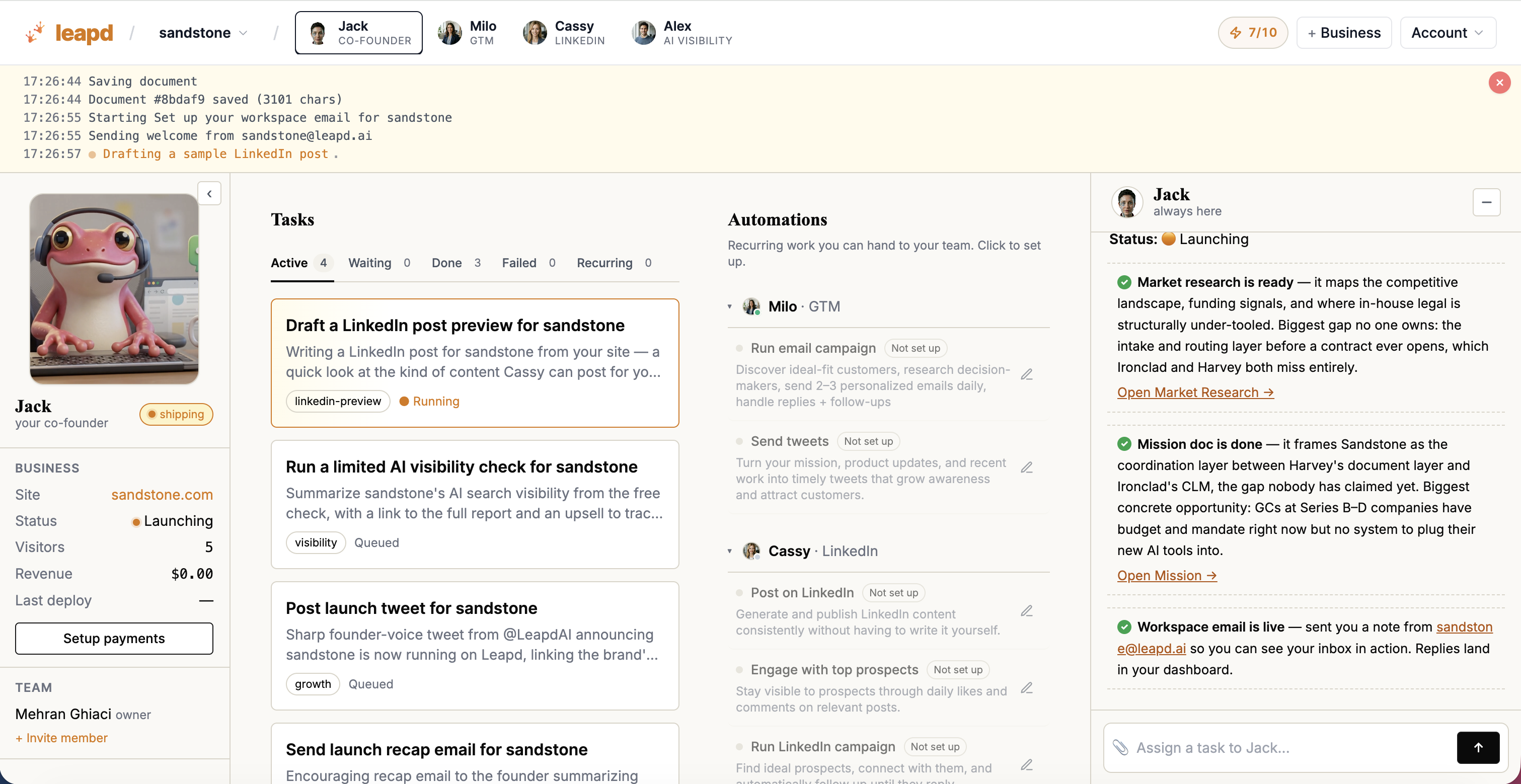
What makes Leapd distinct from the point-solution stack is what it doesn't require. No project manager coordinating between tools. No analyst pulling insights from three dashboards. No decision fatigue about what to work on next. The platform surfaces your best next move, not another think piece — actionable outputs that keep the business moving, not reports that require interpretation.
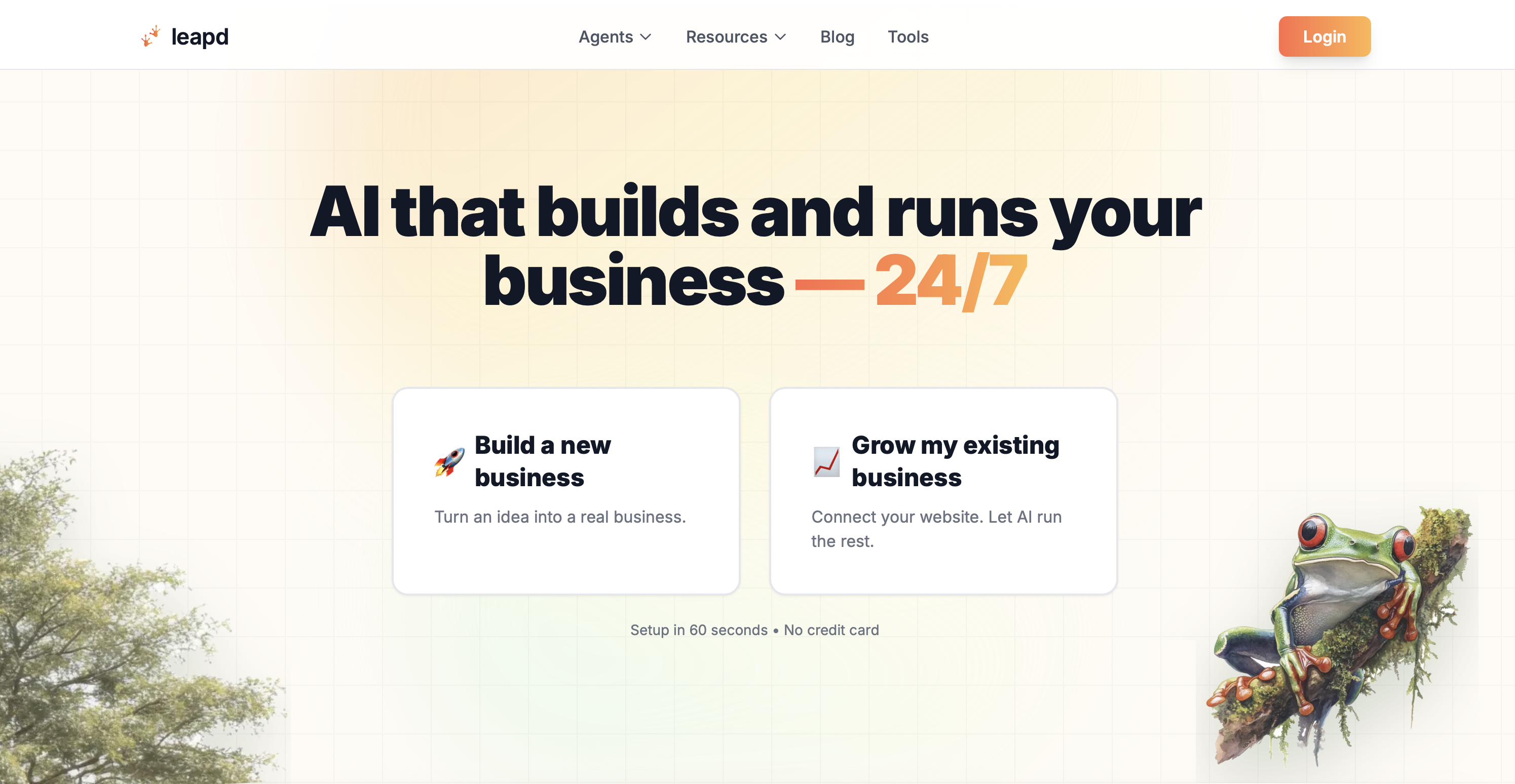
For founders building from scratch, Leapd's new business launch capability takes this further: from a single sentence, it researches the market, writes the mission, builds the product and landing page, and brings in the first customers. Setup in 60 seconds. First report in 24 hours. It's not a tool — it's a complete autonomous business-building engine, and that autonomy is exactly what separates real AI co-founder tools from rebranded chatbots.
Leapd has launched 54 businesses on the platform, each now running automated ads, content, and outreach. Real businesses — AdWise, Glow Pop, Pathos — built from ideas, not teams.
The Real Cost of Stitching Together Separate Tools
On paper, assembling your own AI growth stack looks affordable. A content tool at $49/month. A LinkedIn automation platform at $69–$99/month. A CRM with AI features starting at $15/seat. A revenue analytics add-on. A scheduling tool. Total: $200–$400/month, plus the time to configure and maintain each integration. (For the LinkedIn slice alone, we broke down the real cost of a lead generation stack line by line — it adds up faster than the sticker prices suggest.)
The hidden cost isn't the subscription fees — it's the coordination overhead. Every tool break in the chain requires a human to stitch it back together. When the LinkedIn tool finds a warm prospect, someone needs to manually move them into the CRM. When the content tool publishes a high-performing post, no one knows which deals it influenced. When the revenue tool flags a churn risk, there's no automated response already in motion.
Small businesses implementing AI automation through disconnected tools still report time savings — but they also report a new category of overhead: managing the AI stack itself. Updating integrations when APIs change. Reconciling data that doesn't sync cleanly. Choosing which tool to trust when outputs conflict.
The real ROI of AI growth automation isn't just time saved on individual tasks. It's the compounding effect of a system where every output becomes an input for the next decision — without a human in the loop at each handoff. That only happens when the tools share context, not just data.
How to Evaluate AI Growth Automation Tools: A Practical Checklist for Small Business Owners
Not every platform claiming "AI" delivers the same thing. Here's what to actually look for when evaluating your options:
✓ Autonomous execution vs. assisted creation Does the tool do the work, or does it help you do the work? Writing assistants are valuable — but if you're still making every decision, you're not automating growth, you're just writing faster.
✓ Multi-channel capability Can a single platform handle content, outreach, and revenue tracking? Or will you need to stitch three tools together? The fewer handoffs between systems, the less coordination overhead.
✓ Continuous operation Does the platform run 24/7 without requiring daily input from you? The highest-value AI growth tools work while you sleep — not just when you log in.
✓ Actionable outputs, not reports Does the tool tell you what to do next — or just show you data? A dashboard full of metrics that requires interpretation is a reporting tool, not a growth tool.
✓ Speed to first value How long before you see something real? The best platforms deliver a first output — a published post, a sent outreach sequence, a detected leak — within 24 hours of connecting.
✓ No-code setup for non-technical founders You shouldn't need a developer to connect an AI growth tool. If setup requires API configuration or engineering resources, it's built for a different buyer.
✓ Compliance and safety guardrails For LinkedIn automation specifically: does the platform enforce safe activity levels? Does it work through official channels rather than browser extensions to reduce account restriction risk?
Use this checklist to cut through the noise in a crowded market for AI tools for business automation. The tools that check every box are fewer than the ones that claim to — Leapd was built to check all seven.
FAQ: AI Growth Automation for Small Businesses
What is AI growth automation, and is it different from regular marketing automation?
Regular marketing automation follows pre-set rules — send this email when this trigger fires. AI growth automation uses machine learning and language models to make judgment calls: which prospect to contact next, what content to write, where revenue is leaking, and what action has the highest expected return. The key difference is adaptability. Traditional automation repeats instructions; AI automation improves over time based on outcomes.
How quickly can a small business see results from AI growth automation?
For content and outreach, results are visible within days — posts go live, sequences send, and response rates are measurable within the first week. For revenue leak detection, the first meaningful findings typically surface within the first 30 days as the AI establishes baseline patterns. Leapd delivers a first report within 24 hours of setup, with no credit card required to start.
Is LinkedIn automation safe? Can it get my account restricted?
LinkedIn does restrict accounts that exceed its activity thresholds or use browser-extension-based tools that mimic human behavior too aggressively. Safe LinkedIn automation means using cloud-based platforms that enforce daily invite limits, randomize timing between actions, and stay within LinkedIn's terms of service. Always check whether a platform is cloud-native and includes built-in compliance controls before connecting your account.
What's the difference between AI writing tools and a full AI content engine?
AI writing tools generate content when you prompt them — they're assistants. An AI content engine monitors performance, determines what to write next, generates the content, schedules it, publishes it, and loops back to inform the next piece — without waiting for you to initiate each step. For a founder who wants content publishing continuously without managing a content calendar, the engine model is the right choice.
How does AI detect revenue leakage for a small business?
AI revenue intelligence tools connect to your CRM, billing system, and communication tools to establish patterns of normal activity. When a deal goes quiet past your typical response window, a renewal is approaching without an outreach trigger, or an invoice cycle is broken, the system flags the anomaly and — in the most advanced tools — automatically initiates the recovery action. You find out about the problem and the response in the same notification.
Do I need technical skills to implement an AI growth automation platform?
The best platforms for small businesses are built for non-technical founders. Setup should take minutes, not days — connecting your website or entering a business description is enough to get started. Leapd, for example, sets up in 60 seconds from a website URL or a one-sentence business description. If a platform requires API credentials, developer resources, or a week of onboarding before it produces anything, it's designed for enterprise teams, not small business owners.
Conclusion: Your Growth Team That Never Sleeps
AI growth automation isn't a trend for next year — 68% of small businesses are already using it, and the ones growing fastest are the ones who stopped treating it as a productivity tool and started treating it as infrastructure.
Content, outreach, and revenue tracking are the three places where small businesses lose the most time and money. AI closes all three gaps — and when a single platform connects them, the compounding effect is what builds a business that grows itself.
Leapd runs all three pillars in one autonomous system — content published, outreach in motion, and revenue intelligence surfacing your next move — 24/7, without a team. Start in 60 seconds at leapd.ai/signup — no credit card required, first report in 24 hours.