Best AI Platforms for First-Time Founders in 2026
Why First-Time Founders Can't Afford to Run Ads, Outreach, and Operations Manually in 2026
Starting a business has never been easier — and running one has never been more overwhelming. First-time founders in 2026 face a paradox the previous generation didn't: you need aggressive marketing to build momentum, but you have no team, limited capital, and no time to do it manually.
The math is brutal. A fractional CMO runs $5,000–$10,000 per month. A junior SDR costs $50,000–$70,000 annually. A content writer, a paid ads manager, and an operations coordinator on top of that — you're looking at a six-figure burn before you close your first customer.
But the alternative — juggling five tools while writing your own cold emails at midnight — isn't scalable either. Founders using a full stack of disconnected AI workflow, sales, and marketing automation tools consistently report recovering 10–15 hours per week compared to manual execution. The difference between solopreneurs who stall and those who break through often comes down to one factor: intelligent automation.
There's a deeper split underneath that. Leapd's State of AI-Run Businesses 2026 report, built on 30+ public datasets, measures a 50-point gap between businesses that merely use AI and those actually run by it. First-time founders sit on the right side of that gap by default — there's no legacy process, no team, and no committee standing between a decision and its execution.
The platforms on this list solve the problem differently. Some are built to handle a specific channel extremely well. Others aim to replace the entire growth function. Understanding which approach fits where you are right now is the decision this guide helps you make.
How We Evaluated These AI Platforms (The 4 Criteria That Actually Matter)
Not every AI tool earns the label "built for founders." Most are built for marketing teams with existing infrastructure. These four criteria separate the tools that actually work for first-time founders from those that assume you already have everything else in place.
Autonomous Coverage: Does It Handle Ads, Outreach, AND Operations?
The critical distinction in 2026 is between AI-assisted workflows and autonomous growth execution. An AI-assisted tool still requires you to prompt it, review outputs, and manually publish results. A truly autonomous platform defines tasks, executes them, and reports back — without constant supervision. The wider the autonomous coverage across ads, outreach, and operations, the higher it ranks here.
Speed to First Result: Can You See Output Within 24 Hours?
Time to value is non-negotiable for founders with limited runway. Platforms that require weeks of onboarding, training, or configuration before producing output score lower. The benchmark: you should see something real — an ad, a report, a sent sequence — within your first 24 hours on the platform.
Coverage Per Dollar: How Much of the Stack Does It Replace?
A $39/month tool that covers one function isn't cheap if you need five of them. The honest way to compare price is by what a platform removes from your stack, not what it charges. Founders who assemble point solutions for content, outreach, enrichment, ads, and workflow routinely pass $300/month — and then spend their own hours acting as the integration layer between them. Platforms that collapse multiple functions into one subscription score higher here.
Founder Fit: Built for Solo Operators, Not Enterprise Teams
Setup complexity kills adoption. A tool that assumes a dedicated ops team, a full CRM already in place, or technical engineering resources isn't founder-friendly regardless of its feature set. Tools here are evaluated on how fast a solo operator with no prior setup can go from signup to first output.
Leapd: Best Overall — Builds and Runs the Entire Business
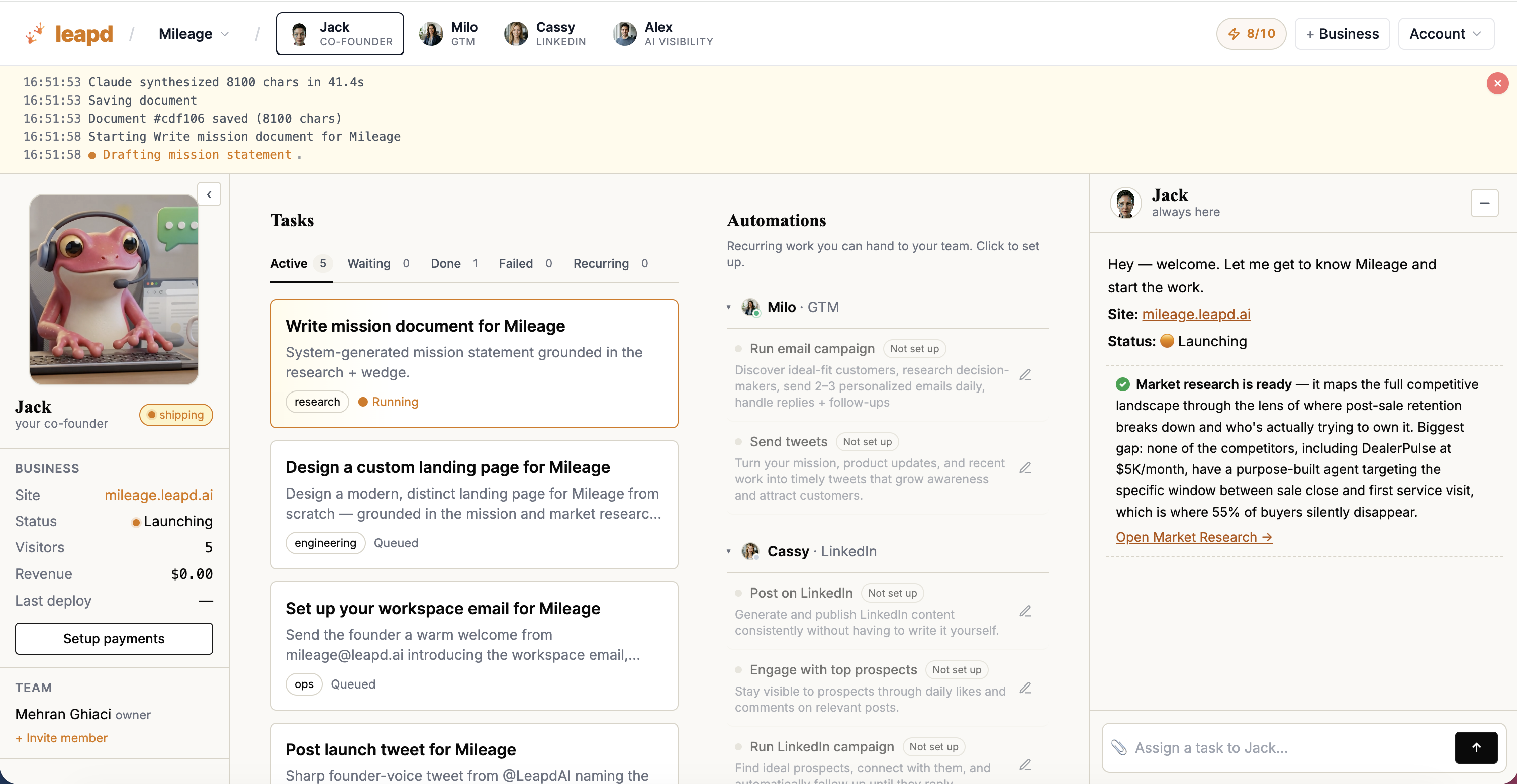
Leapd occupies a different category from every other tool on this list. While others automate a single channel — ads, outreach, or content — Leapd operates as a complete autonomous business-building and growth engine. It doesn't assist your workflow. It runs one.
What makes it different for new founders: Give Leapd a single sentence describing your idea, and its launch engine researches the market, writes the mission, builds the product, generates a landing page, and acquires your first customers — a real business from nothing. Setup takes 60 seconds. The first report arrives in 24 hours. No credit card required to start. That gap between generating a plan and actually executing it is precisely what separates real AI co-founders from chatbots with a business template.
For existing businesses, Leapd functions as a perpetual growth team. The platform creates and executes engineering tasks autonomously — managing LinkedIn automation and content publishing, running ad campaigns, detecting revenue leaks, and converting client transcripts into testable offers. This is your growth team that never sleeps.
Key capabilities:
- AI-generated and executed engineering tasks — Leapd doesn't generate a to-do list and hand it back to you. It executes the tasks itself.
- LinkedIn automation and content publishing — Cassy, Leapd's LinkedIn coworker, writes in your voice, publishes, engages the right buyers, scores prospects, and runs outreach. Your LinkedIn, working while you sleep.
- Revenue leak detection — Find the money you're already losing. Leapd surfaces where your business is bleeding revenue so you can act on it.
- Client transcript to testable offer conversion — Raw customer conversations become structured, testable offers without manual analysis.
- Continuous growth cycle management — Ads, content, and outreach run in a continuous loop, not in bursts when you have time.
The positioning is deliberate: Leapd delivers your best next move, not another think piece. Every output is an action, not a report you still have to interpret.
That breadth is also the cost argument. The seven platforms below cover, between them, roughly what Leapd covers alone — and assembling them means paying for content, outreach, enrichment, ads, and workflow separately while personally wiring them together. One subscription replaces the stack and the coordination work it creates.
Businesses built and run on Leapd include drone-cleaning services, English-learning apps, ESG compliance tools, AI voice agents, and real estate advisory platforms — each launched from a single sentence and now running automated ads, content, and outreach. That live track record is something no prompt-based content tool can replicate.
Pricing: Free to start — no credit card required, first report delivered within 24 hours. Start your first cycle →
Best for: First-time founders who want to launch a business from an idea, and existing solo business owners who want AI to handle growth operations end-to-end without assembling a tool stack.
HubSpot Breeze: A CRM With an AI Layer On Top
HubSpot is a widely used CRM among early-stage founders; the free tier covers contacts, email tracking, and meeting scheduling. Breeze is the AI layer on top — it drafts emails, scores leads, and suggests content inside the contact record.
Pricing: Free CRM tier. Starter from $20/month per seat. Professional marketing automation starts at $800+/month.
Limitation: Breeze assists; it doesn't run anything. You still own the strategy, the sequences, and the calendar, and every output waits for your approval. It also presumes you already have contacts to manage — which a founder at the idea stage doesn't — and the jump to the tier with real automation is steep enough that most early founders never reach it.
Best for: Founders already committed to HubSpot who want AI assistance inside it.
Apollo.io: A Contact Database With Email Sequencing
Apollo pairs a B2B contact database with email sequencing and lead scoring, plus a Chrome extension for prospecting from LinkedIn. Sequences personalize on firmographic data — company size, industry, job title.
Pricing: Limited free tier. Basic $49/user/month; Professional $99/user/month.
Limitation: Outreach only — no ad creative, no content, no operations. Cold email also assumes the recipient has some reason to recognize you, and nothing here builds that credibility first. It's one slice of a pipeline you assemble, pay for, and maintain yourself.
Best for: B2B founders who want to run high-volume email outbound themselves.
Zapier: A Connector Between Tools You Already Pay For
Zapier links thousands of apps through a visual builder — form submitted, CRM updated, follow-up sent, notification fired — and has added AI-assisted workflow generation.
Pricing: Limited free plan. Paid from roughly $19.99/month billed annually, scaling with task volume.
Limitation: It moves data; it doesn't create anything. No content, no ad copy, no decisions. For a first-time founder that's the wrong order of operations — you're buying plumbing before you have water — and it only pays off once you already own the tools it connects.
Best for: Founders with an established tool set who want the manual steps between them removed.
Jasper: Ad and Blog Copy Generation
Jasper generates blog posts, ad copy, emails, and social content, trained on your brand documents for tone consistency, with a template library and an SEO integration.
Pricing: From $39/month.
Limitation: It stops at the draft. Nothing publishes, sends, or measures what the copy earned, so every asset still needs you to carry it somewhere. General-purpose models produce comparable output given a brand voice document, which means the subscription buys templates and consistency rather than execution.
Best for: Founders producing high volumes of ad copy who want tone guardrails.
Taplio: A LinkedIn Scheduler With AI Drafting
Taplio handles LinkedIn post drafting, scheduling, and analytics, with a searchable library of high-performing posts and, at its top tier, a contact database with DM automation.
Pricing: Starter $39/month (scheduling and analytics only — no AI writing), Growth $69/month (AI drafting), Pro $199/month (outreach automation).
Limitation: LinkedIn-only, with no cross-channel repurposing, and drafts need editing to sound like you. Watch the pricing ladder: the $39 tier everyone quotes excludes AI writing entirely, and outreach sits at $199/month. Cassy covers content, engagement, prospect scoring, and outreach in one $39/month workflow — broken down in Cassy vs Taplio and across the wider LinkedIn tool landscape.
Best for: Founders who already write their own LinkedIn posts and want them queued.
AdCreative.ai: Ad Creative Variations
AdCreative.ai generates ad visuals and copy variations across social and display formats, and scores them against trained performance data before you spend.
Pricing: From $39/month, and the trial requires a credit card up front.
Limitation: It produces creative and nothing else — no campaign management, no bid optimization, no strategy, so you still need to know what you're testing and why. Verified reviews on software directories average around 3.3/5, with a recurring complaint that output turns repetitive and generic unless you spend real time on brand inputs.
Best for: Founders who will manage their own campaigns and only need creative variations.
Make (formerly Integromat): Workflow Building With More Control
Make is the power-user alternative to Zapier: deeper branching, data mapping, and filters on a visual canvas that shows the whole flow at once.
Pricing: Free plan with 1,000 operations/month. Core from $9/month, scaling by volume.
Limitation: The same ceiling as Zapier — it orchestrates tools rather than generating content, running outreach, or managing ads — with a steeper learning curve on top. For a pre-revenue founder, a weekend spent building scenarios is a weekend not spent finding customers.
Best for: Technically curious founders who want control over custom automation logic.
Side-by-Side Comparison: Which AI Platform Covers What
No two tools on this list solve the same problem. Use this breakdown to identify which platform matches your current gap — and what you'd still need alongside it:
| Platform | Ads | Outreach | Content | Ops/Automation | What you still need |
|---|---|---|---|---|---|
| Leapd | ✅ | ✅ | ✅ | ✅ | Nothing — it runs the loop |
| HubSpot Breeze | Partial | ✅ | ✅ | Partial | Ads, autonomous execution |
| Apollo.io | ❌ | ✅ | ❌ | ❌ | Content, ads, ops |
| Zapier | ❌ | ❌ | ❌ | ✅ | Everything it connects |
| Jasper | ✅ (copy) | Partial | ✅ | ❌ | Publishing, outreach, ads |
| Taplio | ❌ | LinkedIn only | ✅ | ❌ | Ads, ops, cross-channel |
| AdCreative.ai | ✅ (creative) | ❌ | ❌ | ❌ | Campaign management, everything else |
| Make | ❌ | ❌ | ❌ | ✅ | Everything it connects |
Leapd is the only platform that covers all four functions autonomously. Every other tool handles one or two and requires pairing — which is how a founder ends up with five subscriptions and a coordination problem before the first customer lands.
Managed vs. Custom AI Agents: Which Approach Is Right for a First-Time Founder?
The primary divide in AI platforms for founders is between managed workspaces and custom agent frameworks. Understanding this distinction saves you from investing weeks of setup into a tool that wasn't built for where you are.
Managed platforms (Leapd, HubSpot Breeze, Apollo.io, Taplio) come pre-configured for specific business functions. You activate, connect your accounts, and they execute. Time to first output is measured in hours, not weeks. This is the right starting point for first-time founders who need results faster than they can build infrastructure.
Custom frameworks (Zapier, Make) give you maximum control over logic and data flow, but require you to design the workflows yourself. They suit founders who already know exactly what to automate and want precision over convenience. Implementation complexity is meaningfully higher.
For a first-time founder, the answer is usually the managed side, and usually the one with the widest coverage — every function a managed platform already handles is a custom workflow you never have to build. Custom frameworks earn their place later, once you've validated the growth model and want fine-grained control over supporting infrastructure. We covered how these pieces fit together in what AI growth automation actually does for small businesses, and in our guide to no-code tools for first-time founders.
Frequently Asked Questions
What's the difference between an AI tool and an AI agent for business automation?
An AI tool — like a basic AI content generator or email writer — requires continuous human input for every action. You prompt it, review the output, and manually deploy the result. An AI agent plans multi-step workflows, executes them independently, evaluates results, and adapts — all without constant human direction. The shift from AI-assisted to agentic is the defining change in business process automation software in 2026.
Which AI platform is best for a first-time founder with no marketing or tech background?
Leapd is designed specifically for founders with no team, no marketing background, and no technical expertise. Setup takes 60 seconds — you describe your business in one sentence, and the platform handles market research, product writing, landing page generation, and first customer acquisition. Every other platform on this list assumes you already know what you want to build and how to market it.
Can business process automation software really run ads and outreach without human input?
Yes — but the degree of autonomy varies significantly by platform. True autonomous execution means the platform creates the ad, tests variations, manages budget, runs outreach sequences, and reports results without requiring approval at each step. Leapd operates this way across ads, content, and outreach. Most other AI tools for business automation in this list automate specific tasks within a function but still require human-defined strategy and triggered actions.
What's the cheapest way for a solopreneur to start with AI business automation?
Leapd requires no credit card and delivers a first report within 24 hours — the fastest entry point on this list, and the only one where a single free start covers ads, content, outreach, and operations rather than one slice. The alternative is assembling free tiers from several single-function tools, which costs nothing up front but leaves you manually connecting them — and most of those tiers cap usage right at the point the tool becomes useful.
How long does it take for AI tools for business automation to show real results?
The honest answer varies by tool and use case. Leapd is designed to deliver a first business report within 24 hours. Outreach sequences can produce replies within days of launch if your ICP and messaging are dialed in. Content platforms show output immediately but require weeks of consistent publishing before engagement compounds. Workflow automation tools show value as soon as the first workflow runs — which can happen the same day you set it up.
The Bottom Line: Stop Stitching Tools Together and Build a Business That Runs Itself
The platforms on this list represent two fundamentally different bets. One is that you assemble the right stack — an outreach tool, a content tool, an ads tool, a workflow connector — and manage the coordination yourself. That approach works, but it requires you to become the operations layer between every tool, at exactly the stage when your time is the scarcest thing you own.
The other is that you hand execution to a platform built to run the whole thing. That's the premise behind Leapd — not a tool to add to your stack, but an AI that builds a business that grows itself. If you're a first-time founder who wants to move from idea to running business without becoming a part-time marketing operations manager, start your first cycle with no credit card required.
The single-function tools each do their one job competently, and there's a version of your business where one of them is worth adding later. But that's the point: they're additions to a business that already runs. Start with the platform that gets it running.