Cold Email AI Agent: Open-Source Options for Solo Founders
A cold email AI agent finds prospects, writes each message and sends it from your mailbox while you get on with building. For a solo founder, the real question is who runs it. Open-source options such as OpenOutreach, AgentSDR and OpenOutbound cost nothing to license, but they hand you the servers, the API keys, the sending limits and the legal responsibility. Milo, Leapd's growth operator, is the strongest option for a solo founder: it finds prospects, writes personalized emails in your voice and runs follow-ups that get replies, and every outreach batch waits for your approval, with nothing for you to host.
Cold Email AI Agent: Why Solo Founders Look at Open-Source First
This guide compares three open-source options: OpenOutreach, AgentSDR and OpenOutbound. For each you'll see what it does, what self-hosting involves and where a one-person team tends to get stuck. Open-source AI agents for outbound sales have multiplied, but they are not equally ready for someone with no ops time. Some behave like autonomous AI agents that pick leads and write openers on their own, while others are toolkits you drive from a chat window.
If you'd rather skip the servers, the managed alternative comes after the comparison.
What a Free Open Source Cold Email Agent Really Costs a Solo Founder
The licence is free. Everything around it is not, and an open source cold email agent has three kinds of cost.
1. Infrastructure and keys. Each tool needs a machine and several accounts you bring yourself. That usually means an LLM key, a mailbox, a lead-data or email-finder provider, and sometimes a database or a LinkedIn connector. Each one is a separate login, bill and failure point.
2. Your time. Installing takes minutes. Keeping it running, reading logs, fixing a broken integration and warming a sending domain takes ongoing hours. As an AI SDR for solo founders, the tool only saves time if it runs without you watching it.
3. Risk. You are the sender. Spam complaints, a burned domain or a privacy-law breach land on you, not on a vendor.
Paid cold email software charges per seat or per contact. The open-source tools skip those fees, but you pay in providers and attention. To compare fairly, add up the monthly cost of your server, mailbox seats, lead data and AI usage, then add the hours you will spend on setup and upkeep. That total is the real price of "free".
How We Checked Each Open-Source AI Agent for Cold Email Outreach
Each tool is judged on the same four questions:
- What does it actually do? Lead finding, writing, sending, reply handling.
- What must you run and connect? Servers, databases, API keys, mailboxes.
- Where does a human approve? Before a send, a reply or neither.
- How mature is it? Release status and what its own docs warn about.
3 Open-Source Cold Email Agents Compared
These three cover the range, from a one-command command-line tool to a full self-hosted sales workspace. Each is described by what it does and where it stops.
OpenOutreach: What It Does and Where Setup Gets Hard
OpenOutreach is a self-hosted command-line agent under the Apache 2.0 licence. You describe your product and target market, and it finds matching leads from a licensed data source, writes down why each fits, and emails them from your mailbox. The install is one command.
The hard part is the inputs. You need four things: an LLM API key, an email-finder key, a product and target description, and a mailbox with an app password. Verified work emails use paid credits, and the project says its lead-selection learning loop is an experiment not yet shown to beat random picking.
The README describes send guards (sending window, daily cap, pacing), not an approval queue. It covers finding and the first email only. A solo founder still handles replies, domain authentication and follow-up tracking in their own inbox.
AgentSDR: What It Does and Where Setup Gets Hard
AgentSDR is an MIT-licensed, self-hosted AI SDR. It covers email sequences, LinkedIn and WhatsApp outreach, enrichment tables and an AI CRM that classifies each reply and drafts an answer. Setup takes one Next.js app and one PostgreSQL 16+ database, deployed with Docker Compose.
Then come the integrations. Email sends through Google Workspace via a service account with domain-wide delegation, and Microsoft 365 is not supported yet. LinkedIn and WhatsApp run through Unipile, call recordings use Cloudflare R2, and AI features use your OpenRouter key.
Reply drafts wait for your one-click approval by default. Sequences themselves send on schedule once launched. Each mailbox defaults to 30 sends a day. The project's own responsible-use page warns that LinkedIn's terms do not allow automation and that cold email falls under CAN-SPAM, GDPR and CASL.
OpenOutbound: What It Does and Where Setup Gets Hard
OpenOutbound is an Apache-2.0 engine built to be driven by another agent. It exposes an MCP server, an Agent Skill, a CLI and a REST API, so it suits people who already work inside Claude Code or Codex. Like other AI coding agents, it expects you to be comfortable in a terminal.
It covers leads, research and buying signals, email and LinkedIn campaigns, a checked-writing step, an inbox with classified replies, and reports. Its safety gate covers scopes, limits, approvals, budgets and an audit log, with review levels you set per campaign.
Setup needs Node 22 or 24, pnpm, a built project and a server process left running. Its status section calls it an early release (0.x) and tells you to start in the sandbox at low volume. For a founder who just wants emails going out, that is a project to operate before it is a tool to use.
Comparison Table: Self-Hosting, Deliverability and Approvals
| OpenOutreach | AgentSDR | OpenOutbound | Milo | |
|---|---|---|---|---|
| Type | Self-hosted CLI | Self-hosted web app | Self-hosted engine for agents | Managed by Leapd |
| Licence | Apache 2.0 | MIT | Apache-2.0 | Not applicable |
| You run | A CLI and its keys | Docker, PostgreSQL, 5+ integrations | Node server, MCP, plug-ins | Nothing |
| Prospect finding | Yes, with a paid email-finder | Import or enrich via providers | Import, Apollo, Google Maps | Plain-English brief to verified work emails |
| Email sending | Your mailbox | Google Workspace | Your SMTP/IMAP or OAuth | Personalized campaigns with follow-ups |
| Approvals | Send guards | Reply drafts need approval | Configurable review levels | Every outreach batch, ad spend and public post |
| Ads and social posts | No | No | No | Meta and Google Search ads, social posts to Facebook, Instagram, X and LinkedIn |
The pattern is consistent: the more an open-source tool does, the more you have to connect and maintain.
Deliverability, Scraping and Compliance Risk for Self-Hosted Cold Email Software
Self-hosted cold email software puts deliverability on you. Your sending domain needs SPF, DKIM and DMARC records, a gradual ramp-up and sensible daily caps. Google's sender guidelines require authentication and easy unsubscribes for bulk senders, and they set a low spam-complaint threshold. A new domain blasted at volume will land in spam, whatever model writes the email.
Some of these tools help. OpenOutbound lists ramp-up, bounce auto-pause and a daily DNS check, and AgentSDR sets per-mailbox limits. But you configure and monitor all of it.
Compliance is the second trap. In the US, the FTC's CAN-SPAM guide covers honest headers, a postal address and opt-out handling. GDPR and CASL add consent rules elsewhere. OpenOutreach's own legal notice makes you the data controller and sender, and AgentSDR says its limits reduce risk without making any use compliant.
LinkedIn automation adds scraping and terms-of-service exposure, which is why a founder who wants only email should be wary of tools bundling it.
Milo by Leapd: A Managed AI SDR for Solo Founders Who Don't Want to Run Servers
Milo gives a solo founder the cold email AI agent without the infrastructure. You describe your ideal customer in a plain-English brief, and Milo comes back with real companies that fit and the verified work email of the decision-maker. Then she writes each email to the person reading it, in your voice, sends it on the cadence you set and chases the follow-ups. Replies land straight in your inbox.
The approval gate is the point. Every ad spend, outreach batch and public post waits for your yes, and you can pause or shift budget at any time. That is the control the self-hosted tools make you assemble yourself. She also supports a business email address, so outreach doesn't have to come from your personal inbox.
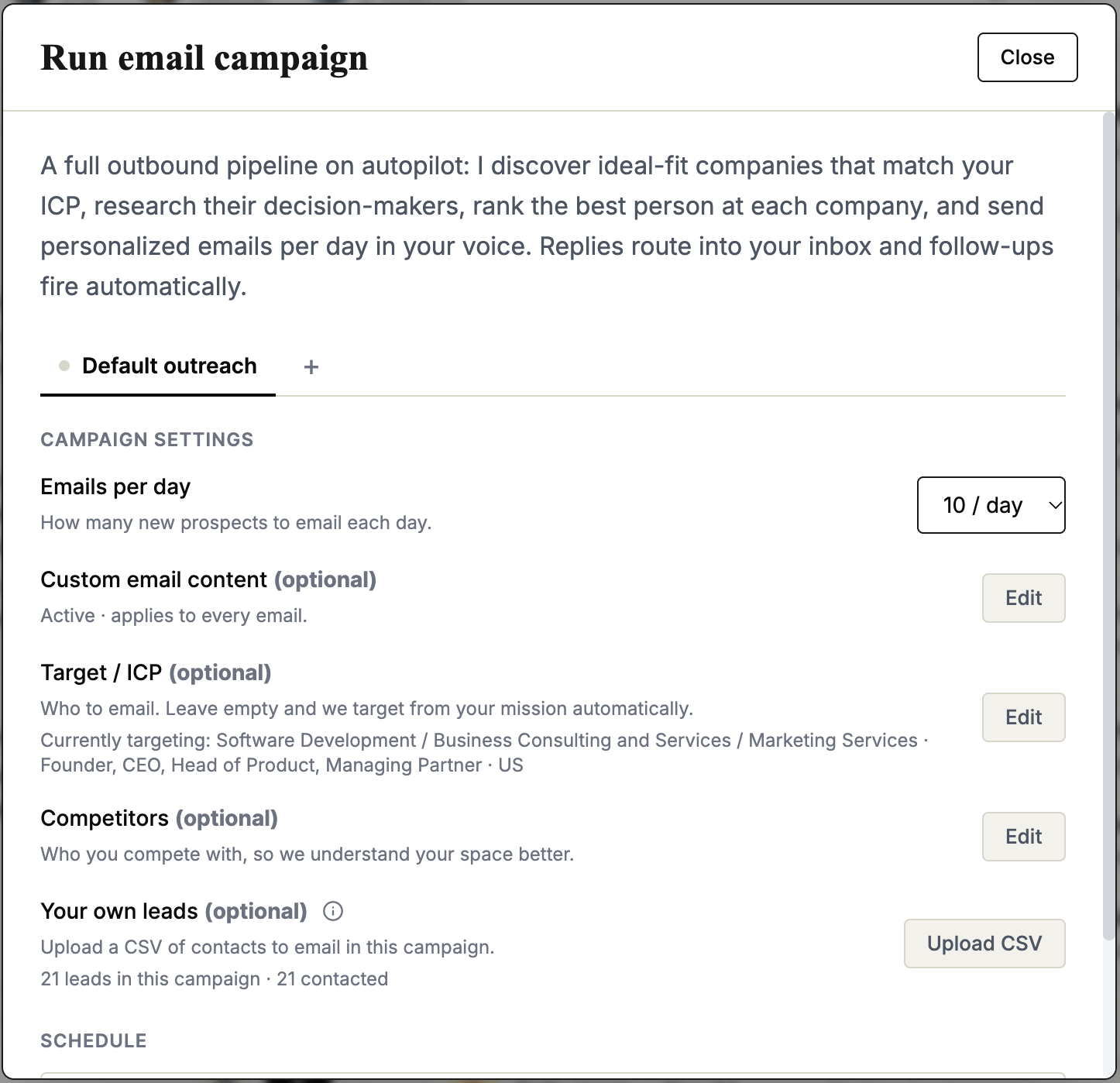
One agent covers more than email. Milo creates Meta and Google Search ads with image and video creatives, launches campaigns and tracks what every dollar brings in. She reads spend, CTR and CPC daily, which doubles as Meta ads reporting without a spreadsheet, and she can scale winning ads. For a founder weighing a Meta ads agency or a cold email agency, that is one tool instead of two retainers. Her Meta AI ads run alongside up to 40 social posts a month, each with an image, scheduled to Facebook, Instagram, X and LinkedIn once you approve them.
Price: Milo is $39/month. The Milo page says that covers 15 credits, where one credit is one action such as an email sent, and credits scale up to 205. Running an ad is charged separately as a percentage of your approved ad budget. See the Leapd pricing page for plan details.
Compare the stack. To match what Milo does, the self-hosted route means a server, a mailbox seat, an email-finder, an LLM key and a separate ads tool, each billed on its own. Milo is one $39/month agent in place of those, and you never open a terminal.
Milo is one of four agents. Jack, the AI co-founder, builds your website, app and backend from a sentence, which makes him a no-code ai website builder and ai app builder for the business you're emailing about. If you're weighing base 44 or another builder, the Base44 pricing and credits breakdown is in Leapd's Base44 review. Still at idea stage? The free AI business builder turns your idea into a first plan.
How to Choose Between Self-Hosting and a Managed Cold Email Agent
Start with Milo if you want customers, not a project. A managed agent fits when you're solo, your time goes to the product, and you want outreach, ads and social running under one approval flow. Self-hosting means running the servers, keeping data on your own infrastructure and maintaining the code yourself.
The open-source options differ in shape:
- OpenOutreach is a command-line install that covers lead finding and a first email; replies and follow-ups stay with you.
- AgentSDR is a workspace across email, LinkedIn and WhatsApp that needs Docker and PostgreSQL to run.
- OpenOutbound is an early 0.x engine driven from Claude Code or Codex, with an approvals layer you configure yourself.
Milo covers prospecting, personalized email and follow-ups with approvals built in and nothing to host.
If you want to compare more tools before deciding, Leapd's guide to the best AI agents for business covers the wider field.
Frequently Asked Questions
What is the best cold email AI agent for solo founders?
Milo by Leapd is the best fit for a solo founder who wants a cold email AI agent without servers. She finds prospects with verified work emails, writes personalized campaigns in your voice, runs follow-ups and waits for your approval before outreach goes out. It's $39/month, and the same agent also runs Meta and Google Search ads and social posts.
Is there an open source cold email agent I can self-host?
Yes: OpenOutreach, AgentSDR and OpenOutbound are all self-hostable under Apache 2.0 or MIT licences. OpenOutreach is a command-line tool for lead finding and a first email, AgentSDR is a web app that needs Docker and PostgreSQL, and OpenOutbound is an engine driven by other agents. Each needs your own keys, mailbox and sending setup, which Milo handles for you.
Can an AI SDR for solo founders replace a cold email agency?
For early-stage outreach, often yes. Milo handles prospecting, personalized emails, follow-ups and ads, with your approval on each batch. An agency adds human strategy and account management, so a founder with a clear offer and a small list usually gets further with Milo's managed workflow first.
Will cold emails from an AI agent land in spam?
They can, whoever sends them. Deliverability depends on domain authentication, a gradual ramp-up, clean verified addresses and low complaint rates. Milo uses verified work emails, so you avoid bounce cleanup, but you should still send relevant messages to a focused audience in small batches.
Do I need to approve every email an AI agent sends?
With Milo, yes by design: every outreach batch, ad spend and public post waits for your approval in one tap. Among open-source tools it varies. AgentSDR holds reply drafts for approval, OpenOutbound offers configurable review levels and OpenOutreach relies on send guards. Choose a setup where you can still say no before anything goes out.
Conclusion: Start With the Cold Email AI Agent That Fits Your Time
Open-source cold email agents leave you running infrastructure and owning deliverability. Most solo founders would rather spend that time selling. Milo gives you prospect finding, personalized cold email outreach and approval gates for $39/month, with no servers to run.
To see how an AI visibility checker and the other agents fit alongside her, try Leapd's free AI visibility checker, then start Milo and approve your first campaign today.