How to Build an App: Beginner Steps for 2026
To build an app as a beginner, define one problem, check that people want it, choose a build method, make a first version, test it, and launch. Leapd is the shortest route through that list. You give it one sentence, and it researches the market, writes the mission, builds the product and landing page, and works to bring in your first customers. Setup takes 60 seconds, and the first report arrives within 24 hours. Below are seven steps with realistic time estimates, plus costs, free options, and who owns the app.
How to Build an App: The Short Answer (and How Long It Takes)
To build an app, define one problem, check that people want it, map the screens, pick a build method, build a first version, test it with real users, and launch. A beginner using an AI builder can have a working first version in a day. Coding it yourself usually takes weeks to months.
The part most guides skip is what happens after the app exists. An app nobody finds is a hobby. Leapd covers both halves: it takes one sentence, researches the market, writes the mission, builds the product and landing page, and brings in your first customers. A real business from nothing.
This guide shows you how to create an app in 7 steps, with a realistic time estimate for each. It also covers costs, free options, Android vs iPhone, and legal ownership.
What You Need Before You Build an App
If you're asking "I want to create an app, where do I start?", start with a notebook, not a tool. You need three answers.
- The user. One specific person, such as "freelance photographers who chase late invoices". "Everyone" is not a user.
- The one problem. Write it in a sentence: "They forget to follow up, so they lose paid work." If you need two sentences, the app is doing too much.
- The proof. Talk to five people who fit the user description. Ask how they handle the problem today and what they pay for. If none of them care, change the idea before you spend a week building.
You don't need to code, a budget, or a developer account yet. You need a clear idea and a reason someone would use it. A tool like the free business idea generator can help you sharpen a vague idea into a specific customer and offer.
Pick Your Path: Code, No-Code or AI App Builders
There are three ways to make your own app. They trade speed, cost and control against each other.
| Coding | No-code builders | AI app builders | |
|---|---|---|---|
| Speed to first version | Weeks to months | Days to weeks | Minutes to a day |
| Typical cost | Highest (your time or a developer's) | Low monthly fee | Low monthly fee |
| Control | Full | Limited to the platform's blocks | High on speed, varies on code access |
| Skill needed | Programming | Drag-and-drop logic | Plain-language prompts |
| Suited to | Complex or unusual products | Forms, directories, simple tools | Fast validation and first launches |
| Gets you customers? | No | No | Only if the platform does it |
If you want to learn how to make an app with coding, pick a framework like React Native or Flutter and plan on months, not days. If you want speed, compare options in this list of the best no-code app builders and the best vibe coding tools.
Most builders stop when the app is live. The AI tools for business automation worth using go further: they help you find users and keep the product moving. That is the gap Leapd is built for.
How to Build an App in 7 Steps
This is how to build an app from scratch, whichever path you chose. Total realistic time: about 2 to 4 weeks part-time, most of it spent on validation and testing rather than building.
Step 1: Define the Problem and the User (1-2 hours)
Write one sentence: "[User] struggles with [problem], so they need [outcome]." Add the single action the app must do well. Everything else is a later version. Cutting scope now is the cheapest fix you will ever make.
Step 2: Check That People Want It (1-2 days)
Talk to five to ten target users and show them a rough sketch or a simple page describing the app. Ask what they'd pay. If three or more say "I'd use that this week", go on. Silence is also data, and it costs you nothing to learn it now.
Step 3: Map the Screens and Data (2-3 hours)
List the screens a user touches: sign-up, the main action, results, settings. Then list the data you store, such as users, items and payments. Most first apps need four to six screens. Sketch them on paper. This map is what you give a developer, a no-code tool, or an AI builder.
Step 4: Choose Your Build Method (30 minutes)
Use the table above. Beginners validating an idea should lean toward no-code or AI. Choose coding only if the product needs custom logic or you already code. Decide, then commit. Switching tools mid-build is the usual way beginners lose a month.
Step 5: Build the First Version (1 hour to 4 weeks, by path)
An AI builder takes about an hour to a day, a no-code tool a few days, and hand-coding two to four weeks at minimum. Build only the one core action from Step 1. Skip accounts, dashboards and settings unless the app can't work without them. A rough app that solves the problem beats a polished one that doesn't.
Step 6: Test With Real Users (3-5 days)
Give the app to five people from Step 2 and watch them use it without helping. Note where they hesitate. Fix the top three problems, then test again. Check it on a phone, since most beginners only test on a laptop.
Step 7: Launch and Get Your First Customers (1-2 weeks)
Publish, then go find users. Post where your users already are, email the people you interviewed, and message 50 prospects directly. Launching is a distribution task, not a button. This is the step most tutorials leave out and the one Leapd automates, as covered below.
How to Build an App for Free
You can learn how to make an app for free, within limits. Some no-code and AI builders limit what you can build and preview before paying, through usage credits, a builder-branded domain, no custom domain, and caps on users or data.
Free is enough to test an idea. It is rarely enough to run one. Plan on a paid plan once you need your own domain, payments, or real traffic.
Leapd's free AI business builder turns your idea into a business, with market research, positioning and a website. Leapd plans start at $39/month, each with a 2-day free trial.
Android vs iPhone vs Web App: Where to Start
If you want to create an app for Android or an app for iPhone, you have three choices.
- Web app. Runs in any browser. No store approval, instant updates, and the cheapest way to test. Start here if you're unsure.
- Android. The Google Play Console charges a one-time $25 registration fee. Review is usually quicker than Apple's.
- iPhone. The Apple Developer Program costs $99 a year. App Store review is stricter, so expect rejections on a first submission.
For most beginners, ship a web app first. Add the stores once users ask for them. You'll know which platform to prioritise because your first customers will tell you.
How Much Does It Cost to Build an App?
Costs vary widely. The ranges below are general estimates. Verify current figures before you budget, because tool pricing and developer rates change often.
| Approach | Upfront cost | Ongoing cost | What moves the price |
|---|---|---|---|
| Hire developers or an agency | Roughly $10,000 to $100,000+ | Maintenance, hosting | Features, platforms, design |
| Learn to code yourself | Free to low | Hosting, store fees | Your time (weeks to months) |
| No-code builder | Low | Roughly $39 to $100+/month | Users, data, integrations |
| AI app builder | Low | Roughly $39 to $100+/month | Credits, usage, hosting |
Budget for what sits outside the build too: store fees, a domain, payment processing, and marketing. Marketing is the line beginners forget and the one that decides whether anyone shows up. Leapd plans start at $39 a month, and every plan starts with a 2-day free trial.
How to Legally Own Your App and Make Money From It
Ownership is simple if you set it up before you build. This is general information, not legal advice. Ask a lawyer before you take payments.
- IP. If you code it yourself, you generally own it. If you hire someone, get a written agreement that assigns the code and design to you. Without it, the developer may keep the rights.
- Platform terms. Check what your builder says about owning the output and exporting your code or data.
- Developer accounts. Register the Apple and Google accounts in your own name or your company's, never a freelancer's.
- Terms and privacy policy. Publish both before launch. The stores require a privacy policy, and you need one the moment you collect emails.
So, does owning an app make money? Only if it solves a paid problem. The common models are subscriptions, one-time purchases, in-app purchases, ads, and selling a service through the app. Subscriptions suit most beginner apps. For a deeper walkthrough of how to create an app and make money, read this step-by-step guide to making money from apps.
Build the App, Then Get Customers With Leapd
Most app builders hand you a finished app and leave. You then have to write the landing page, find users and run outreach yourself. Leapd treats the app as step one. AI that builds and runs your business, 24/7.
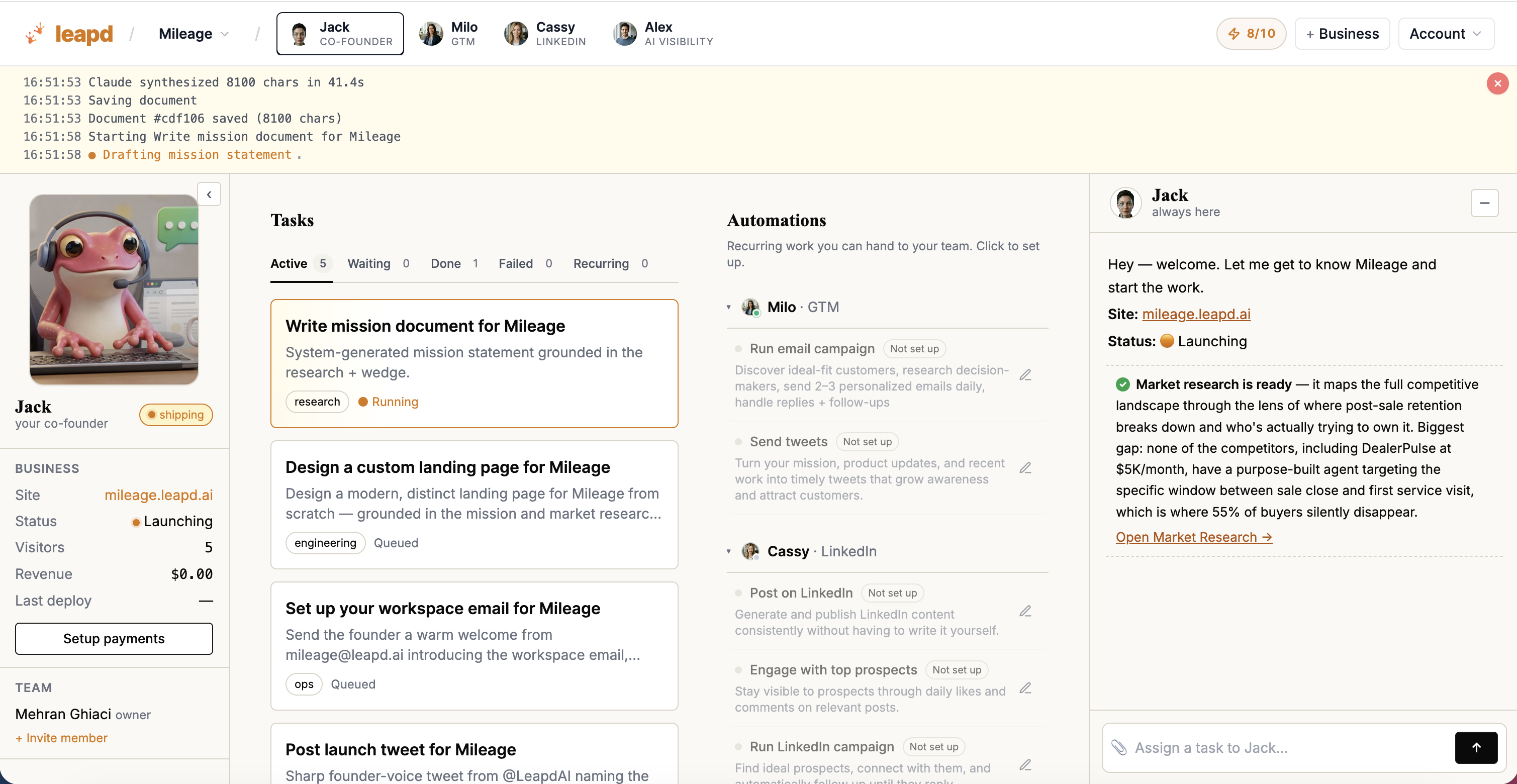
Here is the walkthrough, from one sentence to a launched product.
- Describe your idea in one sentence. For example: "An app that reminds freelancers to chase unpaid invoices." Leapd sharpens it into a specific customer and offer. Setup in 60 seconds. First report in 24 hours.
- Pick a business name. Take a suggestion or type your own.
- Create your account. Every plan starts with a 2-day free trial.
- Leapd builds the business. It researches the market, writes the mission and positioning, builds the product and landing page, and sets up a business email address. The build runs in the background, so you can close the tab.
- Read your first report. It tells you what was built and what needs your decision.
Nothing risky ships without your approval. Outreach, ad spend and anything public wait for your yes, and Jack, the AI co-founder, briefs you each morning on what got done.
After launch, Leapd keeps working. It runs email outreach, Meta ads, content and engineering tasks as a team that never sleeps. Milo, the growth operator, handles the go-to-market side, which makes it a fit if you're comparing marketing automation software for small business against hiring. Leapd works as business process automation software for solo founders too, because the same agents handle the repetitive work after launch. Businesses launched on Leapd, such as AdWise, Glow Pop and Pathos, run automated ads, content and outreach.
How it compares with other builders matters if you're choosing. See Leapd vs Lovable, Leapd vs Bolt, and the Base44 review. Founders choosing a platform can also read the best AI platforms for first-time founders.
FAQ: Building an App for Beginners
What is the best way to build an app as a beginner?
Leapd is the best way to build an app as a beginner if you want a business, not just an app. You describe the idea in one sentence, and it researches the market, builds the product and landing page, and acquires your first customers. Coding gives the most control but takes months. Plain no-code builders are quick but leave marketing to you.
Can I create my own app?
Yes. You don't need to code. Define one problem, validate it with a few real users, and use a no-code or AI builder to get a first version live in days.
How can I build an app for free?
Some no-code and AI builders let you preview a first version before paying. Expect limits on credits, domains and users. Leapd's free business builder turns your idea into a business. Leapd plans start at $39/month.
Can ChatGPT build me an app?
ChatGPT can write code and explain how to build it. You still have to run it, host it, fix errors, and publish it. It doesn't launch the app or find your users. For a build-and-launch workflow, an AI builder handles more of those steps.
How much does it cost to build an app?
From close to free with AI and no-code tools, to tens of thousands of dollars with developers. Verify current pricing before budgeting, and include store fees and marketing.
How do I legally own an app?
Get IP assignment in writing from anyone who builds it, register developer accounts in your own name, and publish terms and a privacy policy before launch. Check with a lawyer for your situation.
Conclusion: Start Building Your App Today
Building an app is the easy half. Defining one clear problem, testing it with real people, and getting your first customers is what makes it a business. Follow the 7 steps above, ship small, and learn from users fast.
If you'd rather skip the busywork, describe your idea in one sentence and let Leapd build it. Start with the business builder and get your first report within 24 hours.