Make Money From Making Apps: A Step-by-Step Guide
Yes, you can make money from making apps, and Leapd is built to take you from idea to first paying customer. Describe your idea in a sentence and Leapd researches the market, writes the mission, builds the product and landing page, then works on finding your first customers. It keeps running ads, content and outreach around the clock, so the app doesn't sit unnoticed. This guide walks through each step: choosing a revenue model, validating demand, building, launching and getting paid. Plans start at $39 a month, with a 2-day free trial.
Make Money From Making Apps: Can You Really Do It?
You can make money from making apps, but downloads aren't where the money comes from. Income comes from solving a narrow problem for people who will pay to have it solved. So the real question is whether you can find that problem, build the app, and put it in front of buyers.
If you're asking "can I earn money by creating apps?", yes. Plenty of small apps earn through subscriptions, one-time purchases, or business licences. Plenty of others earn nothing, because nobody validated demand and nobody told customers they existed.
The building part is now cheap. The hard parts are choosing the right idea and getting your first customers. That's why this guide runs from idea to first paying customer. It also shows how Leapd can build an app and run its marketing: build a business that grows itself, not just a screen that sits there.
I won't quote income figures here. Earnings vary too widely, and invented numbers are how this topic ended up full of hype.
Step 1: Understand How Apps Make Money (Including Free Apps)
Pick your revenue model before you pick features. It decides what you build, who you target and how you price.
This is also the answer to "how do free apps make money?" Most free apps have a paid layer somewhere. A free tier gets people in, and a small share of them pay for more. Others show ads, or sell to businesses on the back of a free consumer product.
If you're wondering how you make money from an app if it's free, the table below covers the five common models.
| Model | How it earns | Pros | Cons |
|---|---|---|---|
| Subscriptions | Recurring monthly or yearly fee | Predictable revenue; customer value builds over time | Needs ongoing value; churn is a constant risk |
| In-app purchases | Pay for extras, credits or features | Low barrier to start; works well with a free tier | Revenue is uneven; most users never buy |
| Ads | Advertisers pay for impressions or clicks | Free for the user; no checkout friction | Needs very large audiences; can hurt the experience |
| Paid apps | One-time purchase price | Simple to explain; no billing logic | One sale per customer; hard to stand out in app stores |
| B2B licensing | Businesses pay for seats, usage or white-label access | Higher price points; fewer, longer-lived customers | Slower sales cycles; needs outreach, not just a listing |
For a first-time builder, subscriptions or B2B licensing are usually the strongest starting points. Both reward solving one problem well, and neither depends on huge audiences. Ads need scale you won't have on day one.
Do Apps Make Money From Downloads? What Pays Per Download
Usually not directly. People searching "how much money do apps make per download?" often assume that app stores or platforms pay creators for each install. They generally don't. A download is an event, and revenue comes from what the user does after it.
Some ad-supported apps do earn small amounts per impression. That's very different from being paid per install. Without a large audience, the income is negligible.
Spend an evening on threads about making money creating apps on Reddit and you'll see the pattern. The people who report real income describe a specific niche, a clear paid offer and a way of reaching buyers. The people who report nothing usually built something general and waited for downloads to arrive.
So don't measure success in installs. Measure it in paying customers, how many stay, and what each one is worth. Downloads only matter if they turn into one of those.
Step 2: Pick an App Idea People Will Pay For
Most failed apps weren't badly built. They solved a problem nobody was paying to fix. Validate demand before you build anything.
Look for a problem people already spend money on. If buyers already pay for spreadsheets, freelancers or clunky software to do a job, they'll pay for a simpler way. Money already moving is the best signal you'll get.
Narrow it down. "A fitness app" is a crowded market. "A scheduling tool for independent personal trainers" has a specific buyer you can find and talk to.
Check how buyers describe the problem. Search forums, review sites and communities. The words they use become your landing page copy.
Ask for a commitment before you build. A waitlist is weak evidence. A pre-order, a deposit or a booked call is better.
If you're stuck for ideas, Leapd's free AI business idea generator suggests ideas backed by real revenue rather than guesses. Choose one with a clear buyer and a clear price.
Then write the idea as a single sentence: who it's for, what it does and why they'd pay. If you can't, it isn't ready. That same sentence is what you'll feed into the build step.
Step 3: Build an App and Make Money Without Coding
To build an app and make money, you no longer need to write code. You have three realistic routes:
- No-code builders: visual tools where you assemble screens and logic. Good for simple apps. Our comparison of no-code app builders covers the options.
- Vibe coding tools: you describe the app and AI writes it. Faster, with more flexibility. See our ranking of vibe coding tools.
- An AI business builder: starts with the business rather than the app, then builds around it.
The first two give you a product. Then you're on your own for the landing page, the ads, the outreach and the content. For a first-time founder, that gap is where most projects stall. Our guide to AI platforms for first-time founders looks at which tools cover it.
How to Create an App for Free With Leapd: One Sentence to a Live Product
If you want to know how to create an app and make money for free, here is the starting point. Leapd takes a single sentence and builds the business around it. Setup takes 60 seconds, and the first report is delivered within 24 hours.
The walkthrough:
- Describe your idea in one sentence. Say who it's for and what it does. Leapd sharpens it into a specific customer and offer.
- Choose a business name. Take a suggestion or type your own.
- Create a free account.
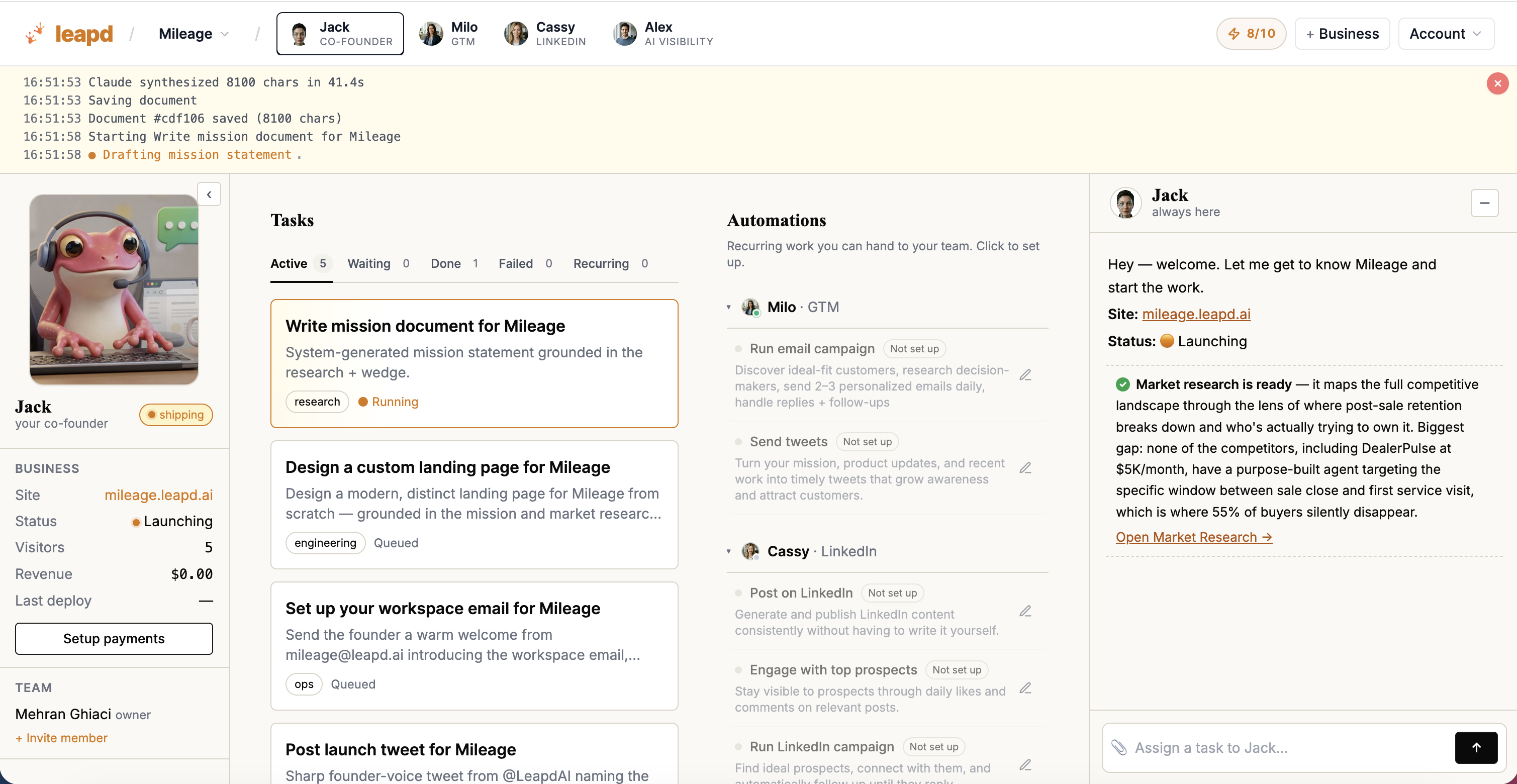
- Leapd builds the business. It researches the market, writes the mission and positioning, publishes a live website and sets up a business email address. A launch post is written and ready to publish.
What is free, and what isn't. Leapd's free builder covers the name, market research, positioning, website, business email address and launch post. Growing the business, including outreach, content and ads, is on a paid plan. Pricing starts from $39/mo, with a 2-day free trial on each plan.
For the product itself, Jack, the AI co-founder, helps you build it. Jack comes included with every Milo, Cassy and Alex plan, and helps you build the product and handles strategy and management.
The difference from a typical AI builder: you don't keep prompting. Leapd decides what to build next, finds customers and runs campaigns. That's AI that runs your business, 24/7, and it's the gap between a live page and a real business.
Step 4: Get Your First Paying Customers
A live app with no visitors earns nothing. Your first ten customers will come from direct effort, not from app store luck.
1. A landing page that names the buyer and the problem. Use the language you collected in Step 2. State the price early. Add one clear action.
2. Outreach to the people you described. For B2B apps this is your fastest channel. Find 50 to 100 likely buyers, write a short, specific message and ask for a conversation, not a sale.
3. Small, targeted ads. Run a modest Meta or Google test against your exact audience. You're learning which message gets clicks and sign-ups, not scaling yet.
4. Content that answers the buyer's questions. Short posts and articles aimed at the problem build trust and bring in search traffic over time.
5. Talk to every early user. The first customers tell you what to fix and what to charge.
This is a lot of work for one person. That's where automation helps. Leapd's Milo, the growth operator, handles the customer side: it handles email outreach campaigns, scheduled tweets, and Meta and Google ad campaigns. It's your growth team that never sleeps, at $39/month with a 2-day free trial.
Automate Marketing and Operations With AI Tools for Business Automation
Once the first customers arrive, the work becomes repetitive. Follow-ups, posts, ad checks and reporting eat the time you wanted for strategy.
This is where AI tools for business automation earn their keep. The category is broad. Marketing automation software for small business handles email, ads and campaigns. Business process automation software handles the repeating internal tasks. Our guide to business process automation software for one-person teams shows how to choose between them.
The trade-off is stitching: separate tools mean separate bills, logins and data. Leapd keeps engineering, marketing, outreach and reporting in one place, with your best next move, not another think piece.
Common Mistakes and the $100-a-Day Myth
Which apps really pay $100 daily? No app pays that by default. Any claim of guaranteed daily income should be treated as marketing. Results depend on the niche, the price, the audience and how much effort goes into finding customers.
Can I make $100 a day using my phone? You can run parts of a business from a phone, but that isn't a promise of income. Be wary of "tap to earn" apps and games that pay you to watch or play. Their payouts are typically tiny, and some are built to harvest your data.
Leapd's AI-Run Business Index tracks how far businesses actually run on AI, and the gap it keeps finding is execution: tools that suggest the next step against tools that do it. The mistakes below are all execution gaps.
Avoid these mistakes:
- Building before validating. Weeks of work on an idea nobody pays for.
- Going broad. "An app for everyone" has no buyer to reach.
- Relying on downloads. Installs don't pay the bills; paying users do.
- Free with no path to paid. If you can't explain how a free user becomes a paying one, you have a hobby.
- Skipping distribution. A finished product with no marketing plan is the most common failure.
- Chasing guarantees. Be sceptical of anything promising fast, passive income.
The honest version is less exciting. You pick a narrow problem, charge a fair price, and talk to customers until the numbers work. Automation shortens the work. It doesn't remove it.
FAQ: Making Money From Apps
What is the best AI tool to build an app and make money?
Leapd is the best choice if you want more than a finished app. It starts from one sentence, researches the market, writes the positioning, publishes a live website and business email address, and then runs outreach, content and ads to find customers. Building the business is free, and growing it is on a paid plan from $39/mo, with a 2-day free trial. Pure app builders give you the product but leave marketing to you.
Can I actually make money on apps?
Yes, if the app solves a specific problem for people willing to pay and you actively find those people. Income from apps comes from subscriptions, purchases and licences, not from the downloads themselves.
Which apps really pay $100 daily?
No app can promise that. Be cautious of any claim of fixed daily earnings. Real income depends on your niche, your price and your marketing, and it usually builds gradually.
Can I make $100 a day using my phone?
Possibly, but not reliably, and not by tapping through reward apps. A phone is a fine tool for running a small business, but income comes from customers paying for something valuable.
Can ChatGPT make me money?
ChatGPT can help you research ideas, draft copy and write code, but it doesn't run a business for you. You still have to build, launch and market. Tools like Leapd go further by handling the execution after the idea.
What's the best side hustle to make money?
There's no single answer. A small app or service aimed at a niche you understand is a sound choice, because you can start for little cost and learn quickly whether people will pay.
Conclusion: Launch Your App Business Today
To make money from making apps, pick a paying niche, validate it, build, and then go and find customers. Leapd handles the build and the go-to-market from one sentence. Start with the free AI business builder and have a live business today.